
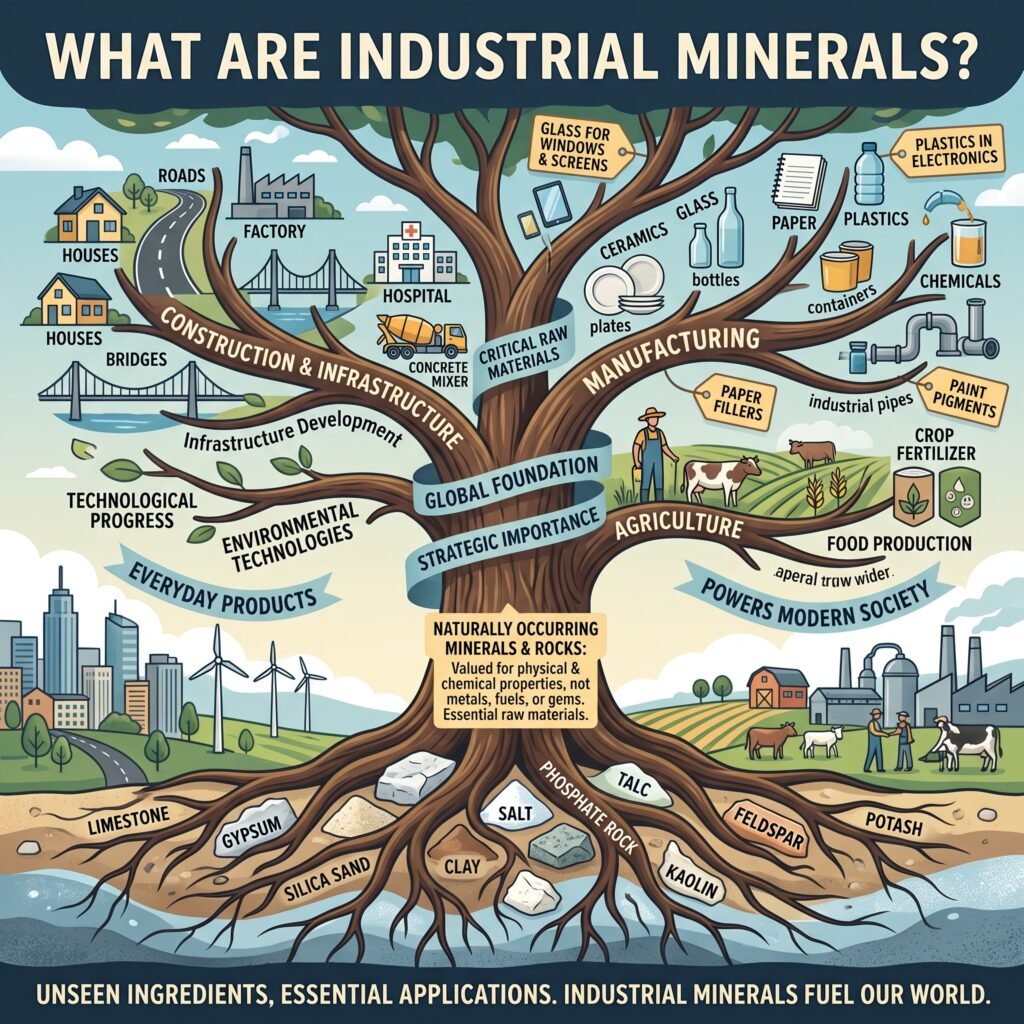
Industrial Minerals are naturally occurring minerals and rocks that are primarily valued for their physical and chemical properties rather than for the metals, fuels, or gemstones they contain. They are essential raw materials used across construction, manufacturing, agriculture, chemicals, ceramics, glass, paper, plastics, environmental technologies, and many other industries.
Unlike metallic minerals such as copper, gold, and iron ores, Industrial Minerals are generally used directly or after relatively simple processing. Examples include limestone, gypsum, silica sand, clay, salt, phosphate rock, talc, kaolin, feldspar, and potash. Although they may appear less prominent than precious metals, these materials form an important foundation of the modern economy.
A house, road, factory, farm, hospital, and many everyday consumer products can depend directly or indirectly on Industrial Minerals. Their widespread applications make them strategically important for infrastructure development, food production, manufacturing, and technological progress.
What Are Industrial Minerals Used For?
Industrial Minerals have a remarkably broad range of applications because different minerals possess different physical and chemical characteristics. Hardness, particle size, chemical composition, heat resistance, absorbency, brightness, and electrical properties can determine how a particular mineral is used.
Limestone, for example, is a major raw material for cement and lime production. Gypsum is widely used in plasterboard and construction materials. Silica sand is important for glass manufacturing and is also used in foundries and various industrial processes.
Clay minerals have applications in bricks, ceramics, cement, paper, and other manufactured products. Kaolin is particularly important in ceramics and can also be used as a filler or coating material. Feldspar is commonly used in glass and ceramics, while talc has applications in products such as paints, plastics, ceramics, and paper.
This diversity means Industrial Minerals connect mineral resources with a large number of downstream industries.
Major Types of Industrial Minerals
There are many types of Industrial Minerals, and their classification can vary according to geology, chemical composition, and commercial use. Some of the most important include limestone, gypsum, silica, kaolin, bentonite, feldspar, talc, salt, phosphate rock, and potash.
Limestone is widely used for cement, construction aggregates, lime, and industrial chemical processes. Gypsum is important for drywall, plaster, and cement. Silica sand provides a major source of silica for glass and other products.
Phosphate rock is particularly significant to agriculture because it provides phosphorus used in fertilizer production. Potash minerals supply potassium, another essential plant nutrient. These agricultural applications demonstrate that mineral resources are connected not only to industrial production but also to global food systems.
Industrial Minerals in Construction
Construction is one of the largest areas of demand for Industrial Minerals. Buildings and infrastructure require enormous quantities of mineral-based materials. Limestone contributes to cement production, while gypsum is used extensively for interior walls and ceilings.
Silica, clay, and feldspar are used in products ranging from glass and ceramics to tiles and sanitary ware. Mineral aggregates are also fundamental components of concrete and road construction.
As cities expand and countries invest in transportation, housing, water systems, and public infrastructure, demand for many construction-related mineral resources can increase. However, sustainable extraction and efficient material use are becoming increasingly important as industries seek to reduce environmental impacts
Industrial Minerals in Agriculture
Agriculture is another major consumer of Industrial Minerals. Modern crop production depends on mineral-derived nutrients and soil-management materials.
Phosphate rock is processed to manufacture phosphorus fertilizers, while potash provides potassium. Limestone can be applied to agricultural soils to reduce acidity and improve soil conditions. Other mineral materials may be used in animal feed, soil amendments, fertilizers, or agricultural processing.
These applications highlight an important relationship between geology and food security. Mineral resources extracted from the Earth can ultimately contribute to maintaining soil productivity and supporting agricultural output.
Processing of Industrial Minerals
After extraction, Industrial Minerals often require processing before reaching their final markets. The exact process depends on the mineral and its intended application.
Typical operations can include crushing, grinding, screening, washing, drying, separation, classification, and purification. Some materials require extremely precise particle sizes or strict chemical purity. A mineral intended for high-quality glass, ceramics, chemicals, or specialized manufacturing may therefore undergo more advanced processing than material intended for basic construction.
Quality control is especially important because industrial customers often purchase minerals according to technical specifications rather than simply by weight. Mineral composition, whiteness, hardness, moisture content, particle distribution, and purity can significantly affect commercial value.
Economic Importance of Industrial Minerals
Industrial Minerals support large supply chains extending from mining operations to processing facilities, manufacturers, construction companies, farms, and consumers. Because they are required in large quantities across numerous industries, reliable supplies can be important to regional and national economies.
Their economic value should not be judged only by the market price of raw material. A relatively inexpensive mineral can become an essential input for higher-value products. Silica, for instance, can enter glass manufacturing, while limestone can support cement production and numerous chemical applications.
Transportation costs are also important. Many Industrial Minerals are bulky materials with relatively low value per unit of weight. Deposits located close to processing plants, cities, ports, or major transportation networks can therefore have significant commercial advantages.
Industrial Minerals and Sustainability
Sustainable management of Industrial Minerals is becoming increasingly important. Mining can affect land, water resources, ecosystems, air quality, and surrounding communities if operations are poorly managed.
Modern mineral projects can reduce impacts through responsible mine planning, efficient water management, dust control, land rehabilitation, waste reduction, recycling, and improved energy efficiency. Environmental assessment and regulatory compliance are also important throughout the mining life cycle.
Circular-economy strategies can further reduce pressure on natural resources. Construction materials, glass, and certain mineral-containing products can sometimes be recovered, reused, or recycled, reducing the amount of newly extracted material required.
The Future of Industrial Minerals
The future demand for Industrial Minerals will be influenced by population growth, urbanization, infrastructure investment, agriculture, manufacturing, technology, and the transition toward more resource-efficient economies.
Traditional materials such as limestone, gypsum, silica, and clay will continue supporting construction and manufacturing. At the same time, advanced industries may require increasingly specialized mineral products with carefully controlled chemical and physical characteristics.
Technology can also improve exploration, mining, processing, and environmental monitoring. Automation, digital geological modeling, advanced sorting systems, renewable electricity, and more efficient processing technologies could help producers increase productivity while reducing waste and environmental impacts.
Conclusion
Industrial Minerals are fundamental natural resources that support construction, agriculture, manufacturing, chemicals, glass, ceramics, infrastructure, and many everyday products. Limestone, gypsum, silica sand, clay, phosphate rock, potash, feldspar, kaolin, and talc demonstrate the extraordinary diversity of this mineral group.
Their importance extends far beyond mining. They provide essential raw materials for industries that build cities, manufacture products, support agriculture, and maintain modern infrastructure. As global demand for materials continues, responsible extraction, efficient processing, recycling, and environmental management will be increasingly important for ensuring that Industrial Minerals contribute to long-term economic development while protecting natural resources.About https://www.futurelearn.com/info/courses/introduction-to-environmental-science/0/steps/269824
Pingback: 5 Powerful Benefits of Industrial Minerals in Manufacturing