
Introduction
Biomethane for Industrial Heating is becoming an important renewable energy option for industries seeking to reduce their dependence on fossil natural gas while maintaining reliable heat production. Industrial facilities require large amounts of thermal energy for boilers, steam systems, drying, food processing, chemical production, manufacturing, and many other operations. Biomethane offers a renewable gaseous fuel that can serve many of these applications.
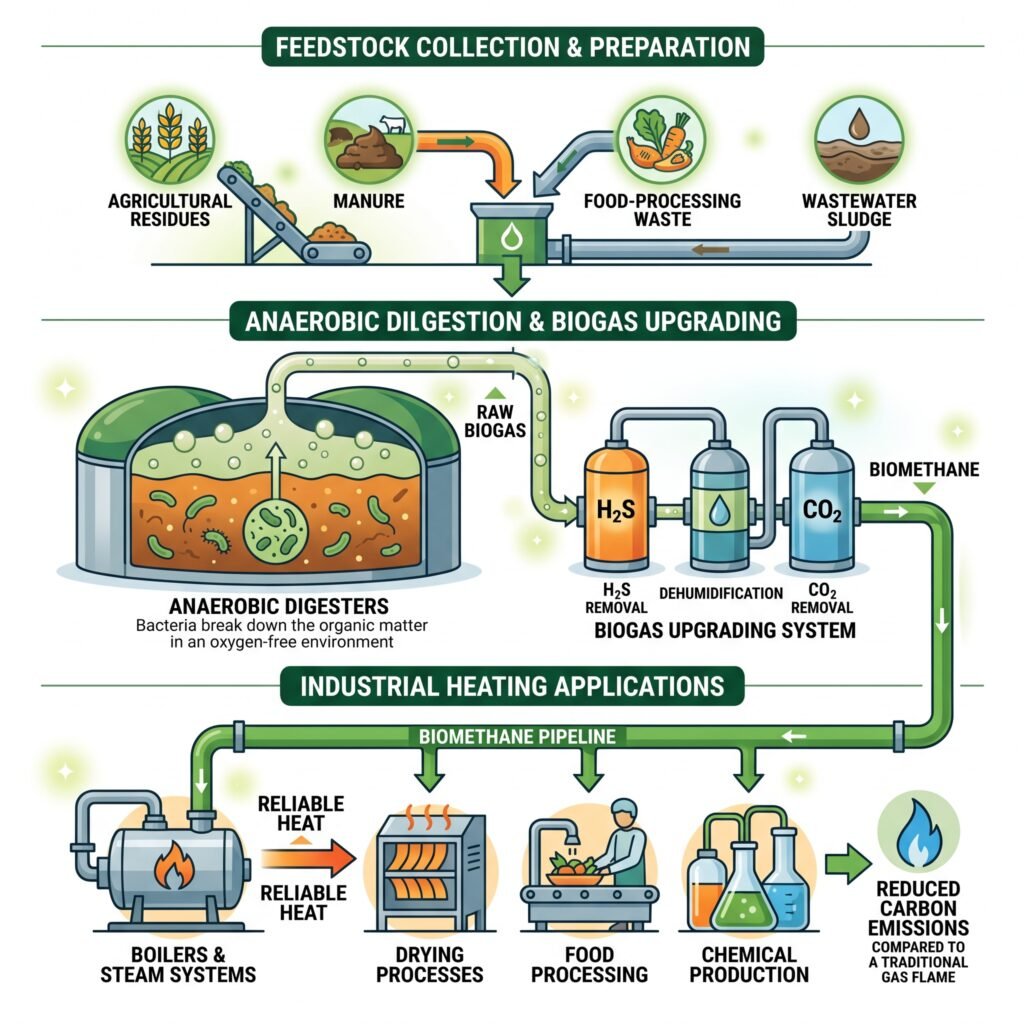
Biomethane is a methane-rich renewable gas commonly produced by upgrading biogas. Biogas originates from the decomposition of biodegradable organic materials under oxygen-free conditions through anaerobic digestion. Feedstocks can include agricultural residues, manure, food-processing waste, wastewater sludge, and other organic wastes.
After carbon dioxide, water, hydrogen sulfide, and other unwanted compounds are removed from raw biogas, the resulting biomethane has characteristics similar to conventional natural gas. This makes it particularly valuable for industrial facilities already designed to consume gaseous fuels.
How Biomethane for Industrial Heating Works
Biomethane for Industrial Heating works by supplying renewable methane to industrial combustion equipment that generates thermal energy. Depending on local infrastructure and technical requirements, biomethane may be delivered through a gas network or supplied through dedicated systems.
When biomethane enters an industrial boiler or heating system, it is burned with oxygen. The combustion process releases thermal energy, which can then heat water, produce steam, warm process fluids, or provide direct process heat.
Because high-quality biomethane has fuel properties close to those of natural gas, existing gas infrastructure and compatible end-use equipment can often play an important role in its adoption. However, equipment specifications, gas quality, safety standards, and local regulations must always be considered before fuel substitution.
Production of Biomethane
The biomethane production chain typically begins with organic feedstocks. Waste materials from farms, food industries, wastewater treatment plants, and other sources can be placed inside anaerobic digesters.
Microorganisms break down biodegradable matter without oxygen and generate raw biogas. This gas usually contains methane and substantial quantities of carbon dioxide, along with smaller amounts of moisture and contaminants.
Raw biogas must therefore undergo cleaning and upgrading. Technologies such as membrane separation, water scrubbing, and pressure swing adsorption can separate carbon dioxide and other unwanted components.
The result is methane-rich biomethane that can be prepared for industrial use or, when it satisfies applicable specifications, injected into natural gas infrastructure.
Biomethane for Industrial Boilers
Industrial boilers are one of the most important potential applications for Biomethane for Industrial Heating. Boilers convert fuel energy into useful heat, often by producing hot water or steam.
Steam is essential in numerous industries. Food manufacturers use it for cooking, sterilization, cleaning, and processing. Chemical plants require heat for reactions and separation processes. Paper facilities use thermal energy for drying, while many manufacturing operations depend on hot water and steam.
Replacing fossil natural gas with sustainably produced biomethane can therefore reduce the fossil component of the energy used to produce industrial steam.
The degree of substitution depends on biomethane availability, gas specifications, boiler design, supply infrastructure, economics, and regulatory requirements.
High-Temperature Industrial Heating
One of the particularly interesting applications of biomethane is industrial heat where direct electrification may be technically difficult or expensive.
Some manufacturing processes require continuously available thermal energy or relatively high temperatures. Gaseous fuels remain useful in these situations because combustion can provide controllable and concentrated heat.
Potential applications can include furnaces, kilns, ovens, dryers, thermal processing equipment, and specialized manufacturing systems.
Biomethane should not necessarily be viewed as a replacement for electrification. Instead, industrial decarbonization can involve several technologies, including energy efficiency, renewable electricity, heat pumps, hydrogen, waste-heat recovery, and renewable gases. The most suitable solution depends on the process.
Benefits of Biomethane for Industrial Heating
One major benefit of Biomethane for Industrial Heating is the ability to substitute renewable gas for fossil natural gas.
Another advantage is compatibility. Since upgraded biomethane has characteristics similar to natural gas, industries may be able to make use of existing gas distribution systems and suitable gas-consuming equipment rather than replacing an entire heating system.
Biomethane can also connect industrial energy production with waste management. Organic residues that might otherwise require treatment or disposal can become feedstocks for renewable gas production.
This creates opportunities for circular industrial systems in which waste is converted into useful energy.
Biomethane and Industrial Carbon Emissions
Reducing greenhouse gas emissions is a major reason for interest in biomethane. However, the climate performance of Biomethane for Industrial Heating must be evaluated across its complete lifecycle.
The environmental benefits depend heavily on the type of feedstock used, how the feedstock would otherwise have been managed, transportation requirements, plant energy consumption, methane leakage, upgrading technology, and the fossil fuel displaced.
Methane management is especially important because methane is a powerful greenhouse gas. Leakage can occur during digestion, upgrading, storage, or gas handling if systems are poorly designed or maintained.
Industrial biomethane projects therefore need effective monitoring, maintenance, closed storage where appropriate, leak detection, and responsible operational practices.
Industrial Waste to Renewable Heat
A particularly valuable model involves producing biomethane from industrial organic waste.
Food and beverage manufacturing, for example, can generate biodegradable residues suitable for anaerobic digestion. Wastewater treatment operations can also provide organic material for biogas production.
A facility or group of facilities can collect these materials, produce biogas through anaerobic digestion, upgrade the gas into biomethane, and then use the renewable fuel for heating.
This creates a circular pathway:
Organic Waste → Anaerobic Digestion → Biogas → Upgrading → Biomethane → Industrial Heat
Instead of treating organic waste only as a disposal problem, the system recognizes it as a potential renewable energy resource.
Biomethane and Natural Gas Infrastructure
Existing gas infrastructure represents another potential advantage of Biomethane for Industrial Heating.
When biomethane meets the required quality standards, it can be injected into suitable natural gas networks. This allows renewable methane produced in one location to support gas demand elsewhere within the connected system.
Industrial consumers may therefore not always need a biomethane production facility located directly beside their factory.
However, grid injection requires strict quality control. Parameters such as gas composition, heating value, moisture, sulfur compounds, oxygen, and pressure can be regulated according to national or network-specific standards.
Energy Security and Industrial Biomethane
Biomethane can also contribute to energy diversification.
Unlike fossil natural gas extracted from underground geological resources, biomethane can be produced from locally available organic wastes and residues. Domestic production can therefore diversify gaseous fuel supplies and make productive use of local resources.
This does not mean biomethane can replace all natural gas demand. Sustainable feedstock availability is limited, and other industries may compete for the same renewable gas.
For this reason, biomethane can be especially valuable where gaseous fuels provide advantages that are difficult to achieve through other low-carbon technologies.
Challenges of Biomethane for Industrial Heating
Despite its benefits, Biomethane for Industrial Heating faces several challenges.
Production costs can exceed those of conventional natural gas in some markets. Biomethane plants require investment in digesters, gas-cleaning systems, upgrading equipment, storage, monitoring, and infrastructure.
Feedstock availability can also restrict production capacity. Transporting bulky organic material over long distances may increase costs and environmental impacts.
Other challenges include methane leakage, gas-grid connection costs, changing energy prices, sustainability requirements, and regulatory differences between regions.
Successful projects therefore require careful technical, environmental, and economic assessment.
Biomethane, Circular Economy and Industry
Biomethane can connect renewable energy with the circular economy.
Industries produce many organic residual streams. Instead of allowing suitable biodegradable resources to go unused, anaerobic digestion can recover part of their energy content.
The digestate remaining after anaerobic digestion may also contain valuable nutrients. Depending on its composition, treatment, quality, and local regulations, it can potentially be used in agricultural applications.
Industrial biomethane therefore has the potential to connect waste management, renewable energy production, industrial heating, and nutrient recovery within a broader resource-efficiency strategy.
Future of Biomethane for Industrial Heating
The future of Biomethane for Industrial Heating is closely connected with industrial decarbonization. As industries seek alternatives to fossil fuels, renewable gases may become increasingly important for applications where gaseous fuels remain technically valuable.
Future developments may include more efficient anaerobic digesters, improved biogas upgrading, advanced methane-leak monitoring, carbon dioxide recovery, digital plant management, and better integration between biomethane facilities and industrial energy systems.
Biomethane could be particularly valuable when combined with energy-efficiency improvements. Reducing heat demand first and supplying the remaining demand with lower-carbon energy can improve overall resource efficiency.
Conclusion
Biomethane for Industrial Heating provides a practical pathway for transforming suitable organic wastes and residues into useful renewable industrial energy. Organic feedstocks can undergo anaerobic digestion to produce biogas, which is subsequently cleaned and upgraded into methane-rich biomethane.
The renewable gas can then provide heat for boilers, steam systems, dryers, furnaces, and other industrial processes where appropriate.
Its greatest strengths include the possibility of replacing fossil natural gas, utilizing existing compatible gas infrastructure, recovering energy from organic waste, and supporting circular resource management.
However, sustainable feedstock selection, strict methane-leak control, efficient production, appropriate gas-quality standards, and lifecycle emissions assessment are essential.
As industries combine electrification, efficiency, renewable electricity, waste-heat recovery, and renewable fuels, Biomethane for Industrial Heating can become one component of a broader strategy for building cleaner and more resource-efficient industrial energy systems. Contact https://www.unesco.org/en/query-list/n/natural-resources