
Introduction
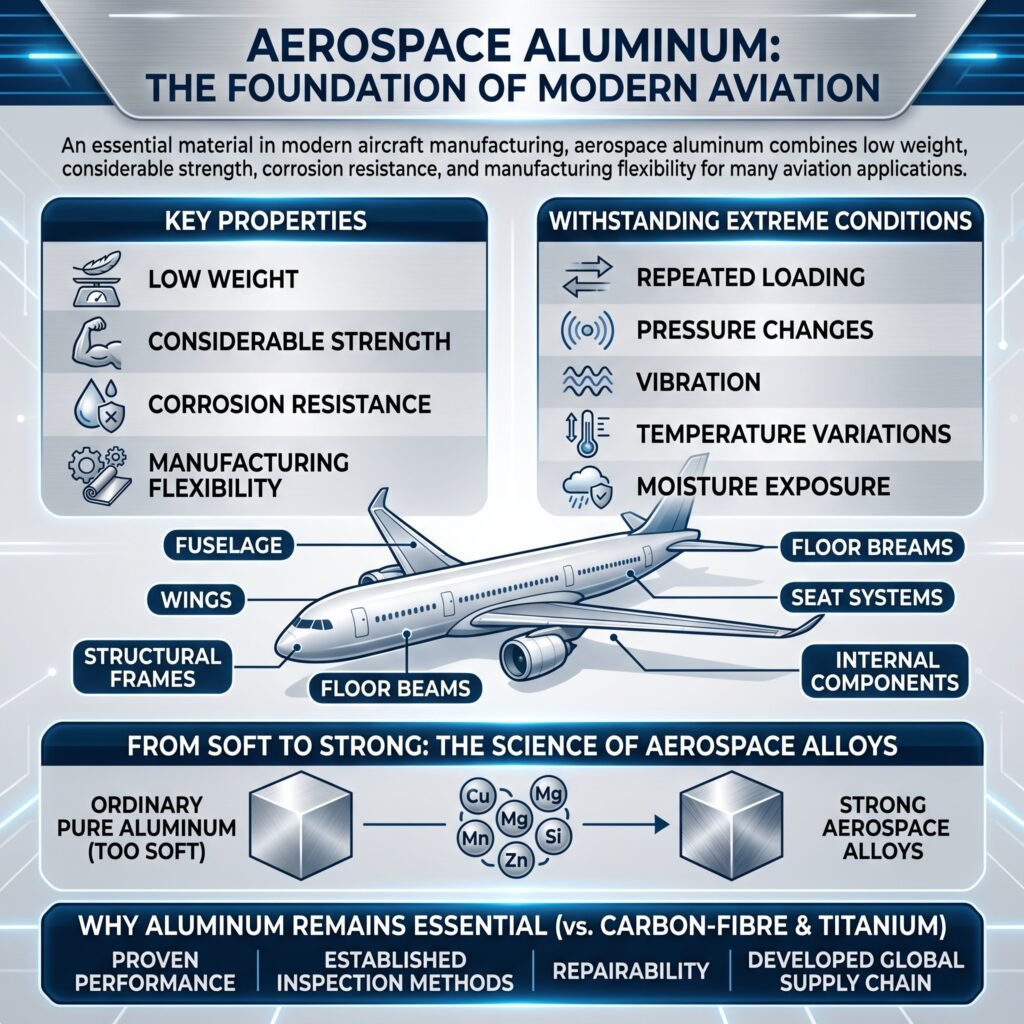
Aerospace Aluminum is one of the most important materials used in modern aircraft manufacturing. Its combination of low weight, considerable strength, corrosion resistance, and manufacturing flexibility makes it suitable for many aviation applications. Aircraft manufacturers use specialized aluminum alloys in fuselages, wings, structural frames, floor beams, seat systems, and numerous internal components.
Modern aviation requires materials that can withstand repeated loading, pressure changes, vibration, temperature variations, and exposure to moisture. Ordinary pure aluminum is too soft for many structural applications. Aerospace engineers therefore combine aluminum with elements such as copper, magnesium, manganese, silicon, and zinc to produce stronger alloys.
Although carbon-fibre composites and titanium are increasingly important, aluminum remains an essential aerospace material. It offers proven performance, established inspection methods, repairability, and a highly developed global supply chain.
What Is Aerospace Aluminum?
Aerospace Aluminum refers to high-quality aluminum alloys manufactured and tested for aviation and space applications. These materials must meet carefully controlled requirements for chemical composition, strength, toughness, fatigue resistance, corrosion behaviour, and dimensional accuracy.
The term “aerospace grade” does not refer to one particular alloy. It describes several material families designed for different operating conditions. Every aircraft component has distinct engineering requirements. For example, an alloy used in a lightly loaded interior structure may not be suitable for a wing spar or another safety-critical component.
Aerospace aluminum products are available in several forms, including:
- Sheets and plates
- Bars and rods
- Tubes and pipes
- Extruded structural profiles
- Forged components
- Cast parts
- Rivets and fasteners
The final material properties depend on its alloy composition, manufacturing process, heat treatment, thickness, and temper designation.
Why Aerospace Aluminum Is Used in Modern Aircraft
Weight reduction is a major priority in aircraft engineering. A lighter airframe generally requires less energy to remain in flight, which can improve fuel efficiency and reduce operating costs. Lower structural weight may also allow an aircraft to carry additional passengers, cargo, or fuel.
Aluminum has a density of about one-third that of steel. Properly engineered aluminum alloys can nevertheless provide substantial structural strength. This favourable strength-to-weight relationship is one of the main reasons Aerospace Aluminum has remained important throughout aviation history.
Aluminum is also relatively easy to form and machine. Manufacturers can roll it into thin sheets, extrude it into long structural profiles, or forge it into strong components. Computer-controlled machining allows companies to produce complex aluminum parts with precise dimensions.
Major Aerospace Aluminum Alloys
Aerospace applications commonly use alloys from the 2000, 6000, and 7000 series. Each series provides different advantages.
2000-Series Aerospace Aluminum
Copper is the principal alloying element in most 2000-series alloys. These materials can provide high strength and good fatigue performance.
Aluminum 2024 is a widely recognized aerospace alloy. It has traditionally been used in aircraft fuselage skins, wing structures, ribs, and other components exposed to repeated loads. However, its corrosion resistance is lower than that of certain other aluminum alloys. Protective coatings, cladding, primers, and regular inspection may therefore be required.
6000-Series Aluminum
The 6000 series primarily contains magnesium and silicon. These alloys offer a useful balance of strength, corrosion resistance, formability, machinability, and weldability.
Aluminum 6061 can be found in light aircraft, fittings, support structures, and selected non-critical components. It is generally easier to fabricate than some very high-strength aerospace alloys. However, engineers must still confirm whether its properties satisfy the requirements of the intended part
7000-Series Aerospace Aluminum
The 7000 series uses zinc as its principal alloying element, frequently combined with magnesium and copper. These alloys include some of the strongest aluminum materials commercially available.
Aluminum 7075 is commonly associated with highly loaded aircraft structures. It may be used in frames, wing components, fittings, and other areas requiring high strength. Certain conditions of high-strength aluminum can be susceptible to stress-corrosion cracking, making correct material selection, protective treatment, and inspection essential.
Aluminum-Lithium Alloys
Aluminum-lithium alloys were developed to reduce density and improve structural stiffness. They can help lower aircraft weight while maintaining the required performance. These advanced materials have been used in selected commercial aircraft, military aircraft, launch vehicles, and spacecraft.
Their production, joining, inspection, and repair can be more specialized than those of conventional alloys.
Aerospace Aluminum in Aircraft Fuselages
The fuselage forms the primary body of an aircraft. It accommodates passengers, cargo, flight systems, and crew while transferring structural loads between major aircraft sections.
Many traditional aircraft fuselages use a semi-monocoque construction consisting of aluminum skin supported by frames, stringers, and other reinforcing elements. This arrangement distributes loads across the structure without adding unnecessary weight.
Pressurized aircraft experience repeated expansion and contraction during flight cycles. The structure must therefore be evaluated for fatigue and damage tolerance. The FAA describes fatigue and damage tolerance as the study of how aircraft materials and structures respond to repeated loading and environmental influences over time. FAA Fatigue and Damage Tolerance
Aerospace Aluminum in Aircraft Wings
Aircraft wings must withstand lift, bending, vibration, twisting, and changing aerodynamic forces. Aerospace Aluminum may be used in wing skins, ribs, spars, stringers, and control surfaces.
Wing spars are particularly important because they carry a significant portion of the flight load. The selected material must provide strength, fatigue resistance, and predictable performance throughout the aircraft’s approved service life.
Engineers also consider the direction in which aluminum products are rolled or forged. Material properties can vary according to grain direction, meaning that component orientation may influence structural performance.
Heat Treatment and Material Strength
Heat treatment is used to modify the internal structure and mechanical properties of aluminum alloys. Typical processing stages may include solution heat treatment, quenching, artificial aging, and stress relief.
Temper designations identify the processing condition of the material. Two products made from the same basic alloy can demonstrate different strength or corrosion characteristics when supplied in different tempers.
Consequently, an alloy number alone is not sufficient for aerospace selection. Engineers must also specify the correct temper, dimensions, production standard, surface condition, and inspection requirements.
Corrosion Protection and Maintenance
Aluminum naturally forms a thin oxide layer when exposed to air. This layer provides some protection, but aircraft operate in environments where moisture, salt, chemicals, and temperature variations can increase corrosion risks.
Manufacturers protect Aerospace Aluminum through methods such as:
- Anodizing
- Protective cladding
- Conversion coatings
- Corrosion-resistant primers
- Paint systems
- Sealants and drainage design
Regular inspection is essential because corrosion can develop beneath paint, around fasteners, between overlapping sheets, or in areas where moisture collects. The FAA’s aircraft-corrosion guidance emphasizes that operators and maintenance organizations need structured inspection and treatment programmes. FAA Corrosion Control for Aircraft
Manufacturing and Quality Control
Aerospace production requires strict quality control and material traceability. Manufacturers must be able to identify where material originated, how it was processed, and whether it passed the required examinations.
Quality procedures may include:
- Chemical-composition testing
- Tensile and hardness testing
- Fatigue evaluation
- Ultrasonic inspection
- Dye-penetrant inspection
- Corrosion testing
- Dimensional measurement
- Batch and certificate verification
A material cannot be considered suitable simply because its commercial description contains the words “aircraft aluminum.” Its documented properties must conform to the approved engineering specification
Environmental Benefits and Challenges
Primary aluminum production requires substantial energy, beginning with bauxite mining and alumina refining before smelting. The environmental footprint depends heavily on mining practices, electricity sources, production efficiency, and transportation.
Recycling can reduce demand for newly mined raw materials and keep valuable metal in circulation. Manufacturing scrap can often be collected, separated by alloy family, processed, and reused.
Nevertheless, recycled aluminum intended for demanding aerospace components must meet the same relevant quality and performance requirements as other approved material. Poor sorting can introduce unwanted elements and change the alloy’s properties.
Future of Aerospace Aluminum in Modern Aircraft
Composite materials have replaced aluminum in some large aircraft structures, but this does not mean that aluminum is disappearing. Manufacturers continue to develop stronger alloys, improved aluminum-lithium systems, better corrosion protection, and more efficient manufacturing methods.
Additive manufacturing may also enable lightweight aluminum parts with complex shapes. Automated inspection, digital material records, and closed-loop recycling could further improve quality and sustainability.
Future aircraft will probably use a carefully optimized combination of aluminum, titanium, steel, composites, and other advanced materials. The best material will depend on safety, weight, cost, temperature, reparability, and environmental performance.
Conclusion
Aerospace Aluminum remains essential to modern aircraft because it provides an effective combination of low density, structural strength, manufacturability, corrosion protection, and repairability. It is used throughout fuselages, wings, internal supports, fittings, and numerous aircraft systems.
Its successful application depends on more than choosing an alloy number. Proper heat treatment, engineering design, testing, surface protection, traceability, inspection, and regulatory approval are equally important. As aviation pursues lighter and more efficient aircraft, advanced aluminum alloys will continue to suppoand sustainable aerospace development. https://naturalresourc.com/hydrogen-powered-aircraft/