
Introduction
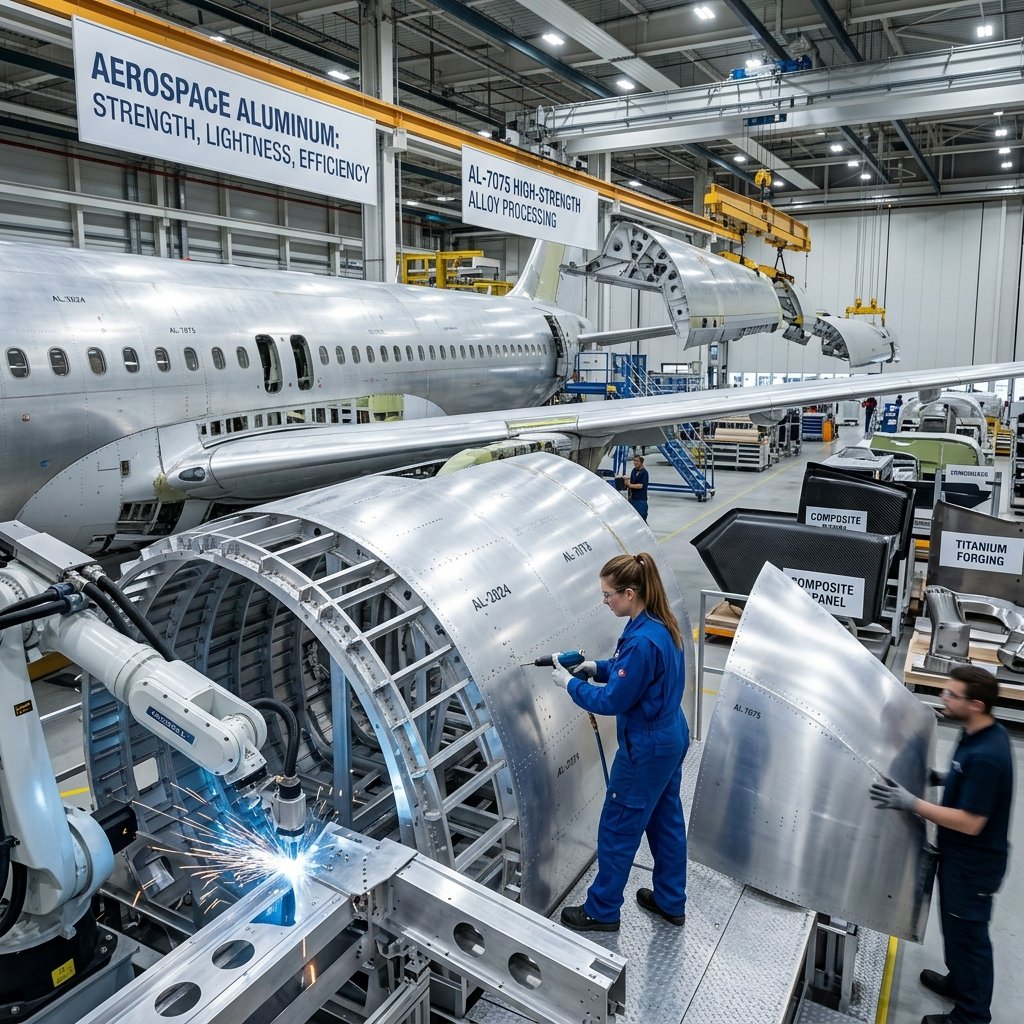
Aerospace Aluminum for Aircraft Manufacturing is essential to the production of safe, lightweight, and efficient airplanes. Aircraft manufacturers require materials capable of supporting considerable structural loads without making an aircraft unnecessarily heavy. Specialized aluminum alloys meet this requirement by combining low density with strength, formability, corrosion resistance, and established manufacturing methods. Aerospace Aluminum for Aircraft Manufacturing plays a crucial role in achieving these goals.
Pure aluminum is lightweight and naturally resistant to corrosion, but it is generally too soft for major aircraft structures. Manufacturers improve its properties by adding controlled quantities of copper, zinc, magnesium, manganese, silicon, and other elements. The resulting alloys can be processed through heat treatment, rolling, extrusion, forging, casting, and precision machining.
In the realm of aviation, Aerospace Aluminum for Aircraft Manufacturing stands out for its unique properties. By utilizing this material, manufacturers can create parts that not only meet stringent safety standards but also optimize fuel efficiency and performance.
Aluminum is not the only material used in modern aviation. Aircraft may also contain carbon-fibre composites, titanium, steel, and specialized polymers. Nevertheless, aerospace aluminum remains important because it offers a reliable balance of performance, manufacturing cost, inspection, repairability, and recycling potential.
What Is Aerospace Aluminum for Aircraft Manufacturing?
Through the use of Aerospace Aluminum for Aircraft Manufacturing, engineers can design aircraft structures that withstand the rigorous demands of flight while maintaining a lightweight profile. This balance is essential for modern aviation.
Aerospace Aluminum for Aircraft Manufacturing refers to aluminum alloys produced according to carefully controlled technical specifications for aviation applications. These specifications can define chemical composition, mechanical strength, toughness, heat-treatment condition, surface quality, dimensions, and testing requirements.
Aerospace aluminum is supplied in several forms, including:
Rivets and specialized fasteners
Thin sheets for aircraft skins
Thick plates for machined structural parts
Extrusions for frames and support sections
Forgings for highly loaded components
Tubes for selected aircraft systems
Bars and rods for precision machining
An alloy described as “aerospace grade” is not automatically appropriate for every aircraft component. Engineers must evaluate the exact alloy, temper, thickness, manufacturing process, operating environment, and expected loads before selecting it.
Furthermore, utilizing Aerospace Aluminum for Aircraft Manufacturing not only supports weight reduction efforts but also minimizes environmental impact through better fuel economy.
Why Aluminum Is Important in Aircraft Production
As Aerospace Aluminum for Aircraft Manufacturing continues to dominate the industry, innovation in processing techniques is essential for enhancing its properties and expanding its applications.
The ongoing research in Aerospace Aluminum for Aircraft Manufacturing is crucial for developing lighter, stronger materials that can withstand the increasing demands of air travel.
One of the key benefits of Aerospace Aluminum for Aircraft Manufacturing is its ability to be tailored through alloying to meet specific performance and safety requirements. This adaptability is what keeps the industry evolving.
Reducing aircraft weight is one of the main objectives of aerospace engineering. A lighter airframe can require less fuel or energy during operation. Weight reduction may also allow an aircraft to carry more passengers, cargo, or fuel while remaining within its approved operating limits.
Aluminum has approximately one-third the density of steel. When it is properly alloyed and heat-treated, it can provide substantial strength without the weight associated with many steel components. This valuable strength-to-weight relationship has made aluminum a major aviation material for decades.
With Aerospace Aluminum for Aircraft Manufacturing being at the forefront of material science, the future holds promise for even more advanced applications and uses in the aerospace sector.
Aerospace aluminum also supports efficient manufacturing. It can be cut, drilled, rolled, formed, forged, extruded, and machined into complex shapes. These capabilities allow manufacturers to produce both large structural sections and small precision parts.
Major Aerospace Aluminum Alloy Families
Different aluminum alloy families provide different combinations of strength, fatigue resistance, corrosion resistance, weldability, and machinability.
2000-Series Aluminum Alloys
The principal alloying element in most 2000-series aluminum is copper. These alloys are known for high strength and useful fatigue performance.
Aluminum 2024 is a widely recognized aerospace alloy. It has traditionally been used for fuselage skins, wing structures, ribs, and other components exposed to repeated mechanical loading. Its corrosion resistance is lower than that of certain other aluminum alloys, so protective cladding, surface treatments, primers, or paint systems may be required.
6000-Series Aluminum Alloys
The 6000 series generally contains magnesium and silicon. These alloys provide a practical combination of moderate strength, corrosion resistance, formability, machinability, and weldability.
Aluminum 6061 is used in light-aircraft structures, fittings, tubes, frames, and selected support components. It can be easier to manufacture than some very high-strength alloys, although its suitability must still be evaluated for each specific application.
7000-Series Aluminum Alloys
Zinc is the main alloying element in the 7000 series, often combined with magnesium and copper. This family includes some of the strongest commercial aluminum alloys.
Aluminum 7075 is frequently associated with highly loaded aircraft structures. Depending on its temper and engineering requirements, it can be used in wing components, frames, fittings, and other structural parts. High-strength alloys require careful protection and inspection because certain conditions may be vulnerable to stress-corrosion cracking.
As we explore the various components of an aircraft, Aerospace Aluminum for Aircraft Manufacturing becomes apparent in critical areas such as the fuselage and wings, proving its indispensable nature.
Aluminum-Lithium Alloys
Lithium can be added to aluminum to reduce density and improve stiffness. Aluminum-lithium alloys may lower structural weight while maintaining the properties needed for demanding aerospace applications.
These materials have been used in selected commercial aircraft, military aircraft, spacecraft, and launch vehicles. However, their production, joining, inspection, and repair procedures can be more specialized.
The versatility of Aerospace Aluminum for Aircraft Manufacturing allows it to be used in various applications, from fuselages to wings, ensuring that each component contributes to the overall efficiency of the aircraft.
With Aerospace Aluminum for Aircraft Manufacturing being widely used in wings, it is crucial to ensure that the right alloy is chosen to meet the specific mechanical properties needed for flight safety.
Applications of Aerospace Aluminum for Aircraft Manufacturing
In addition to structural components, Aerospace Aluminum for Aircraft Manufacturing also finds usage in interior structures, offering both weight savings and design flexibility.
Aerospace Aluminum for Aircraft Manufacturing is used across numerous sections of an airplane. The selected alloy depends on structural loads, environmental exposure, temperature, safety requirements, and manufacturing methods.
Fittings and fasteners made from Aerospace Aluminum for Aircraft Manufacturing ensure reliable connections throughout the aircraft, highlighting the material’s strength and durability.
Aircraft Fuselages
The fuselage forms the main body of an aircraft and carries passengers, crew, cargo, and essential systems. Many aluminum aircraft use semi-monocoque construction, in which thin metal skin is supported by frames, stringers, and reinforcing elements.
The fuselage must withstand aerodynamic forces and repeated pressurization cycles. Manufacturers therefore select materials that provide suitable strength, toughness, and fatigue performance.
Aircraft Wings
Wings experience bending, twisting, vibration, and changing aerodynamic loads. Aluminum may be used in wing skins, ribs, spars, stringers, and control surfaces.
Wing spars are particularly important because they carry substantial flight loads. Materials used in these areas require carefully verified mechanical properties and controlled production quality.
Interior Structures
Aluminum can be used in seat frames, cabin partitions, flooring supports, storage systems, and equipment housings. Its low weight helps manufacturers reduce the mass of the aircraft interior.
Interior materials and assemblies must still comply with applicable requirements for strength, fire protection, crashworthiness, and passenger safety
Fittings and Fasteners
Aircraft contain thousands of mechanical connections. Aluminum alloys may be used in fittings, brackets, rivets, and other attachment components. Engineers must consider loading, corrosion, contact between different metals, and maintenance access when designing these connections.
Manufacturing Aerospace Aluminum Components
Manufacturing begins with material whose chemical composition is carefully controlled. The aluminum may then be cast into an initial form before being rolled, extruded, forged, or machined.
Heat treatment is especially important. Typical processing can include solution heat treatment, quenching, artificial aging, and stress relief. These processes alter the material’s internal structure and can significantly change its strength, toughness, and corrosion performance.
Temper designations identify the condition in which an alloy is supplied. Two components made from the same alloy may have different properties if they have undergone different heat treatments. Engineers must therefore specify both the alloy and the correct temper.
Modern aircraft factories increasingly use computer numerical control machining, automated drilling, robotic inspection, and digital production records. These technologies improve dimensional accuracy, reduce manufacturing errors, and support material traceability.
Quality Control and Traceability
Aerospace components require strict quality assurance. Manufacturers must confirm that materials and finished parts meet the approved design specifications.
Inspection and testing may include:
- Chemical-composition analysis
- Tensile-strength testing
- Hardness measurement
- Fatigue evaluation
- Dimensional inspection
- Ultrasonic examination
- Dye-penetrant testing
- Surface-quality inspection
- Material-certificate verification
Traceability connects a finished component to its original material batch, manufacturing processes, inspections, and documentation. This information is important for quality investigations, aircraft maintenance, and continued operational safety.
The European Union Aviation Safety Agency provides the European regulatory framework covering areas such as aircraft design, production, maintenance, and continuing airworthiness. Manufacturers operating under European aviation rules must follow the requirements applicable to their activities and approved products. More information is available through the EASA regulations portal
The ability of Aerospace Aluminum for Aircraft Manufacturing to resist corrosion is vital for ensuring the longevity and safety of aircraft structures in harsh environments.
As manufacturers adapt to new challenges, Aerospace Aluminum for Aircraft Manufacturing will remain fundamental in achieving lightweight designs without compromising safety or performance.
Corrosion and Fatigue Management
Aluminum naturally produces a thin oxide layer that helps protect it from corrosion. However, aircraft are exposed to moisture, salt, cleaning chemicals, temperature changes, and other demanding conditions.
Additionally, Aerospace Aluminum for Aircraft Manufacturing plays a significant role in the sustainability efforts of the aviation industry by promoting recycling and resource efficiency.
Manufacturers can protect aerospace aluminum through anodizing, conversion coatings, protective cladding, sealants, primers, and paint. Aircraft design must also reduce areas where water can collect.
Fatigue is another major consideration. Takeoffs, landings, turbulence, cabin pressurization, and normal flight operations create repeated loads. Small cracks may develop and grow if they are not detected. Damage-tolerance design, scheduled inspection, and approved maintenance procedures help manage this risk.
Sustainability and Aluminum Recycling
Primary aluminum production consumes considerable energy and begins with mining bauxite, refining it into alumina, and smelting the alumina into metal. Its environmental footprint depends on mining practices, energy sources, production efficiency, and transportation.
Recycling aluminum can reduce the need for newly mined resources and keep valuable material in circulation. Aircraft manufacturing generates sheets, chips, offcuts, and other recyclable scrap. Proper separation is important because mixing different alloys may change the final material composition.
Looking ahead, the evolution of Aerospace Aluminum for Aircraft Manufacturing will be driven by technological advancements and increasing demand for efficient and sustainable solutions in aviation.
Recycled aluminum intended for aerospace applications must still satisfy relevant chemical, mechanical, quality, and traceability requirements. Recycled content does not replace engineering certification or material testing.
Ultimately, the role of Aerospace Aluminum for Aircraft Manufacturing is indispensable in shaping the future of aviation and ensuring that aircraft continue to meet the demands of safety, efficiency, and sustainability.
Future of Aerospace Aluminum Manufacturing
The future of Aerospace Aluminum for Aircraft Manufacturing will be shaped by stronger alloys, improved corrosion protection, digital production, additive manufacturing, and lower-carbon metal production.
Manufacturers are developing aluminum alloys that provide improved strength, lower density, and better fatigue behaviour. Additive manufacturing may enable complex lightweight parts that are difficult to produce through conventional machining.
Closed-loop recycling systems could allow manufacturing scrap to be returned to qualified aluminum production. Renewable electricity and improved smelting technologies may also reduce emissions connected with primary aluminum.
Composite materials will continue to grow in aerospace, but aluminum is unlikely to disappear. Future aircraft will use carefully selected combinations of aluminum, composites, titanium, and steel according to the needs of each component.
Conclusion
Aerospace Aluminum for Aircraft Manufacturing provides the lightweight strength, manufacturing flexibility, corrosion protection, and durability required by modern aviation. It is used in fuselages, wings, structural frames, fittings, interior supports, and many other aircraft components.
Successful application requires more than selecting a familiar alloy. Manufacturers must control material composition, temper, heat treatment, production methods, testing, documentation, and traceability. When supported by approved engineering and proper maintenance, aerospace aluminum can contribute to safe, efficient, and increasingly sustainable aircraft.Privacy Policy
Disclaimer: This article provides general educational information. It does not constitute aircraft-design, engineering, manufacturing, maintenance, certification, or legal advice.