
Introduction
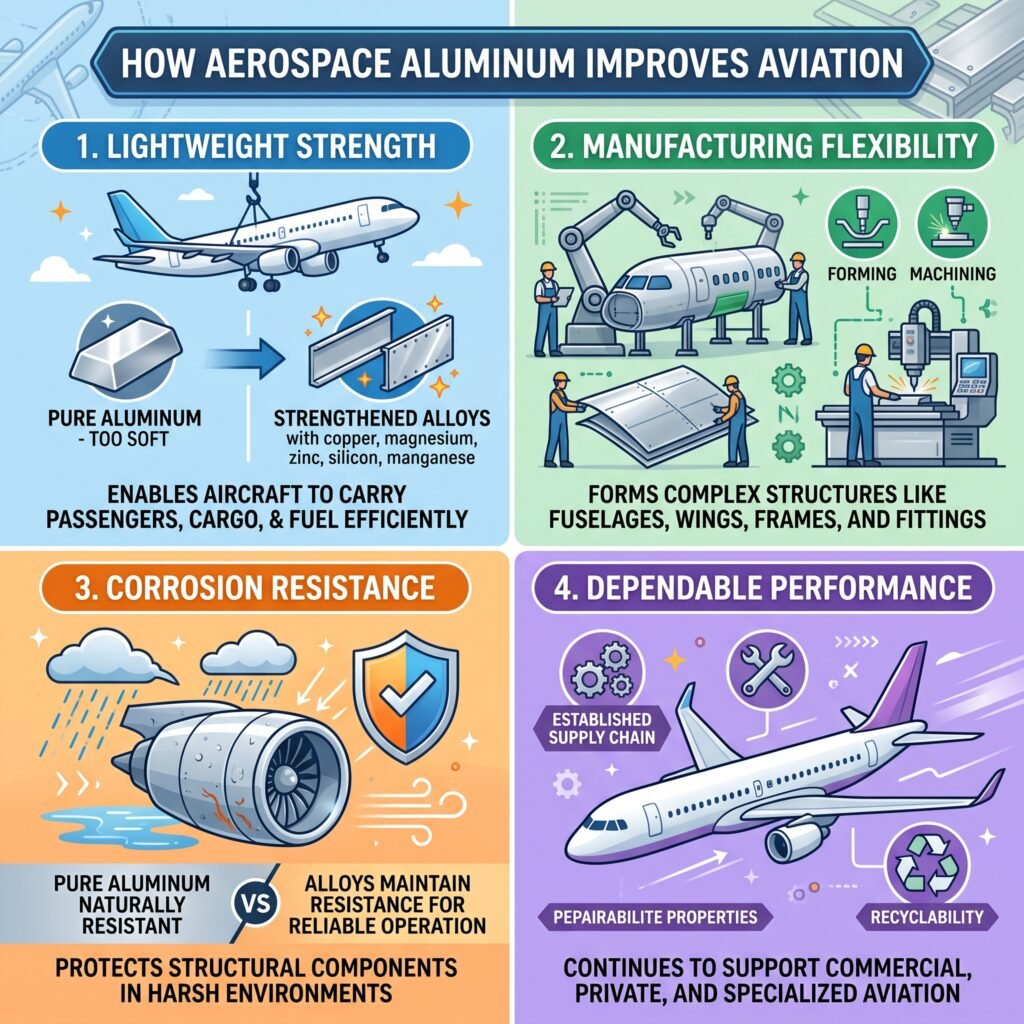
How aerospace aluminum improves aviation can be understood by examining its lightweight strength, manufacturing flexibility, corrosion resistance, and dependable performance. Modern aircraft must carry passengers, cargo, fuel, and complex equipment while remaining light enough to operate efficiently. Aerospace aluminum helps manufacturers achieve this balance.
Pure aluminum is lightweight and naturally resistant to corrosion, but it is too soft for many structural aircraft components. Engineers strengthen it by adding controlled amounts of copper, magnesium, zinc, silicon, manganese, and other elements. These combinations create aluminum alloys with properties suitable for wings, fuselages, frames, fittings, and interior structures.
Although modern aircraft also use carbon-fibre composites, titanium, steel, and advanced polymers, aluminum remains one of aviation’s most practical materials. Its established supply chain, predictable properties, repairability, and recyclability continue to support commercial, private, and specialized aviation.
How Aerospace Aluminum Improves Aviation Efficiency
One of the clearest examples of how aerospace aluminum improves aviation is its ability to reduce aircraft weight. Aluminum has approximately one-third the density of steel. Properly engineered aluminum alloys can still provide substantial strength, allowing manufacturers to build lighter structures without ignoring safety requirements.
Reducing weight can improve aviation in several ways. A lighter aircraft may require less fuel or energy during operation. It may also carry more passengers, cargo, or fuel while remaining within its approved maximum weight.
Aircraft weight affects takeoff performance, climbing, cruising, and landing. However, the relationship between material weight and fuel consumption depends on aircraft design, route length, payload, engine efficiency, and operating conditions. Aluminum contributes to efficiency as part of a complete aircraft design rather than acting as a single solution.
High Strength-to-Weight Performance
Aerospace aluminum offers a valuable strength-to-weight ratio. This means that selected alloys can resist substantial mechanical forces while weighing considerably less than many steel alternatives.
Aircraft experience several types of loading. Wings bend under aerodynamic lift, fuselages expand and contract during pressurization cycles, and landing systems experience considerable force during ground operations. Turbulence and normal manoeuvres also create repeated stresses.
Manufacturers select particular aluminum alloys and tempers according to these operating conditions. Material thickness, component shape, fastener placement, heat treatment, and structural support all influence final performance.
High strength alone is not sufficient. Aerospace materials must also demonstrate appropriate toughness, fatigue resistance, corrosion behaviour, and predictable performance over their approved service lives.
Important Aerospace Aluminum Alloys
Different aluminum alloy families provide different properties. No single alloy is ideal for every component.
2000-Series Alloys
Copper is the primary alloying element in many 2000-series materials. These alloys are valued for their strength and fatigue performance.
Aluminum 2024 has traditionally been used in aircraft skins, wing structures, ribs, and other components exposed to repeated loading. Its corrosion resistance can be lower than that of certain other alloys, so it may require cladding, protective coatings, primers, or paint.
6000-Series Alloys
The 6000 series generally contains magnesium and silicon. These alloys offer a useful balance of strength, corrosion resistance, formability, machinability, and weldability.
Aluminum 6061 can be used in light-aircraft structures, frames, tubes, fittings, and selected support components. It is often easier to manufacture than certain high-strength alloys, although engineers must confirm its suitability for every application.
7000-Series Alloys
Zinc is the principal alloying element in the 7000 series, frequently combined with magnesium and copper. This group contains some of the strongest commercially available aluminum alloys.
Aluminum 7075 may be used in wing components, structural frames, fittings, and other highly loaded parts. Its strength makes it valuable, but material condition and corrosion protection must be carefully controlled.
Aluminum-Lithium Alloys
Adding lithium can reduce aluminum’s density while improving stiffness. Aluminum-lithium alloys have been used in selected commercial aircraft, military aircraft, spacecraft, and launch vehicles. Their lower weight can support efficient structural designs, but manufacturing and repair processes may be more specialized.
How Aerospace Aluminum Improves Aviation Manufacturing
Another way to understand how aerospace aluminum improves aviation is to examine manufacturing. Aluminum can be rolled into sheets, extruded into long profiles, forged into strong components, cast into complex forms, and machined into precise parts.
This flexibility supports the production of:
- Fuselage skins
- Wing ribs and spars
- Frames and stringers
- Floor beams
- Brackets and fittings
- Seat structures
- Equipment housings
- Tubes and support systems
Computer numerical control machines can remove material accurately to create lightweight components with complex shapes. Automated drilling and riveting systems can improve production consistency, while digital inspection equipment helps verify dimensions and surface quality.
Aluminum’s workability also makes it useful for producing large aircraft sections. However, every manufacturing operation must follow approved specifications because excessive heat, incorrect machining, or improper forming can alter material properties.
Supporting Aircraft Durability
Aircraft are expected to operate safely through thousands of flights. Their structures experience repeated loads during takeoff, cruising, turbulence, pressurization, and landing. Over time, these loads may contribute to metal fatigue.
Aerospace engineers use fatigue analysis, damage-tolerance principles, structural testing, and scheduled inspections to manage this risk. The material is not simply judged by whether it can carry a load once. Engineers must understand how it behaves under repeated loading and how cracks could develop or grow.
The Federal Aviation Administration describes fatigue and damage tolerance as disciplines that evaluate how aircraft materials and structures respond to repeated loads and environmental conditions throughout their service lives.
Corrosion Resistance and Protection
Corrosion management provides another example of how aerospace aluminum improves aviation. Aluminum naturally develops a thin oxide layer when exposed to oxygen. This layer provides basic protection against corrosion.
Aircraft nevertheless operate in demanding environments containing moisture, salt, fuel, cleaning chemicals, and changing temperatures. Manufacturers enhance protection through:
- Anodizing
- Protective cladding
- Conversion coatings
- Corrosion-resistant primers
- Paint systems
- Sealants
- Effective drainage designs
Maintenance teams inspect areas around fasteners, joints, overlapping sheets, and locations where moisture could accumulate. Early detection allows corrosion to be evaluated and treated before it seriously damages a structure.
Improving Aircraft Repairability
Repairability is an important advantage of many aluminum aircraft structures. Aviation technicians have decades of experience inspecting and repairing aluminum skins, frames, and supporting components.
Nondestructive inspection methods can help identify cracks, corrosion, and other defects without destroying the part. Common methods include visual inspection, ultrasonic testing, eddy-current inspection, and dye-penetrant testing.
Repairs must always follow approved maintenance data. A technician cannot replace an aircraft component merely because another aluminum product looks similar. The alloy, temper, thickness, fasteners, repair dimensions, and installation process must satisfy the applicable engineering requirements.
Quality Control and Traceability
Aviation depends on consistent material quality. Aerospace aluminum must be supported by documentation showing its composition, production condition, heat treatment, testing, and origin.
Quality-control procedures may include:
- Chemical-composition analysis
- Tensile-strength testing
- Hardness measurement
- Fatigue evaluation
- Corrosion testing
- Dimensional verification
- Ultrasonic inspection
- Surface-defect examination
- Material certificate review
Traceability allows manufacturers and operators to connect a finished aircraft component to its original material batch and production history. This information is essential when investigating manufacturing problems, planning maintenance, or determining whether a particular batch requires additional inspection.
Environmental Benefits and Limitations
Recycling helps explain how aerospace aluminum improves aviation sustainability. Aluminum scrap can be collected and processed into new material, reducing the need for some primary raw-material extraction.
Aircraft manufacturing generates metal chips, sheet offcuts, and rejected components. When this scrap is carefully separated by alloy type, it can remain a valuable industrial resource.
However, primary aluminum production requires substantial electricity and begins with bauxite mining and alumina refining. Its environmental impact depends on mining practices, energy sources, production efficiency, transportation, and waste management.
Recycled aluminum intended for demanding aircraft applications must still meet relevant chemical, mechanical, quality, and traceability requirements. Recycling does not remove the need for testing and certification.
Aerospace Aluminum and Aviation Safety
The phrase “aerospace grade” does not automatically prove that a material is approved for installation in an aircraft. The exact alloy, temper, product form, component design, manufacturing process, and documentation must comply with the applicable approved specifications.
In the European Union, the European Union Aviation Safety Agency provides regulatory material covering aircraft design, production, maintenance, and continuing airworthiness. Organizations should identify the requirements applicable to their specific activities through the official EASA regulations portal.
This distinction is important because material selection is only one part of aircraft safety. Safe aviation also requires qualified engineering, controlled manufacturing, inspection, certification, professional maintenance, and complete documentation.
Future of Aerospace Aluminum
New alloy development will continue to expand how aerospace aluminum improves aviation. Researchers and manufacturers are working on stronger aluminum alloys, lighter aluminum-lithium materials, improved corrosion protection, advanced joining methods, and additive manufacturing.
Digital traceability could make it easier to follow materials from production to installation and maintenance. Automated inspection may identify defects more quickly, while closed-loop recycling could return manufacturing scrap to qualified production systems.
Composite materials will continue to grow in aviation, but aluminum is unlikely to disappear. Future aircraft will probably use combinations of aluminum, titanium, steel, composites, and other materials. Engineers will select each material according to safety, weight, temperature, cost, manufacturing, repair, and environmental requirements.
Conclusion
Understanding how aerospace aluminum improves aviation requires looking beyond its low weight. Aerospace aluminum provides a useful combination of strength, fatigue performance, manufacturing flexibility, corrosion protection, repairability, and recycling potential.
It supports aircraft fuselages, wings, frames, fittings, interior structures, and many other components. When combined with approved engineering, strict quality control, traceability, inspection, and professional maintenance, aerospace aluminum helps manufacturers produce safe, efficient, durable, and increasingly sustainable aircraft.https://naturalresourc.com/aerospace-aluminum-for-aircraft-manufacturing/
Disclaimer: This article is intended for general educational purposes. It does not constitute aircraft-design, manufacturing, engineering, maintenance, certification, or legal advice.