
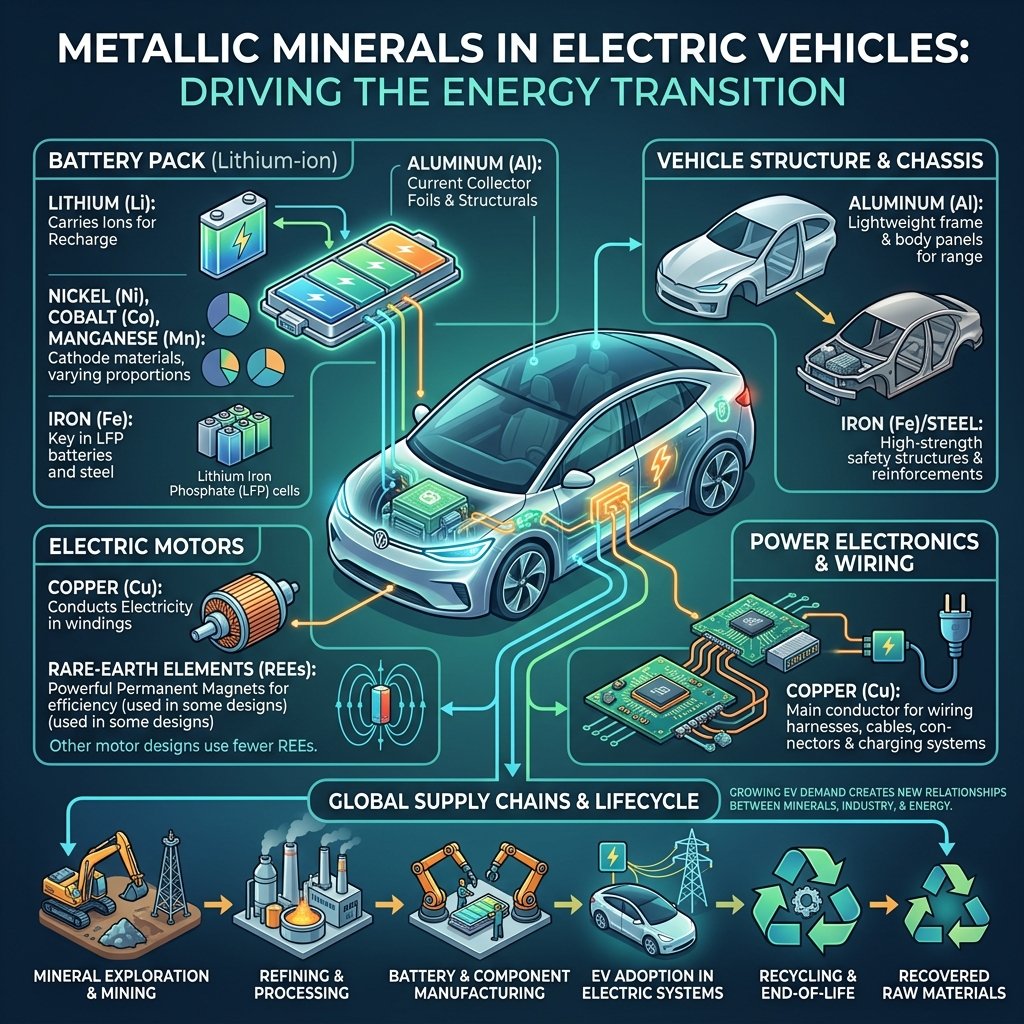
Metallic Minerals in Electric Vehicles are essential raw materials for batteries, electric motors, electrical wiring, power electronics, charging systems, and vehicle structures. Electric vehicles (EVs) depend on metals such as lithium, nickel, cobalt, copper, manganese, aluminum, iron, and, in some motor designs, rare-earth elements.
These materials perform different functions. Lithium can carry ions within rechargeable battery cells, copper conducts electricity, aluminum provides lightweight structural components, and iron is important in steel and some battery chemistries. Nickel, cobalt, and manganese are used in several lithium-ion cathode technologies, although their proportions vary considerably among battery types.
The growth of electric transportation is therefore creating new relationships between mineral resources, mining, refining, battery manufacturing, electricity systems, recycling, and global supply chains.
Importance of Metallic Minerals in Electric Vehicles
The importance of Metallic Minerals in Electric Vehicles comes from the different physical and chemical properties required by an EV. No single metal performs every function.
A vehicle needs highly conductive materials to transport electricity, electrochemically suitable materials to store energy, strong materials for structural components, and specialized materials for motors and electronic systems.
However, it is important to distinguish between minerals and metals. Mining initially produces mineral-bearing ores or brines. These resources generally undergo extraction, concentration, refining, and chemical processing before manufacturers obtain battery-grade materials or usable metals.
This processing chain means the quality and availability of mineral deposits are only part of the EV raw-material story.
Lithium in Electric Vehicle Batteries
Lithium is one of the best-known materials associated with electric vehicles. Lithium compounds are essential components of most current rechargeable lithium-ion EV batteries.
During battery operation, lithium ions move between the cathode and anode through an electrolyte. This reversible electrochemical process allows electrical energy to be stored during charging and released while the vehicle is operating.
Lithium can be obtained from hard-rock deposits, mineralized brines, and other resources. Extraction and processing methods vary by deposit type and location.
Future battery technologies may change how much lithium is required per unit of storage, but lithium remains important to today’s dominant EV battery technologies.
Nickel, Cobalt, and Manganese
Several lithium-ion battery cathodes use combinations of nickel, manganese, and cobalt, commonly associated with NMC battery chemistry.
Nickel can contribute to high energy density, an important characteristic for vehicles requiring substantial driving range. Manganese can contribute to cathode stability and performance, while cobalt has historically helped provide stability and durability in several cathode formulations.
Battery chemistry is nevertheless evolving. Manufacturers are developing formulations that reduce the use of expensive or supply-constrained materials.
Lithium iron phosphate, or LFP, batteries are a major example. LFP cathodes use lithium, iron, and phosphate rather than nickel and cobalt. Consequently, statements suggesting that every EV battery requires large quantities of nickel and cobalt would be inaccurate.
Copper and Metallic Minerals in Electric Vehicles
Copper is one of the most important Metallic Minerals in Electric Vehicles because of its excellent electrical conductivity.
EVs use copper in electric motors, high-voltage wiring, battery connections, inverters, power electronics, and charging equipment. The wider electricity infrastructure supporting EV charging also uses substantial amounts of conductive materials.
Copper therefore illustrates how EV mineral demand extends beyond the battery itself.
After copper-bearing ore is mined, multiple processing and refining stages may be required to produce copper of sufficient purity for electrical applications. Recycling is also significant because copper can be recovered from many products and reused.
Aluminum and Lightweight Vehicle Design
Aluminum is widely used in modern transportation because it combines relatively low density with useful mechanical properties. EV manufacturers can use aluminum in body structures, battery enclosures, wheels, chassis components, and electrical applications.
Reducing vehicle mass can improve energy efficiency, although vehicle design involves trade-offs among weight, strength, safety, manufacturing costs, repairability, and material availability.
Aluminum production begins largely with bauxite mining, followed by refining to produce alumina and electrolytic smelting to produce aluminum metal. Primary aluminum production can require substantial electricity, making the electricity source an important factor in its environmental footprint.
Recycled aluminum generally requires substantially less energy than primary production, making material recovery particularly valuable.
Rare-Earth Elements in Electric Motors
Some electric motors use permanent magnets containing rare-earth elements such as neodymium and, in certain designs, dysprosium or other elements.
These magnets can provide high magnetic strength and help manufacturers build compact and efficient motors. However, not every electric vehicle motor requires rare-earth permanent magnets. Alternative motor designs include induction motors and other configurations.
This distinction is important because EV mineral requirements depend on engineering choices rather than one universal material list.
Iron and Steel in Electric Vehicles
Iron remains fundamental to vehicle manufacturing. Steel is used in structural components, body systems, suspension components, fasteners, and many other parts.
Iron has also gained additional importance through lithium iron phosphate batteries. LFP technology demonstrates how changing battery chemistry can alter mineral demand.
Steel manufacturing itself is evolving, with research and industrial investment focusing on greater recycling, improved energy efficiency, electrification, and lower-carbon production technologies.
Environmental Challenges of Metallic Minerals in Electric Vehicles
Expanding Metallic Minerals in Electric Vehicles supply creates environmental and social challenges that must be considered alongside the climate benefits expected from transportation electrification.
Mining can disturb land, generate waste rock and tailings, consume water and energy, and create pollution risks if operations are poorly managed. Refining and metal processing can also produce significant emissions.
The severity of these effects varies substantially according to deposit geology, mining technique, electricity source, environmental regulation, processing technology, water availability, and operational management.
Responsible sourcing therefore requires more than increasing mineral production. Environmental assessment, worker protection, water management, tailings safety, emissions controls, community engagement, and mine-site rehabilitation are important parts of responsible mineral development.
Recycling Metallic Minerals from Electric Vehicles
Recycling could become an increasingly important source of EV materials as larger numbers of vehicle batteries reach the end of their useful lives.
Battery recycling technologies can recover materials including lithium, nickel, cobalt, copper, and other components, although recovery rates and economic viability depend on battery chemistry and recycling processes.
Recycling does not immediately eliminate the need for new mining. During periods of rapid EV-market growth, there may not be enough end-of-life batteries available to supply all new material demand.
Over the longer term, however, improved collection, battery design, reuse, and recycling could reduce dependence on newly extracted resources.
Future of Metallic Minerals in Electric Vehicles
The future of Metallic Minerals in Electric Vehicles will depend on several uncertain and rapidly developing factors, including EV adoption, battery chemistry, material efficiency, recycling technology, mineral discoveries, government policies, and manufacturing innovation.
Research continues into sodium-ion batteries, solid-state batteries, improved lithium-ion technologies, alternative cathodes, and motor designs that require fewer supply-constrained materials.
Some technologies may become commercially important, while others remain under development. For this reason, long-term mineral-demand forecasts should be treated as projections rather than established facts.
Conclusion
Metallic Minerals in Electric Vehicles connect natural resources with batteries, motors, electronics, electrical wiring, charging infrastructure, and vehicle manufacturing. Lithium, copper, aluminum, iron, nickel, manganese, cobalt, and certain rare-earth elements can each perform important but different functions.
The exact minerals required depend on battery chemistry, motor design, vehicle architecture, and technological development. EVs therefore should not be understood as depending on one fixed group of materials.
Responsible mining, cleaner refining, efficient manufacturing, technological innovation, longer-lasting batteries, and effective recycling will all influence how sustainably these mineral resources support the expansion of electric transportation. https://www.unesco.org/en/query-list/n/natural-resources