
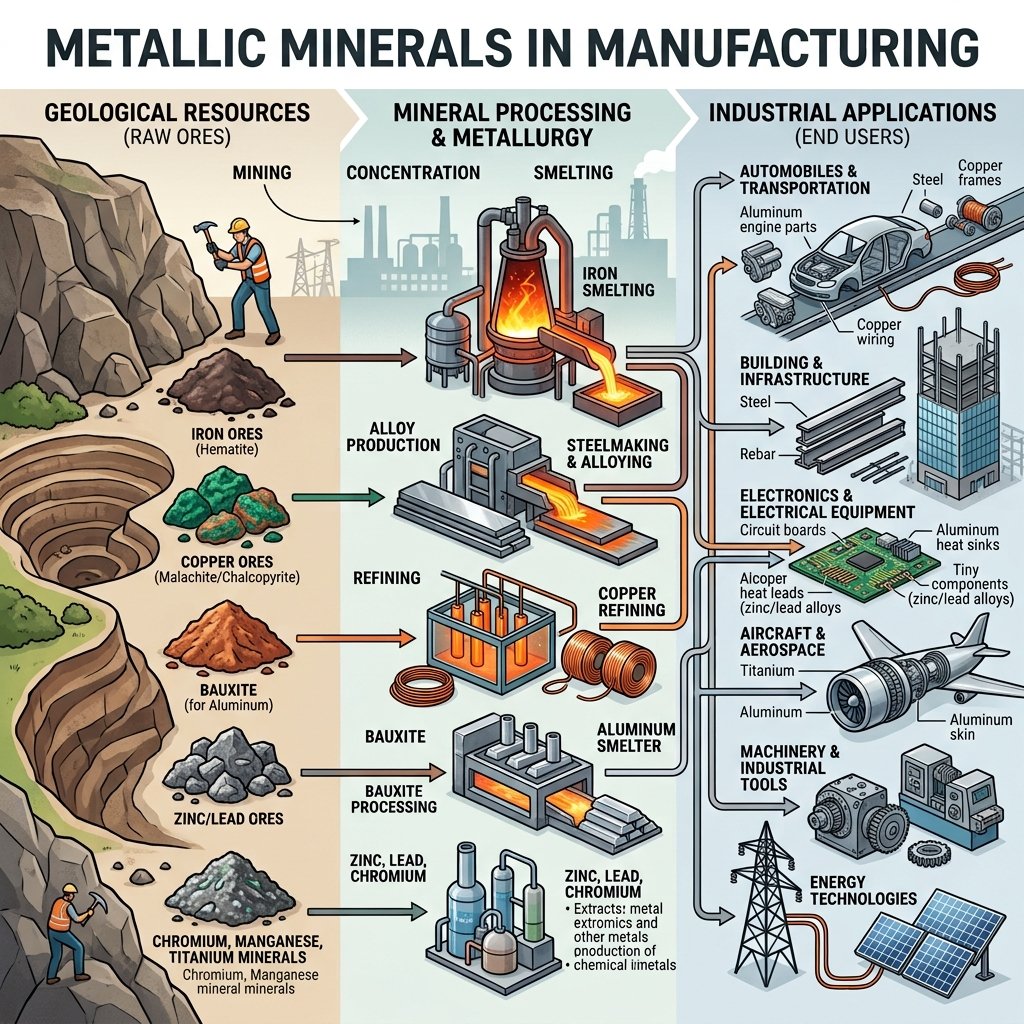
Metallic Minerals in Manufacturing provide the geological raw materials from which many of the metals essential to modern industry are produced. Iron ores, copper ores, bauxite, zinc ores, nickel ores, lead ores, and mineral sources of chromium, manganese, titanium, and other metals ultimately support the manufacture of machinery, vehicles, electrical equipment, buildings, electronics, aircraft, industrial tools, and energy technologies.
Scientifically, a distinction should be made between a metallic mineral or ore and the refined metal used in a factory. Manufacturers generally do not place raw copper ore directly into electrical wiring or iron ore directly into automobiles. Mining, mineral concentration, smelting, refining, alloy production, and manufacturing transform geological resources into materials with controlled properties suitable for industrial use.
This connection between geology and manufacturing makes metallic mineral resources an important foundation of industrial economies.
Importance of Metallic Minerals in Manufacturing
Metallic Minerals in Manufacturing are important because metals provide combinations of strength, electrical conductivity, thermal conductivity, corrosion resistance, durability, and formability that are difficult to reproduce with a single alternative material.
Iron and steel dominate many structural and mechanical applications. Copper is especially valuable where high electrical and thermal conductivity are required. Aluminum combines relatively low density with corrosion resistance and useful mechanical properties. Zinc protects steel against corrosion, while nickel and chromium are important components of many specialized alloys.
These metals supply downstream industries including construction, automotive manufacturing, mechanical and electrical engineering, aerospace, electronics, energy infrastructure, and medical equipment.
Iron Minerals and Steel Manufacturing
Iron is among the most important metallic resources in manufacturing. Major iron ores contain minerals such as hematite and magnetite. After mining and beneficiation, iron-bearing material enters metallurgical processes that ultimately produce iron and steel.
Steel is not one single material. Its properties can be modified by controlling carbon content, manufacturing processes, heat treatment, and alloying elements. This allows manufacturers to produce steels designed for buildings, bridges, automobiles, machinery, pipelines, tools, appliances, and industrial equipment.
Elements such as chromium, nickel, manganese, molybdenum, vanadium, and niobium can be added to particular steel grades to modify properties such as strength, hardness, toughness, corrosion resistance, or high-temperature performance.
Steel therefore demonstrates how several mineral resources can come together within one engineered manufacturing material.
Copper and Metallic Minerals in Manufacturing
Copper is another major example of Metallic Minerals in Manufacturing. Copper-bearing ores must undergo extraction and processing before high-purity copper becomes available for industrial applications.
Copper’s combination of electrical conductivity, thermal conductivity, ductility, malleability, and corrosion resistance makes it particularly useful in electrical and manufacturing industries.
Manufacturers use copper in electrical wiring, motors, generators, transformers, electronic equipment, heat exchangers, industrial machinery, plumbing systems, vehicles, and renewable-energy infrastructure.
Copper is also combined with other metals to create important alloys. Copper and zinc form many types of brass, while copper combined with tin and other elements can produce different bronzes. The properties of these alloys can be adjusted for specific engineering applications.
Aluminum in Modern Manufacturing
Aluminum is widely used in manufacturing because it has relatively low density, good corrosion resistance, and useful forming and machining characteristics. Bauxite is the principal ore used for most primary aluminum production.
Bauxite is refined to produce alumina, which is subsequently converted into aluminum metal through an energy-intensive electrolytic process.
Manufacturers use aluminum in aircraft, automobiles, trains, buildings, packaging, electrical systems, machinery, and consumer products. Its relatively low density is particularly valuable in transportation because reducing vehicle mass can improve energy efficiency.
Aluminum can also be recycled repeatedly. Recycling generally requires much less energy than producing primary aluminum from mined resources, making secondary aluminum an important component of more resource-efficient manufacturing systems.
Zinc and Corrosion Protection
Zinc has an important role in manufacturing, particularly in protecting iron and steel from corrosion. Sphalerite is the world’s principal zinc ore mineral.
One of zinc’s major industrial applications is galvanization, where a zinc coating helps protect steel against corrosion. Galvanized materials are widely used in construction, transportation, infrastructure, appliances, and manufactured products.
Zinc is also used in alloys such as brass and in die-cast components. Zinc compounds have additional applications in rubber, chemicals, paints, and other products.
The ability to extend the service life of steel components makes zinc important not only economically but also from a resource-efficiency perspective.
Nickel and Chromium in Manufacturing
Nickel and chromium are important alloying metals used to manufacture materials that must operate under demanding conditions.
Chromium is strongly associated with stainless steel, where sufficient chromium allows a protective oxide layer to form at the surface, greatly improving corrosion resistance.
Nickel is used in stainless and high-performance steels, superalloys, batteries, and other specialized materials. Nickel-containing alloys can be engineered for demanding applications involving high temperatures, corrosive environments, or significant mechanical stresses.
These characteristics make nickel- and chromium-containing materials valuable in chemical processing, transportation, power generation, aerospace, food-processing equipment, and other industrial sectors.
Metallic Minerals in Electronics
Metallic Minerals in Manufacturing also support electronics and electrical technology. Copper is extensively used for electrical conductors, while gold, silver, tin, tantalum, nickel, and other metals can perform specialized functions in electronic components.
Gold is particularly useful in selected electrical contacts because of its conductivity and resistance to corrosion. Tin is important in solder and electronic connections, while tantalum has applications in electronic components designed to operate reliably under demanding conditions.
Modern electronic products may contain small quantities of numerous metals. Although the amount of an individual metal in one device can be small, large-scale electronics manufacturing creates significant mineral supply requirements.
Metallic Minerals in Automotive and Aerospace Manufacturing
Vehicle and aircraft manufacturers require materials combining strength, durability, safety, weight efficiency, and resistance to environmental conditions.
Steel remains fundamental to automotive production, while aluminum is widely used where reducing mass is advantageous. Copper supports electrical systems, and zinc protects many steel components.
Aerospace manufacturing uses aluminum alloys, titanium alloys, nickel-based superalloys, and other engineered metallic materials. Different components require different properties: an aircraft structure has different material requirements from a high-temperature turbine component.
Material selection is therefore based on engineering performance rather than simply choosing the lightest or strongest available metal.
Processing Metallic Minerals for Manufacturing
The journey from mineral deposit to manufactured product can involve many stages. These may include exploration, mining, crushing, grinding, mineral concentration, smelting, refining, alloying, casting, rolling, extrusion, forging, machining, and final fabrication.
Copper, for example, can be produced through multistage routes involving concentration, smelting, and electrolytic refining for many sulfide ores, while some oxide resources are processed through leaching and related hydrometallurgical methods.
Processing requirements differ significantly among commodities and ore types. This is why geological knowledge, mineral processing, metallurgy, materials science, and manufacturing engineering are closely connected disciplines.
Recycling and Sustainable Manufacturing
Recycling is increasingly important for Metallic Minerals in Manufacturing. Steel, aluminum, copper, zinc, and many other metals can be recovered from manufacturing scrap and end-of-life products.
Metal recycling can reduce primary raw-material requirements and, for some metals and production routes, substantially reduce energy consumption and associated emissions. The European Commission notes that metals such as steel and non-ferrous metals are important components of circular industrial systems.
However, recycling does not completely eliminate primary mining. Growing material demand, long product lifetimes, collection losses, contamination, and technical limitations mean that both recycled and newly mined resources may be needed.
Responsible mining, efficient processing, longer product life, improved collection systems, and advanced recycling therefore need to work together.
Future of Metallic Minerals in Manufacturing
The future of Metallic Minerals in Manufacturing will be influenced by electrification, renewable-energy systems, electric vehicles, digital technology, infrastructure investment, recycling, and new manufacturing techniques.
Copper remains important for electrical systems, while aluminum supports lightweight engineering. Nickel, manganese, chromium, rare-earth elements, and other mineral commodities have specialized applications across batteries, alloys, magnets, electronics, and advanced equipment. Current USGS mineral information demonstrates how widely individual mineral commodities are distributed across modern industrial applications.
Future demand is not completely predictable. Material substitution, improved recycling, changes in product design, new battery chemistries, and technological innovation can alter which metals are needed and in what quantities.
Conclusion
Metallic Minerals in Manufacturing connect Earth’s geological resources with the engineered materials that make modern industrial society possible. Iron ores support steelmaking, copper ores provide conductive metals, bauxite supports aluminum production, zinc minerals contribute to corrosion protection, and nickel and chromium resources support specialized alloys.
Their importance extends across machinery, transportation, construction, electronics, aerospace, energy infrastructure, and countless manufactured products. The European Commission similarly identifies steel and non-ferrous metals such as aluminum, copper, and zinc as important inputs to major manufacturing sectors.
As industrial demand evolves, the long-term challenge is not simply to extract more minerals. It is to combine responsible mining, efficient metallurgy, cleaner energy, durable product design, material efficiency, and effective recycling so that metallic resources can support manufacturing with lower environmental impacts.