
Utility-Scale Wind Farm Technology combines large wind turbines, electrical infrastructure, control systems, sensors, communications, and grid connections to generate electricity on a commercial scale. Unlike a single small turbine supplying electricity locally, a utility-scale wind farm normally contains multiple large turbines whose output is collected and delivered to a regional or national electricity network.
Modern wind farms are complex power-generation facilities. Their performance depends not only on individual turbine efficiency but also on turbine positioning, atmospheric conditions, wake interactions, electrical equipment, digital monitoring, maintenance strategies, and grid-management technologies.
How Utility-Scale Wind Farm Technology Works
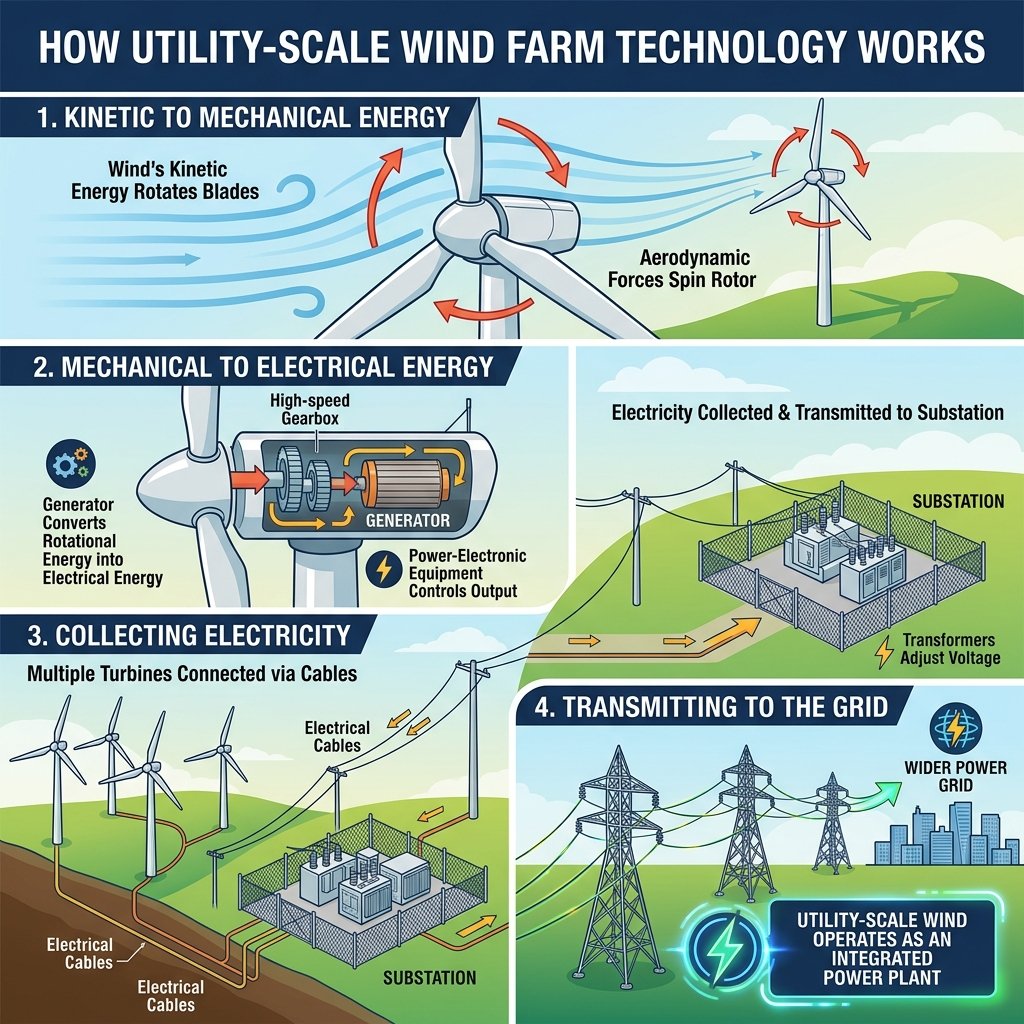
A wind farm begins generating electricity when moving air passes across turbine blades. Aerodynamic forces rotate the blades and rotor, transforming part of the wind’s kinetic energy into mechanical rotation.
Inside each turbine, a generator converts rotational mechanical energy into electrical energy. Power-electronic equipment helps control the electrical output before electricity enters the wind farm’s collection system.
Multiple turbines are connected through electrical cables. Their combined electricity is collected and transmitted toward a substation, where transformers adjust voltage for efficient transmission to the wider power grid.
Utility-scale wind therefore operates as an integrated power plant rather than simply as a collection of independent machines.
Large Wind Turbine Technology
Wind turbines are the central components of Utility-Scale Wind Farm Technology.
A modern utility-scale turbine typically includes three aerodynamic blades, a rotor and hub, nacelle, generator, drivetrain, tower, control equipment, power electronics, and foundation.
Pitch-control systems change blade angles to manage energy capture and structural loads. Yaw systems orient the rotor appropriately relative to wind direction.
Sensors continuously measure operating conditions such as wind speed, wind direction, rotor speed, vibration, temperature, and electrical output. Control software uses this information to adjust turbine operation.
Technological advances have enabled longer blades, taller towers, more reliable drivetrains, and increasingly sophisticated control systems.
Wind Farm Layout and Wake Effects
Turbine placement has a major influence on wind farm performance.
When wind passes through a turbine, the turbine extracts some energy from the airflow. The downstream air consequently has lower wind speed and increased turbulence. This disturbed region is called a wake.
If another turbine operates inside a strong wake, its electricity production can decrease while turbulence may increase mechanical loading.
Engineers therefore analyze prevailing wind directions, turbine spacing, terrain, atmospheric conditions, environmental constraints, and wake interactions when designing wind farm layouts.
Advanced research is also investigating wake steering, in which turbine controls intentionally redirect wakes to improve overall wind-plant performance rather than maximizing each turbine independently.
Utility-Scale Wind Farm Technology and Digital Controls
Modern wind farms increasingly depend on digital monitoring and automated control.
Supervisory Control and Data Acquisition, commonly called SCADA, allows operators to monitor turbines and other wind-farm equipment. It can provide information about electricity production, equipment condition, alarms, wind conditions, temperatures, and operating status.
Advanced sensors and data analytics can also support predictive maintenance.
Instead of waiting for equipment to fail, operators can analyze vibration, temperature, lubrication, electrical signals, and other indicators to identify developing problems.
Artificial intelligence and machine-learning techniques are also being researched for forecasting, equipment diagnostics, turbine control, and maintenance optimization.
Electrical Collection and Substations
Electricity generated by turbines must be efficiently collected before entering the transmission network.
Electrical cables connect individual turbines to the wind farm’s internal collection system. Transformers and substations then manage voltage and prepare electricity for transmission.
Onshore wind farms generally use underground or overhead electrical infrastructure depending on project design. Offshore wind farms require subsea cables and may use offshore substations before transmitting electricity toward land.
Electrical losses occur in cables, transformers, and other equipment, making electrical-system design another factor affecting overall wind-farm performance
Connecting Wind Farms to the Power Grid
Grid integration is a critical component of Utility-Scale Wind Farm Technology because wind generation varies with weather conditions.
Grid operators must continuously balance electricity production and consumption. Wind forecasting helps operators estimate how much electricity a wind farm may generate over coming hours or days.
Modern power electronics and advanced turbine controls can also provide important grid-support functions.
Research has demonstrated that appropriately controlled wind turbines can contribute services related to voltage and frequency stability, illustrating that wind technology can have a broader role in modern electricity systems than simply supplying energy.
Energy storage, expanded transmission infrastructure, demand flexibility, and complementary generation resources can further support electricity systems containing substantial variable renewable generation.
Wind Measurement and Forecasting Technology
Accurate wind measurements are essential before and after wind farm construction.
Meteorological towers, anemometers, wind vanes, lidar, and other sensing technologies can provide information about wind speed, direction, turbulence, and atmospheric conditions.
Before construction, these measurements help developers estimate potential electricity production and determine suitable turbine locations.
During operation, weather observations and forecasting systems help wind-farm operators anticipate changing conditions and optimize power production.
Advanced atmospheric modeling can additionally examine interactions between weather systems, turbines, wakes, and entire wind farms.
Maintenance and Reliability
Wind turbines operate under repeated aerodynamic and mechanical loads, making maintenance an essential part of wind farm management.
Technicians inspect blades, generators, drivetrains, towers, electrical equipment, foundations, and control systems. Scheduled maintenance can reduce the probability of unexpected failures.
Remote monitoring has become particularly valuable because operators can continuously observe equipment without physically inspecting every turbine.
For offshore wind farms, drones, robotic systems, remotely operated vehicles, and advanced sensors may reduce some difficult inspection requirements.
Reliable equipment is important because turbine downtime reduces electricity production and can increase project operating costs.
Environmental Considerations
Wind turbines produce electricity without burning fuel during normal operation, but wind farms still have environmental impacts that require management.
Project development can affect landscapes, habitats, birds, bats, marine ecosystems in offshore projects, and surrounding communities.
Manufacturing also requires materials including steel, concrete, copper, polymers, and composites.
Responsible development therefore involves environmental assessment, appropriate site selection, wildlife monitoring, community engagement, material management, and eventual decommissioning planning.
Future of Utility-Scale Wind Farm Technology
Future Utility-Scale Wind Farm Technology is likely to involve continued improvements in turbine size, blade design, digital controls, forecasting, wake management, power electronics, grid integration, robotics, and predictive maintenance.
Research increasingly examines the wind farm as an interconnected system rather than optimizing every turbine independently. DOE research, for example, has demonstrated that coordinated turbine controls can reduce wake-related losses and improve overall plant production.
Future development will also depend on transmission capacity, supply chains, permitting, project economics, environmental requirements, and the ability of electricity systems to integrate variable renewable resources.
Conclusion
Utility-Scale Wind Farm Technology transforms wind farms into sophisticated renewable power plants. Large turbines capture wind energy, generators convert it into electricity, electrical networks collect the output, and substations and transmission infrastructure connect the facility to the power grid.
Digital monitoring, advanced controls, wind forecasting, wake management, and predictive maintenance are making wind farms increasingly intelligent and interconnected.
Continued research into turbines, plant-level controls, atmospheric science, electrical systems, and grid integration can improve reliability and electricity production while helping utility-scale wind contribute to diversified low-carbon power systems. https://www.futurelearn.com/info/courses/introduction-to-environmental-science