
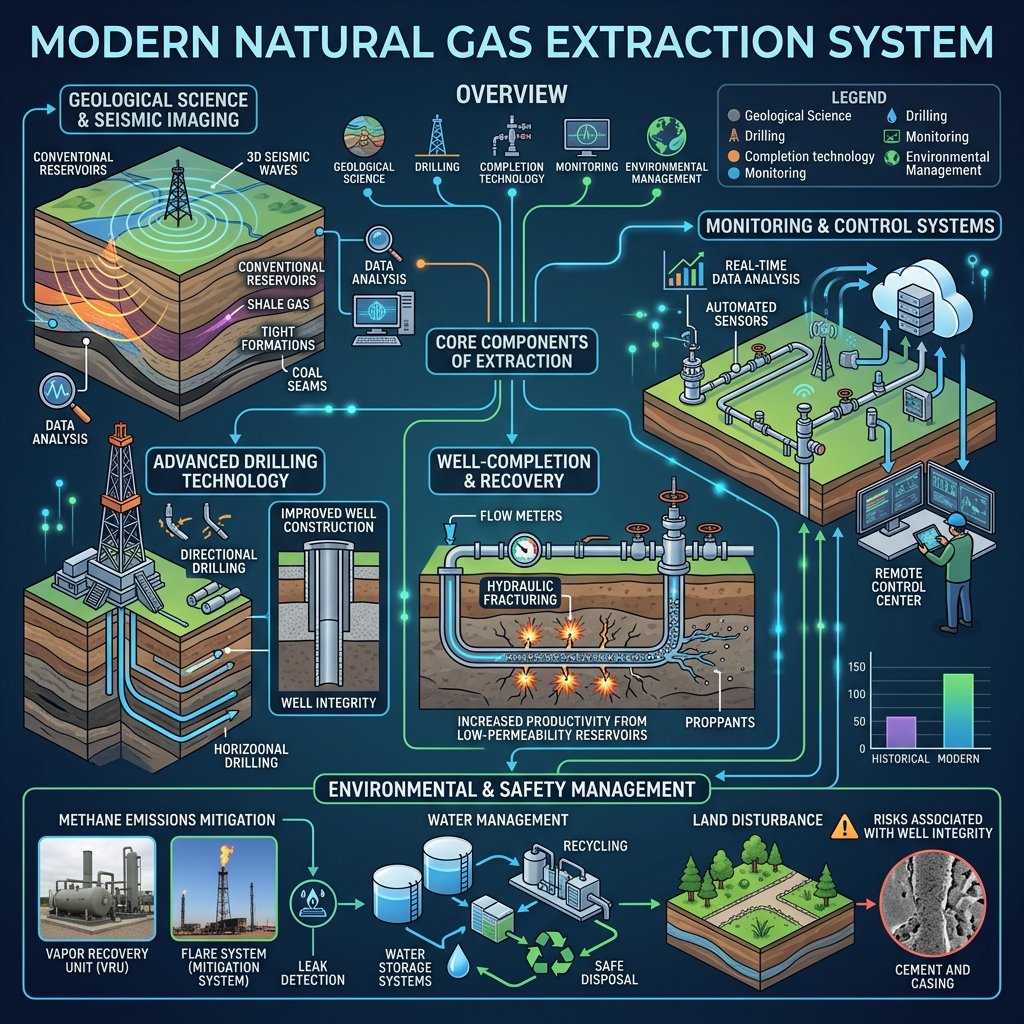
Modern Natural Gas Extraction combines geological science, advanced drilling, well-completion technology, monitoring systems, and environmental management to recover natural gas from underground formations. Natural gas occurs in conventional reservoirs as well as shale, tight formations, coal seams, and other geological settings. The techniques used to recover it depend strongly on reservoir geology, depth, pressure, permeability, economics, and regulatory requirements.
Modern extraction has changed considerably from early gas production. Technologies such as three-dimensional seismic imaging, horizontal drilling, improved well construction, hydraulic fracturing, automated sensors, and real-time data analysis allow operators to characterize reservoirs and control wells more precisely. However, extraction also creates environmental and safety challenges, including methane emissions, water management, land disturbance, and risks associated with well integrity.
How Modern Natural Gas Extraction Works
Modern Natural Gas Extraction generally begins long before drilling. Geologists and geophysicists study rock formations to determine whether economically recoverable natural gas may be present underground.
Geological mapping, existing well information, seismic surveys, and subsurface models can help characterize potential reservoirs. Seismic methods use generated energy waves and analyze their reflections from underground rock layers. The resulting information helps scientists develop models of subsurface structures.
Exploration does not guarantee commercial production. A geological formation may contain natural gas but still be technically difficult or uneconomic to develop. Exploratory drilling and additional measurements are therefore often necessary before large-scale development decisions are made.
Drilling Natural Gas Wells
Once a suitable location has been selected and regulatory requirements have been addressed, drilling can begin. A drilling rig creates a wellbore through layers of rock toward the targeted gas-bearing formation.
Modern wells can include both vertical and horizontal sections. Vertical drilling provides access to deep formations, while directional drilling allows engineers to control the path of the well.
Horizontal drilling has become particularly important in shale and other low-permeability formations. After reaching the desired depth, the well can gradually turn until it travels laterally through the target rock.
A horizontal section can expose considerably more reservoir rock to the well than a simple vertical penetration. This can improve production from formations in which natural gas does not flow easily through the rock.
Well Construction and Integrity
Well integrity is a critical part of Modern Natural Gas Extraction. Steel casing is installed within sections of the well, and cement is placed around casing strings to provide structural support and isolate geological formations.
Proper well design is important for separating produced fluids from groundwater-bearing formations and maintaining control of pressure.
Well integrity must be managed throughout the well’s life—not only during initial construction. Operators use pressure testing, cement evaluation, monitoring, maintenance, and other integrity-management techniques according to well conditions and applicable regulations.
Failures in casing, cement, equipment, or operating procedures can create environmental and safety risks, making engineering standards and quality control essential.
Hydraulic Fracturing and Natural Gas
Hydraulic fracturing is widely associated with modern shale gas development. It is used when the target rock has low permeability and natural gas cannot readily flow toward the well.
During hydraulic fracturing, fluid is injected into the target formation at sufficient pressure to create or extend fractures in the rock. The fracturing fluid is primarily water in many operations and normally includes proppant, commonly sand, which helps keep fractures open after pumping pressure decreases. Chemical additives are also used for specific technical purposes.
These fractures create pathways that allow natural gas to move through the formation and enter the well.
Hydraulic fracturing and horizontal drilling are distinct technologies, although they are frequently used together in unconventional gas development.
Water Management in Modern Natural Gas Extraction
Water management is an important environmental issue associated with some natural gas operations, particularly hydraulically fractured wells.
Water is needed during drilling and completion activities, and significant quantities can be required for hydraulic fracturing. After fracturing, some injected fluid can return to the surface as flowback. Wells can also produce naturally occurring formation water during production.
These water streams may contain dissolved minerals, salts, hydrocarbons, treatment chemicals, and naturally occurring substances from underground formations.
Management options can include treatment, recycling for additional operations, permitted disposal, or other approaches depending on water chemistry, local infrastructure, geology, economics, and environmental regulations.
Methane Emissions and Modern Natural Gas Extraction
Methane management is another major issue in Modern Natural Gas Extraction. Methane is the principal component of natural gas and is also a powerful greenhouse gas.
Emissions can occur through equipment leaks, pneumatic devices, tanks, compressors, valves, well-completion activities, and other parts of oil and gas infrastructure. The quantity released varies significantly among facilities and equipment.
Modern methane-control strategies include leak detection and repair programs, improved equipment design, vapor recovery, operational changes, and direct measurement technologies.
Optical gas imaging cameras, fixed sensors, aircraft, drones, and satellites are increasingly being investigated or deployed for methane detection and measurement. No single monitoring technology is ideal for every source, so combinations of methods may be needed.
Digital Technology in Modern Natural Gas Extraction
Digital systems increasingly influence natural gas production. Sensors can continuously measure pressure, temperature, flow rates, vibration, and equipment conditions.
Real-time information allows engineers to observe well performance and identify abnormal operating conditions. Data analytics can also support decisions about drilling, production optimization, equipment maintenance, and reservoir management.
Machine-learning and artificial-intelligence techniques are being researched and deployed for selected applications, including equipment diagnostics and interpretation of large datasets. However, these systems depend on data quality and should not be viewed as replacements for geological knowledge, engineering judgment, inspections, and established safety procedures.
Safety in Natural Gas Extraction
Natural gas operations involve high pressures, heavy equipment, combustible materials, and potentially hazardous gases. Safety management therefore covers well control, equipment integrity, worker training, gas detection, fire prevention, emergency response, and operational procedures.
Hydrogen sulfide can also occur naturally in some gas reservoirs. Because H₂S is highly toxic, operations where it may be present require appropriate monitoring and protective measures.
Automation can reduce human exposure to certain hazardous operations, but safe extraction still depends on engineering controls, maintenance, training, regulatory compliance, and effective safety management.
Environmental Impacts and Limitations
Modern Natural Gas Extraction can provide substantial quantities of energy, but it is not environmentally impact-free.
Potential impacts include land disturbance from drilling sites and roads, water consumption, wastewater generation, air pollution, methane emissions, noise, habitat disruption, and risks from spills or equipment failures.
Hydraulic fracturing has also generated concern about groundwater protection and induced seismicity. These issues need to be distinguished carefully. Groundwater risks depend on factors including well integrity, surface handling of fluids, local geology, and operational practices. Meanwhile, some of the more significant induced earthquakes associated with oil and gas development have been linked to underground wastewater disposal, although hydraulic fracturing itself can also induce seismic events under certain geological conditions.
Environmental performance therefore varies substantially between projects and regions.
The Future of Modern Natural Gas Extraction
The future of Modern Natural Gas Extraction will depend on natural gas demand, energy policy, climate objectives, economics, regulation, and technological development.
Research and industry development are focusing on improved methane measurement, lower-emission equipment, better drilling efficiency, water recycling, automated monitoring, and more accurate reservoir modeling.
Natural gas is sometimes described as having climate advantages when it replaces more carbon-intensive fuels in particular applications. However, its overall climate impact depends substantially on methane emissions across production, processing, transportation, and distribution, as well as carbon dioxide released when the gas is burned. Consequently, the climate role of natural gas remains dependent on the specific comparison, time frame, leakage rates, and energy system being studied.
Conclusion
Modern Natural Gas Extraction is a technically sophisticated process that integrates geology, drilling engineering, horizontal wells, well construction, hydraulic fracturing where appropriate, digital monitoring, and environmental management.
Modern technology has made previously difficult natural gas resources commercially accessible and has improved operators’ ability to understand and monitor wells. At the same time, technical progress does not eliminate environmental challenges. Methane emissions, water use, wastewater, well integrity, land disturbance, and operational safety remain important areas requiring careful management.
Future improvements are likely to emphasize more accurate methane detection, stronger well monitoring, efficient water management, improved equipment, automation, and better environmental performance. Understanding both the capabilities and limitations of Modern Natural Gas Extraction provides a more scientifically balanced picture of how natural gas resources are developed today. https://en.wikipedia.org/wiki/Natural_resource
Pingback: 7 Essential Natural Gas Drilling Basics You Need to Know