
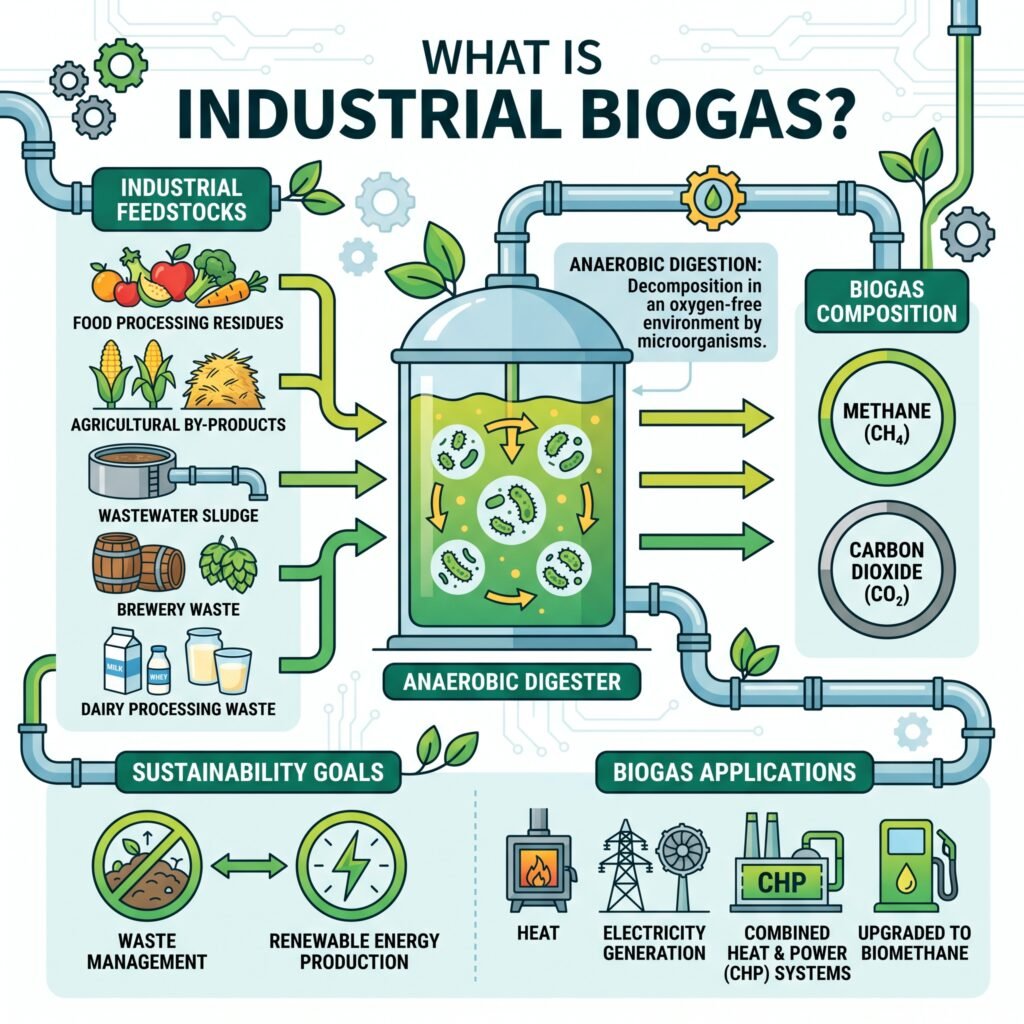
Industrial Biogas is a renewable gas produced when organic materials from industrial operations decompose in an oxygen-free environment. This biological process, known as anaerobic digestion, uses microorganisms to break down biodegradable materials and produce a gas mixture primarily containing methane and carbon dioxide.
Industries generate large quantities of organic waste every day. Food-processing residues, agricultural by-products, wastewater sludge, brewery waste, dairy-processing waste, and other biodegradable materials can potentially become feedstocks for Industrial Biogas production. Instead of treating all these materials simply as waste, suitable organic residues can be converted into useful energy.
Industrial Biogas can therefore connect two important sustainability goals: waste management and renewable energy production. Depending on the facility and gas quality, the resulting biogas can provide heat, generate electricity, fuel combined heat and power systems, or be upgraded into biomethane.
How Does Industrial Biogas Work?
The production of Industrial Biogas generally begins with collecting suitable organic materials. These feedstocks are prepared and transferred into a sealed vessel called an anaerobic digester.
Inside the digester, microorganisms gradually break down complex organic matter. Because oxygen is excluded from the process, anaerobic microorganisms convert part of the material into biogas.
The process can be understood through four major biological stages: hydrolysis, acidogenesis, acetogenesis, and methanogenesis. During these stages, complex organic compounds are progressively transformed into simpler substances and eventually into methane-rich biogas.
The raw gas normally contains methane and carbon dioxide along with smaller amounts of water vapor and other compounds. Its exact composition varies according to feedstock, digester conditions, and treatment technology.
After production, the gas may undergo cleaning to remove moisture, hydrogen sulfide, and other unwanted substances before being used in energy equipment.
Major Sources of Industrial Biogas
Many industries have organic waste streams suitable for biogas production. Food and beverage manufacturing is one of the most important examples because these facilities often generate biodegradable residues with significant energy potential.
Breweries and beverage plants may produce wastewater and organic residues. Dairy processing can generate whey and wastewater containing organic matter. Sugar, starch, fruit, vegetable, meat, and other food-processing operations may also produce residues that can be treated through anaerobic digestion.
Wastewater treatment facilities represent another important source. Organic sludge can be processed in digesters, allowing treatment plants to recover part of its energy value rather than treating it entirely as a disposal problem.
However, not every industrial waste stream is automatically suitable for anaerobic digestion. Feedstock composition, contaminants, moisture content, biodegradability, local regulations, and plant economics must all be evaluated.
Benefits of Industrial Biogas
One of the main benefits of Industrial Biogas is its ability to recover energy from materials that might otherwise require treatment or disposal. This can improve resource efficiency within industrial operations.
Biogas can also provide a relatively flexible renewable energy source. Unlike solar and wind resources, which depend directly on current weather conditions, properly managed biogas systems can store gas and use it according to operational requirements.
Another potential benefit is greenhouse gas management. Organic waste can release methane when it decomposes under uncontrolled anaerobic conditions. Capturing methane through engineered digestion systems and using it for energy can reduce uncontrolled emissions. The overall climate benefit, however, depends strongly on preventing methane leakage throughout production, storage, upgrading, and use.
Industrial facilities may also benefit from producing energy close to where it is consumed. A factory can potentially use its biogas for process heat, electricity, or combined heat and power, reducing dependence on externally purchased energy.
Industrial Biogas and Waste Management
Waste management is central to Industrial Biogas systems. Traditional industrial waste management can involve transportation, treatment, disposal, or other processes that require money and resources.
Anaerobic digestion provides another pathway for appropriate biodegradable materials. It does not eliminate all waste, but it converts part of the organic matter into useful gas while leaving a material called digestate.
Digestate contains nutrients and organic matter. Depending on its quality, composition, treatment, and applicable regulations, it may have value as a fertilizer or soil amendment. Careful management is essential because contaminants or unsuitable feedstocks can limit its agricultural use.
This combination of waste treatment, energy recovery, and potential nutrient recycling makes biogas particularly relevant to circular-economy strategies.
Industrial Biogas for Electricity and Heat
Industrial Biogas can be used in several ways. One common application is combustion in a combined heat and power system, often called CHP.
A CHP installation generates electricity while recovering heat produced during electricity generation. The electricity can support industrial machinery, pumps, lighting, and other equipment, while recovered heat can potentially support manufacturing processes or maintain digester temperatures.
Biogas can also be burned in suitable boilers to generate thermal energy directly. This can be valuable for industries requiring steam or process heat.
The best application depends on gas production, facility energy demand, equipment efficiency, local energy prices, and infrastructure.
Upgrading Industrial Biogas into Biomethane
Raw biogas is not identical to conventional natural gas because it contains significant carbon dioxide and other impurities. Through an upgrading process, carbon dioxide, hydrogen sulfide, moisture, and other unwanted components can be reduced.
The resulting methane-rich gas is generally known as biomethane or renewable natural gas in some markets.
When it meets applicable quality standards, biomethane may be suitable for injection into gas networks or use as a transportation fuel. Upgrading can therefore expand the potential applications and economic value of Industrial Biogas.
Environmental Challenges of Industrial Biogas
Although Industrial Biogas can provide environmental benefits, it should not automatically be considered impact-free.
Methane leakage is particularly important because methane is a powerful greenhouse gas. Digesters, pipelines, storage systems, upgrading equipment, and engines must therefore be properly designed, monitored, and maintained.
Feedstock sourcing also matters. Using genuine waste and residue streams can provide different environmental outcomes from deliberately producing crops primarily for energy. Water consumption, transportation distances, nutrient management, odors, and digestate handling should also be considered when assessing a project.
Professional biogas development therefore requires environmental management alongside energy production.
Industrial Biogas and the Circular Economy
The circular economy seeks to keep materials and resources useful for as long as practical while reducing unnecessary waste. Industrial Biogas can contribute to this approach by turning certain organic residues into energy and potentially recovering nutrients through digestate.
For example, a food-processing facility may send biodegradable residues to an anaerobic digester. The resulting biogas can provide energy for the facility, while appropriately managed digestate may return nutrients to agriculture.
This creates a more circular relationship between production, waste management, energy generation, and nutrient recovery.
The Future of Industrial Biogas
The future of Industrial Biogas is closely connected to improvements in anaerobic digestion, gas upgrading, methane monitoring, automation, and waste-management technology.
Modern sensors and digital control systems can help operators monitor temperature, pH, gas production, methane concentration, and other important conditions. Better monitoring can improve operational stability and help identify leaks or performance problems.
Biomethane production may also become increasingly important where industries and governments seek alternatives to fossil natural gas. Industrial facilities with reliable supplies of suitable organic residues can potentially become both waste processors and renewable-energy producers.
However, successful expansion will depend on project economics, methane control, sustainable feedstocks, infrastructure, regulations, and responsible digestate management.
Conclusion
Industrial Biogas offers a practical method for converting suitable organic industrial waste into renewable energy through anaerobic digestion. Food-processing residues, wastewater sludge, agricultural by-products, and other biodegradable materials can become valuable energy resources instead of being viewed solely as waste.
The technology can produce electricity, heat, or biomethane while supporting improved waste management and circular resource use. Its environmental performance depends on responsible feedstock selection, efficient equipment, methane-leak prevention, and careful management of digestate.
As industries search for ways to reduce waste, improve resource efficiency, and transition toward lower-carbon energy systems, Industrial Biogas can play an important role. When designed and operated responsibly, it demonstrates how industrial waste streams can become useful resources within a more sustainable and circular economy.Privacy Policy https://www.unesco.org/en/query-list/n/natural-resources