
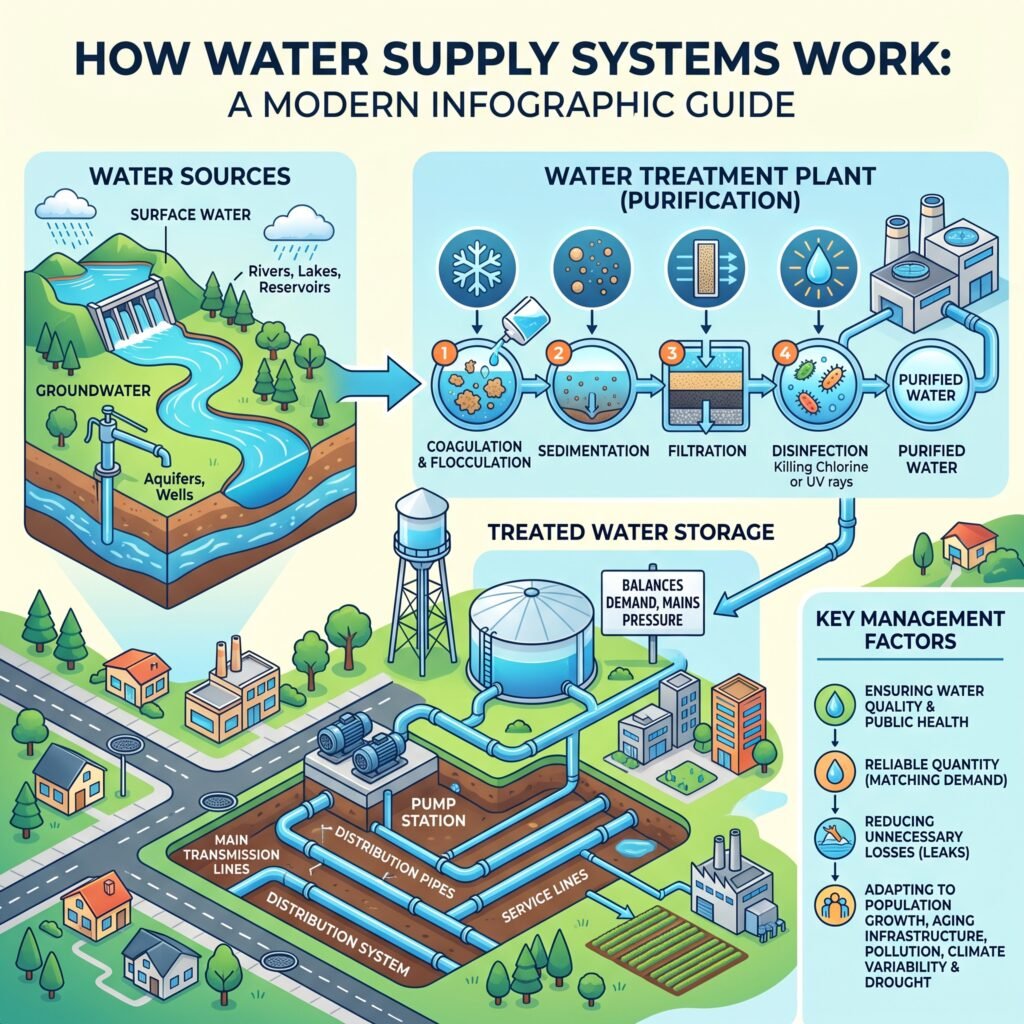
How Water Supply Systems Work is an important topic for understanding how communities obtain reliable and safe water for drinking, cooking, sanitation, agriculture, businesses, and industry. A modern water supply system is more than a network of pipes. It is an interconnected infrastructure system that collects water from natural or engineered sources, treats it when necessary, stores it, maintains suitable pressure, and distributes it to consumers.
Water utilities must manage both water quantity and water quality. A successful system needs enough water to satisfy demand while protecting public health and reducing unnecessary losses. Population growth, aging infrastructure, pollution, drought, climate variability, and rising demand are making efficient water management increasingly important.
How Water Supply Systems Work from Source to Consumer
Understanding how water supply systems work begins with the water source. Most public systems obtain water from surface water, groundwater, or a combination of both. In some water-scarce regions, desalinated seawater and recycled water can also contribute to available supplies.
After collection, water generally moves through treatment, storage, and distribution infrastructure before reaching consumers. Pumps, pipelines, valves, reservoirs, water towers, meters, sensors, and pressure-control equipment help maintain a dependable flow.
The exact design differs between communities because geography, population, source-water quality, climate, elevation, regulations, and available infrastructure all influence the system.
1. Water Sources
Every water supply system begins with a source. Surface water comes primarily from rivers, lakes, streams, and reservoirs. These sources can provide large quantities of water but may contain sediment, microorganisms, organic matter, and pollutants that require treatment.
Groundwater is stored beneath Earth’s surface in water-bearing geological formations called aquifers. Wells are drilled into these formations so groundwater can be pumped to the surface. Groundwater can naturally be relatively clean because soil and rock provide some filtration, but it may still contain dissolved minerals or contaminants.
Some regions also use desalination, which removes salts and other substances from seawater or brackish water. Although desalination can strengthen water supplies in dry coastal areas, it typically requires substantial energy and specialized infrastructure
2. Water Collection and Intake
The next stage in how water supply systems work is collecting raw water and transporting it toward treatment facilities.
Surface-water systems commonly use intake structures located in rivers, lakes, or reservoirs. Screens can prevent large objects such as branches, leaves, and debris from entering pumps and treatment equipment.
Groundwater systems use wells and pumps. The extracted water can be delivered directly toward treatment or temporarily stored, depending on local conditions and water quality.
Protecting the source is extremely important. Preventing contamination at the watershed or groundwater level can reduce treatment challenges and help maintain long-term water security.
3. Water Treatment
Water intended for drinking must meet applicable water-quality standards. Treatment processes vary depending on the characteristics of the source water.
Conventional surface-water treatment commonly includes processes such as coagulation, flocculation, sedimentation, filtration, and disinfection.
During coagulation and flocculation, treatment chemicals help very small suspended particles combine into larger particles called flocs. Sedimentation allows many of these particles to settle.
Water then passes through filtration systems designed to remove additional particles and impurities. Finally, disinfection is used to control disease-causing microorganisms.
Treatment plants continuously monitor important water-quality indicators. Modern facilities may use automated instruments and control systems to detect changes and adjust treatment processes.
4. Water Storage
Storage provides an important buffer between water production and consumer demand. Treated water may be stored in ground-level reservoirs, elevated tanks, or water towers.
Demand is rarely constant throughout the day. A community might consume relatively little water overnight but experience high demand during the morning and evening. Storage facilities allow water produced during lower-demand periods to remain available when consumption increases.
Elevated storage can also help maintain pressure through gravity. Properly designed storage improves system reliability and can provide additional water during emergencies, equipment failures, or firefighting operations.
5. Water Distribution Networks
The distribution network connects the water supply infrastructure with consumers. It typically contains large transmission mains, smaller distribution pipes, valves, service connections, and other equipment.
Large mains transport significant quantities of treated water across a service area. Smaller pipes branch from these mains and deliver water into neighborhoods, commercial districts, industrial areas, and public facilities.
Valves allow utilities to control sections of the network. If a pipe breaks, operators can isolate the affected section rather than shutting down the entire system.
Distribution networks require regular maintenance because corrosion, pipe deterioration, ground movement, and pressure changes can contribute to leaks and failures.
6. Water Pressure and Pumping
Adequate pressure is essential to understanding how water supply systems work. Without sufficient pressure, water may not reach buildings reliably, particularly in elevated areas or tall structures.
Gravity can provide pressure when reservoirs or tanks are positioned above consumers. Where gravity alone is insufficient, pumping stations move water and maintain appropriate pressure.
Utilities must carefully manage pressure. Pressure that is too low can affect service reliability, while unnecessarily high pressure may increase leakage and place additional stress on pipes.
Modern pressure-management systems increasingly use sensors and automated controls to monitor network conditions.
7. Water Meters and Consumption
Water meters measure how much water individual customers use. Metering supports billing, demand management, conservation, and leak detection.
Traditional meters require periodic readings, while smart meters can transmit consumption information electronically. More detailed usage data can help utilities identify unusual consumption patterns that may indicate leaks.
Consumers can also use this information to understand their water consumption and find opportunities to conserve water.
8. Leakage and Water Loss
Not all water entering a distribution network reaches customers as billed consumption. Water can be lost through leaking pipes, damaged connections, overflowing storage facilities, inaccurate meters, or other problems.
Reducing water loss is therefore an important part of water supply management. Utilities can use leak-detection technologies, pressure monitoring, pipe inspections, asset-management programs, and infrastructure replacement to reduce losses.
Water conservation through leak reduction is especially valuable in regions experiencing drought or limited freshwater availability.
9. Smart Water Supply Technology
Digital technology is changing how water supply systems work. Sensors, smart meters, geographic information systems, automated controls, and data analytics can provide utilities with more detailed information about their networks.
Sensors can monitor pressure, flow, reservoir levels, and selected water-quality conditions. When abnormal changes occur, operators can investigate possible leaks, equipment problems, or other disruptions.
Predictive maintenance can also help utilities identify infrastructure that may require attention before a major failure occurs. These technologies can improve operational efficiency while reducing unnecessary water and energy use
10. Sustainable Water Supply Management
Sustainable management seeks to provide reliable water today without undermining the resources needed by future generations. This requires balancing withdrawals with the long-term availability of rivers, reservoirs, and aquifers.
Water conservation, efficient irrigation, wastewater reuse, rainwater management, leakage reduction, watershed protection, and appropriate infrastructure investment can all contribute to sustainability.
Climate change adds another challenge because changing precipitation patterns, droughts, floods, and extreme weather can affect both water availability and infrastructure. Water managers increasingly need resilient systems capable of operating under changing environmental conditions.
Why Water Supply Systems Matter
Reliable water infrastructure supports public health, agriculture, economic activity, sanitation, firefighting, industry, and everyday household life. When these systems fail, the consequences can extend far beyond temporary inconvenience.
Understanding how water supply systems work also demonstrates why protecting natural water resources is essential. Rivers, lakes, reservoirs, groundwater aquifers, and watersheds are closely connected to the infrastructure that communities depend on.
Conclusion
Understanding how water supply systems work requires looking at the complete journey of water. Water begins at a source such as a river, reservoir, lake, or aquifer. It is collected, treated when required, stored, pressurized, and transported through distribution networks until it reaches consumers.
Modern systems increasingly combine traditional infrastructure with smart monitoring, leak detection, automated controls, and improved water-management practices. As populations grow and environmental pressures increase, efficient and sustainable water supply management will become even more important.
Protecting water sources, maintaining infrastructure, reducing leakage, improving treatment, and using water efficiently can help communities build safer and more resilient supplies for the future.Privacy Policy https://www.unesco.org/en/query-list/n/natural-resources
Pingback: 7 Key Strategies for Oil Refining Waste Management