
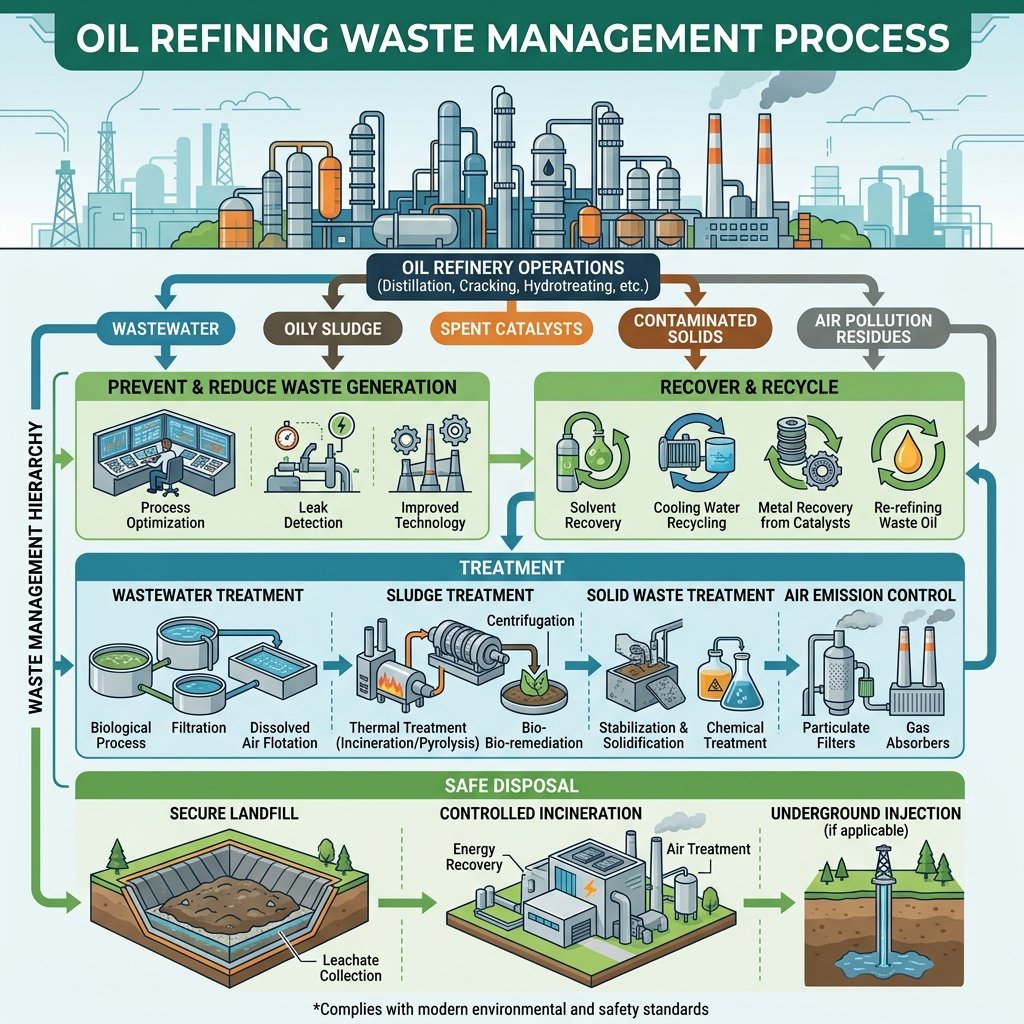
Oil Refining Waste Management is the systematic handling, treatment, recovery, recycling, and disposal of wastes generated when crude oil is converted into useful petroleum products. Refineries process complex mixtures of hydrocarbons through operations such as distillation, cracking, hydrotreating, reforming, and product blending. While these processes produce fuels and petrochemical feedstocks, they can also generate wastewater, oily sludge, spent catalysts, contaminated solids, and air-pollution-control residues.
Effective waste management is therefore an important part of modern refinery operations. Its purpose is not simply to dispose of waste. A well-designed system first seeks to prevent or reduce waste generation, then recover valuable materials where technically and economically practical, treat remaining waste, and finally dispose of residues using controlled methods that meet applicable environmental and safety requirements.
Major Sources of Oil Refining Waste
Waste can originate at many points within a petroleum refinery. Storage tanks may accumulate sediments and oily sludge. Equipment maintenance and cleaning can produce contaminated water and solids. Wastewater treatment systems themselves generate sludge, while chemical processes may eventually produce spent catalysts or treatment materials.
The composition of refinery waste varies considerably because crude oils and refinery configurations differ. Potential contaminants can include petroleum hydrocarbons, suspended solids, sulfur compounds, metals, salts, treatment chemicals, and other process-specific substances.
This variability is important. Refinery waste should not automatically be treated as one uniform material. Characterization and classification are needed to determine appropriate handling and treatment methods.
Wastewater in Oil Refining Waste Management
Water is used extensively in refinery operations, including cooling, steam production, desalting, equipment cleaning, and process operations. As a result, wastewater management is a major component of Oil Refining Waste Management.
Refinery wastewater may contain oil and grease, dissolved hydrocarbons, suspended materials, ammonia, sulfides, salts, and other contaminants. Treatment normally involves several stages rather than one single technology.
Physical separation can remove free oil and larger solids. Additional physical and chemical processes can separate smaller oil droplets and suspended particles. Biological treatment may then use microorganisms to break down biodegradable organic compounds. Depending on discharge requirements and intended water reuse, further treatment can include filtration or other advanced processes.
Water reuse can reduce freshwater demand and decrease the quantity of treated wastewater requiring discharge. However, reuse requires suitable treatment because contaminants that remain in recycled water can affect refinery equipment and industrial processes.
Managing Oily Sludge
Oily sludge is another important refinery waste. It may accumulate in crude-oil storage tanks, separators, wastewater systems, and other processing equipment. This material can contain water, hydrocarbons, sediments, and inorganic substances.
Modern management strategies increasingly consider whether useful hydrocarbons can be recovered before the remaining material is treated. Techniques may involve mechanical separation, thermal treatment, or other processes selected according to the sludge’s composition.
Recovery can provide environmental and resource-efficiency benefits, but not every sludge is suitable for economical recovery. Treatment decisions require laboratory characterization and consideration of environmental regulations, energy consumption, cost, and final residue quality.
Spent Catalysts and Material Recovery
Petroleum refining relies on catalysts to accelerate important chemical reactions. Over time, some catalysts lose performance and must be regenerated, recycled, or replaced.
Spent catalysts can contain valuable metals, depending on their original composition and refinery service. In some cases, specialized recycling operations can recover these materials. This supports resource conservation and may reduce the amount of waste requiring final disposal.
Some spent catalysts can also contain hazardous substances accumulated during refinery operation. Consequently, storage, transportation, recycling, and disposal must follow appropriate regulatory and safety controls.
This illustrates an important principle of Oil Refining Waste Management: a material considered waste at one facility may still contain recoverable resources, but recovery must be technically appropriate and environmentally controlled.
Waste Prevention and Cleaner Production
The preferred approach to waste management is often to prevent unnecessary waste before it is created. Refineries can pursue this through improved process control, preventive maintenance, leak detection, better material handling, optimized cleaning procedures, and segregation of different waste streams.
Segregation is particularly important. Mixing relatively clean water with highly contaminated streams can increase the volume requiring intensive treatment. Keeping streams separate allows operators to apply treatment technologies more efficiently.
Digital monitoring and automated process controls can also help facilities detect abnormal operating conditions, identify losses, and optimize resource consumption. These technologies do not eliminate refinery waste, but they can support more efficient environmental management.
Recycling and Circular Resource Use
Resource recovery is increasingly relevant to refinery waste management. Used oils may sometimes be recovered or reprocessed, metals can potentially be reclaimed from certain residues, and treated water can be reused within industrial operations.
These practices are related to the broader concept of a circular economy, in which materials are kept in productive use for longer rather than immediately becoming disposal wastes.
However, recycling is not automatically environmentally beneficial in every situation. Transportation distances, treatment energy, contamination levels, recovery efficiency, and the environmental performance of recycling facilities must also be considered. Life-cycle assessment can help compare different management options.
performance of recycling facilities must also be considered. Life-cycle assessment can help compare different management options.
Environmental and Health Protection
Poorly controlled refinery waste can contaminate soil, surface water, or groundwater. Volatile substances can also contribute to air emissions during improper storage or handling. For this reason, facilities use containment systems, monitoring programs, controlled storage areas, wastewater treatment, and documented waste-handling procedures.
Worker protection is another essential consideration. Certain refinery residues may contain toxic, corrosive, flammable, or otherwise hazardous substances. Appropriate engineering controls, worker training, protective equipment, and emergency procedures are therefore important components of waste-management systems.
Environmental monitoring can also help determine whether treatment systems are operating as intended and whether releases remain within applicable regulatory limits.
Oil Refining Waste Management and Sustainability
Oil Refining Waste Management can improve the environmental performance of petroleum refining by reducing uncontrolled releases, conserving water, recovering useful materials, and decreasing the volume of waste requiring disposal.
Nevertheless, waste management should not be confused with eliminating the broader environmental impacts of petroleum. Refining consumes energy and produces greenhouse-gas emissions, while combustion of petroleum fuels releases carbon dioxide. Waste treatment addresses an important part of refinery environmental management, but it does not remove all impacts associated with fossil-fuel production and use.
This distinction is important in professional environmental analysis because operational improvements and broader energy-system impacts are separate issues.
Oil Refining Waste Management and Sustainability
Oil Refining Waste Management can improve the environmental performance of petroleum refining by reducing uncontrolled releases, conserving water, recovering useful materials, and decreasing the volume of waste requiring disposal.
Nevertheless, waste management should not be confused with eliminating the broader environmental impacts of petroleum. Refining consumes energy and produces greenhouse-gas emissions, while combustion of petroleum fuels releases carbon dioxide. Waste treatment addresses an important part of refinery environmental management, but it does not remove all impacts associated with fossil-fuel production and use.
This distinction is important in professional environmental analysis because operational improvements and broader energy-system impacts are separate issues.https://en.wikipedia.org/wiki/Natural_resource
Pingback: 7 Fearless Insights on Crude Oil Extraction Unveiled