
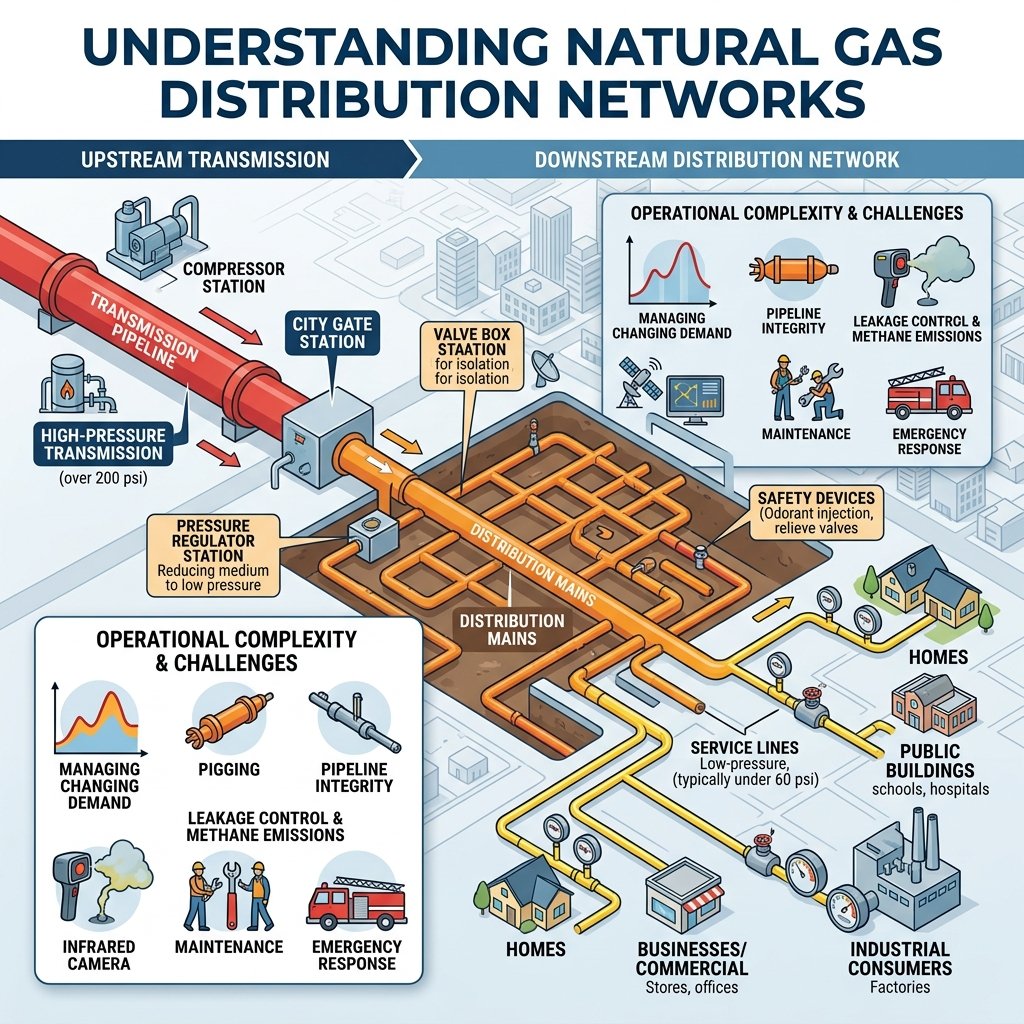
Natural Gas Distribution Networks Explained provides an understanding of how processed natural gas moves from large transmission pipelines into local networks that supply homes, businesses, public buildings, and industrial consumers. Distribution represents the downstream portion of the pipeline system and is essential because high-pressure transmission infrastructure generally does not deliver gas directly to individual residential customers.
A natural gas distribution network consists of interconnected pipelines, pressure-control equipment, valves, meters, service lines, monitoring systems, and safety devices. Together, these components control gas pressure and flow while delivering the amount of natural gas required by different customers.
Although the basic principle appears straightforward, modern distribution is a complex engineering system. Operators must manage changing demand, pipeline integrity, leakage, pressure, maintenance, emergency response, and increasingly, methane emissions.
Natural Gas Distribution Networks Explained: How the System Works
Understanding Natural Gas Distribution Networks Explained begins where long-distance transmission pipelines approach a local distribution area.
Transmission pipelines carry large volumes of natural gas between production regions, processing plants, storage facilities, power stations, and major markets. They generally operate at higher pressures than local distribution systems.
Before gas enters a distribution network, its pressure is reduced at specialized facilities or regulator stations. Pressure-control equipment ensures that downstream pipelines receive gas within their designed operating limits.
From there, distribution mains transport natural gas through communities. Smaller service lines branch from these mains and connect individual buildings or facilities.
The basic pathway can therefore be summarized as:
ransmission pipeline → pressure regulation → distribution main → service line → customer meter → end-use equipment.
This interconnected structure allows gas to move efficiently from large regional infrastructure toward individual consumers.
Distribution Mains and Service Lines
Two important components of a natural gas distribution system are distribution mains and service lines.
Distribution mains run through communities and carry gas toward groups of customers. Their diameter, material, pressure, and configuration vary according to system design, age, demand, and local requirements.
A service line connects the distribution main with an individual customer’s premises.
Modern networks commonly use materials such as steel and polyethylene depending on pressure, location, application, and engineering requirements. Older networks in some regions may contain legacy materials that require additional inspection, maintenance, or replacement.
Pipeline material alone does not determine system safety. Installation quality, corrosion control, operating pressure, inspection, maintenance, and damage prevention are also important.
Pressure Regulation in Natural Gas Networks
Pressure management is fundamental to Natural Gas Distribution Networks Explained.
Natural gas loses pressure as it travels through pipelines because of friction and changing demand. At the same time, gas arriving from transmission infrastructure may be at a pressure that is too high for local distribution or customer equipment.
Pressure regulators reduce and control gas pressure at different stages.
Distribution systems can contain several pressure levels. Gas pressure may be progressively reduced as it moves from transmission infrastructure toward smaller distribution mains and eventually individual customers.
Maintaining appropriate pressure is critical. Excessive pressure can damage equipment, while insufficient pressure can prevent appliances or industrial systems from operating correctly.
Regulators, relief devices, monitoring instruments, and operating procedures therefore form important parts of pressure management.
Natural Gas Metering Systems
Before natural gas reaches customer equipment, it normally passes through a gas meter.
Meters measure the quantity of gas delivered to the customer. Utilities use this information for billing, system planning, demand analysis, and other operational purposes.
Different meter technologies are available depending on customer size and flow requirements. Residential systems typically handle much smaller gas flows than large industrial facilities.
Modern smart-metering technologies can provide more frequent consumption information than traditional manual meter readings. When appropriately implemented, digital systems can help utilities understand demand patterns and identify certain abnormal operating conditions.
However, metering technology is only one component of a much broader distribution safety and monitoring system.
Safety in Natural Gas Distribution Networks
Safety is a central issue in Natural Gas Distribution Networks Explained because natural gas is combustible and uncontrolled releases can create fire or explosion hazards.
Distribution operators use multiple layers of protection. These can include pressure regulation, isolation valves, pipeline inspection, corrosion protection, leak surveys, emergency procedures, and public damage-prevention programs.
Underground pipelines can also be damaged accidentally during excavation. For this reason, locating buried utilities before construction or digging is an important element of pipeline safety.
Natural gas itself is primarily methane and is naturally odorless. Distribution companies generally add an odorant so that people can more readily detect certain gas leaks by smell.
Odorization is an important safety measure, but it does not replace professional leak-detection equipment or proper emergency procedures.
Methane Leakage and Environmental Concerns
Methane emissions are an increasingly important consideration when studying Natural Gas Distribution Networks Explained.
Methane is the principal component of natural gas and a powerful greenhouse gas. Leakage can occur from pipelines, joints, valves, pressure-regulating equipment, meters, and other infrastructure.
The scale of leakage varies among networks depending on factors such as infrastructure age, materials, maintenance practices, operating conditions, and measurement methods.
Reducing distribution-system methane emissions can involve replacing leak-prone infrastructure, conducting leak detection and repair, improving equipment, and using more sensitive measurement technologies.
This is an important distinction: natural gas distribution efficiency should not be evaluated only by how reliably gas reaches customers. Environmental performance also depends partly on how much methane escapes before reaching its intended use.
Digital Monitoring and Smart Gas Networks
Modern technology is changing how distribution networks are monitored.
Sensors can measure pressure, flow, temperature, and equipment conditions. Supervisory Control and Data Acquisition systems can provide operators with information from different parts of the network.
Geographic Information Systems are also important. GIS technology allows utilities to map pipelines, valves, regulators, customer connections, and other infrastructure.
Advanced data analysis can help identify unusual changes in pressure or flow and support maintenance planning.
Some utilities are exploring artificial intelligence and predictive analytics to identify patterns that may indicate equipment deterioration or abnormal network behavior. These technologies have potential, but their effectiveness depends on reliable data and appropriate engineering interpretation.
Digital systems therefore supplement rather than eliminate physical inspection and maintenance
Managing Changing Natural Gas Demand
Natural gas consumption is not constant.
Demand can rise sharply during cold weather in regions where gas is widely used for heating. Industrial activity and gas-fired electricity generation can also influence demand patterns.
Distribution operators must maintain sufficient network capacity and appropriate pressure as consumption changes.
Regional storage facilities and transmission networks can support supply during periods of high demand. However, local distribution infrastructure must still be capable of delivering gas safely to customers.
Network planning therefore uses historical consumption, expected population and industrial changes, weather patterns, infrastructure capacity, and other information to estimate future requirements.
Environmental and Infrastructure Challenges
Natural gas distribution systems face several long-term challenges.
Older infrastructure may require replacement or rehabilitation. Excavation damage, corrosion of metallic infrastructure, equipment failure, ground movement, and extreme weather can also affect network integrity.
Utilities must determine which assets require inspection, repair, or replacement. Risk-based integrity management can help prioritize infrastructure according to condition and potential consequences of failure.
Energy transitions create another area of uncertainty. Some gas networks may face declining fossil-gas demand, while others may investigate the introduction of gases such as biomethane or hydrogen
However, introducing alternative gases into existing infrastructure is not automatically possible. Gas composition can affect pipeline materials, seals, meters, combustion equipment, safety procedures, and operating requirements. Detailed engineering assessments and regulatory approval are therefore necessary.
Future of Natural Gas Distribution Networks
The future of Natural Gas Distribution Networks Explained involves both technological development and uncertainty about the long-term role of gaseous fuels.
Improved methane sensors, advanced metering, automated pressure control, better pipeline materials, satellite or aerial methane detection, and predictive maintenance could improve network performance.
At the same time, climate policies, electrification, renewable energy, biomethane development, hydrogen research, and changing consumer demand may influence how existing gas infrastructure is used.
It is therefore difficult to make one universal prediction for natural gas distribution. Future development will differ among countries and regions according to infrastructure, energy resources, regulations, economics, and climate objectives.
Conclusion
Natural Gas Distribution Networks Explained shows that delivering natural gas involves much more than simply connecting pipelines between suppliers and customers. Distribution systems integrate mains, service lines, regulators, valves, meters, sensors, and safety equipment into a coordinated network.
Pressure regulation allows high-pressure gas to be progressively adapted for local delivery, while metering measures consumption and monitoring systems help operators manage network conditions.
However, reliable delivery must be considered alongside pipeline integrity, public safety, methane emissions, aging infrastructure, and environmental performance.
As energy systems change, natural gas distribution networks may also evolve through better leak detection, digital monitoring, infrastructure modernization, biomethane integration, and potentially other compatible gases. Understanding both their capabilities and limitations provides a stronger technical foundation for evaluating the role of gas distribution infrastructure in modern energy systems. https://www.futurelearn.com/info/courses/introduction-to-environmental-science/0/steps/269824