
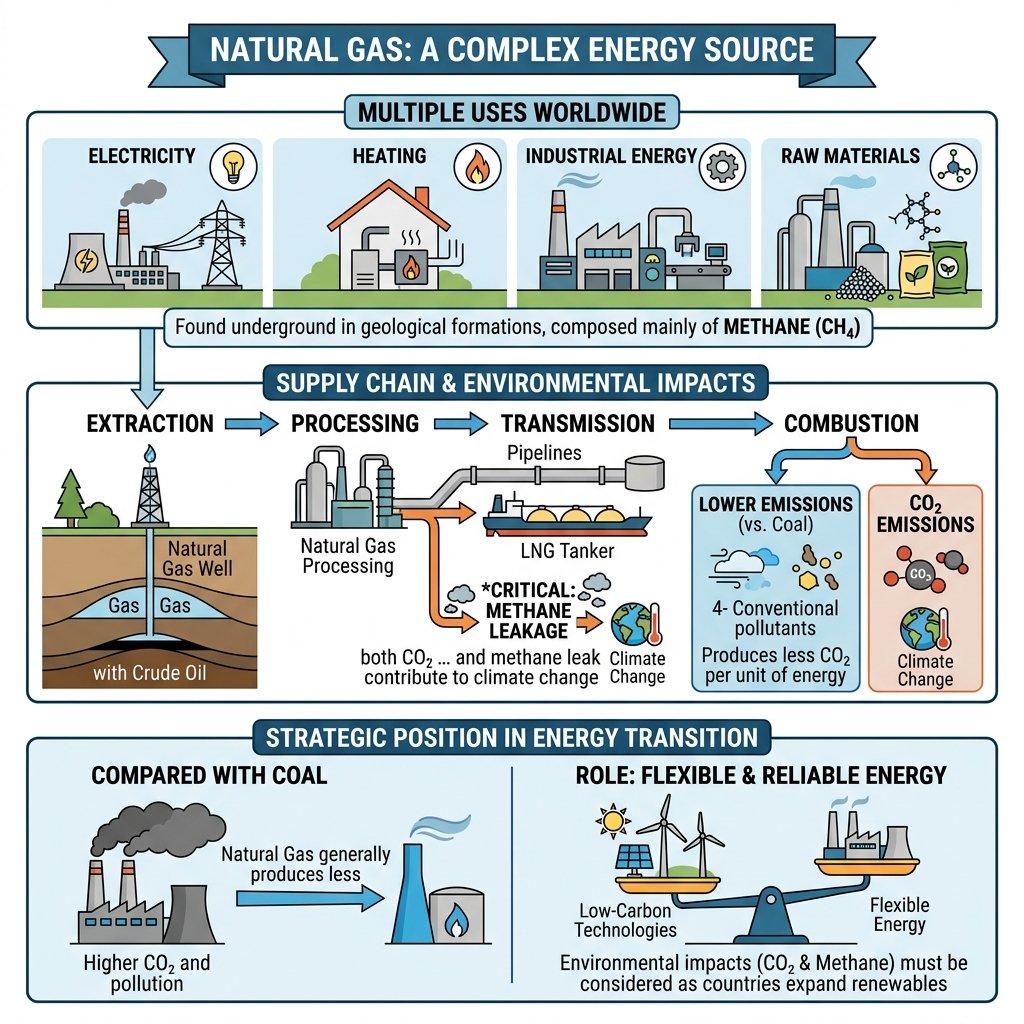
The Role of Natural Gas in Energy is important to understand because natural gas supplies electricity, heating, industrial energy, and raw materials in many parts of the world. Natural gas is a fossil fuel composed mainly of methane and is found in underground geological formations, sometimes together with crude oil.
Understanding The Role of Natural Gas in Energy is essential as it plays a vital part in global energy strategies.
Compared with coal, burning natural gas generally produces less carbon dioxide per unit of energy and lower emissions of several conventional air pollutants. However, natural gas is still a fossil fuel, and both carbon dioxide from combustion and methane leakage across the supply chain contribute to climate change.
For this reason, natural gas occupies a complex position in the modern energy system: it can provide flexible and reliable energy, but its environmental impacts must also be considered as countries expand low-carbon technologie
What Is Natural Gas?
Natural gas is a naturally occurring mixture of hydrocarbon gases. Methane is its main component, although smaller quantities of ethane, propane, butane, carbon dioxide, nitrogen, and other gases may also be present.
Natural gas forms over millions of years as organic material buried beneath layers of sediment is exposed to heat and pressure.
After extraction, raw natural gas is processed to remove water, impurities, and some valuable natural gas liquids. The processed gas can then be transported through pipelines or converted into liquefied natural gas, commonly known as LNG, for transportation by specialized ships.
The Role of Natural Gas in Energy production is significant for countries aiming to balance energy needs.
Examining The Role of Natural Gas in Energy reveals its implications on future energy policies.
The Role of Natural Gas in Energy Production
One of the most significant applications of natural gas is electricity generation. Gas-fired power plants burn natural gas to produce energy that drives turbines and electrical generators.
Many experts discuss The Role of Natural Gas in Energy during industry conferences and meetings.
Some facilities use simple-cycle gas turbines, while combined-cycle power plants capture heat from the gas turbine exhaust to produce steam. That steam drives an additional turbine, allowing more electricity to be produced from the same quantity of fuel.
Gas-fired power plants can also adjust their output relatively quickly. This flexibility can help electricity systems respond to changes in demand and variations in electricity production from sources such as wind and solar.
Natural Gas for Heating
Natural gas is widely used for heating homes, commercial buildings, and water in countries with established gas distribution networks.
Understanding The Role of Natural Gas in Energy helps in evaluating energy security strategies.
Gas is transported through pipelines from production and storage facilities to cities and communities. Local distribution networks then deliver it to individual buildings.
Companies involved in The Role of Natural Gas in Energy are increasingly adopting innovative technologies.
Natural gas can also be used for cooking and other household applications. However, electrification technologies such as heat pumps and electric cooking systems are increasingly providing alternatives in efforts to reduce fossil-fuel consumption.
The debate surrounding The Role of Natural Gas in Energy continues to evolve amidst changing policies.
Natural Gas in Industry
Industrial activity represents another major use of natural gas.
Factories can use natural gas to generate high-temperature heat required for manufacturing products such as glass, cement, ceramics, steel, and other materials.
Natural gas is also an important chemical feedstock. It is used in the production of hydrogen, ammonia, and fertilizers as well as numerous industrial chemicals.
This means natural gas serves not only as an energy source but also as a raw material for important manufacturing processes.
Natural Gas and Electricity Reliability
Modern electricity systems must continuously balance electricity supply with consumer demand.
Research on The Role of Natural Gas in Energy highlights its potential in climate strategies.
Solar and wind power production changes according to sunlight and weather conditions. Gas-fired generators can often increase or decrease electricity production relatively quickly, making them useful for balancing some power systems.
However, energy storage, stronger transmission networks, demand management, hydropower, nuclear power, and other technologies can also provide grid flexibility.
The long-term role of natural gas will therefore depend partly on how rapidly these low-carbon alternatives develop.
Liquefied Natural Gas and Global Energy Trade
Natural gas is traditionally transported through pipelines, but pipelines cannot economically connect every producer and consumer.
Liquefied natural gas provides another transportation option. At an LNG facility, natural gas is cooled to approximately −162°C, transforming it into a liquid and dramatically reducing its volume.
LNG can then be transported by specialized ships to receiving terminals in other countries. At its destination, the liquid is converted back into gas through a process known as regasification.
LNG has helped create a more interconnected international natural gas market and allows countries without direct pipeline connections to import natural gas.
Regulatory frameworks will influence The Role of Natural Gas in Energy strategies significantly.
Benefits of Natural Gas
Natural gas offers several characteristics that have contributed to its widespread use.
Understanding The Role of Natural Gas in Energy is vital for energy transition discussions.
Gas-fired power stations can provide reliable electricity and flexible generation. Natural gas infrastructure can also deliver large quantities of energy to homes and industrial facilities.
When natural gas replaces coal in electricity generation, it can reduce carbon dioxide emissions per unit of electricity produced, particularly when efficient combined-cycle technology is used.
However, the overall climate advantage depends partly on controlling methane emissions during extraction, processing, transportation, and distribution.
With advancements, The Role of Natural Gas in Energy is becoming more crucial in transitional energy systems.
Environmental Impact of Natural Gas
Despite some advantages over more carbon-intensive fossil fuels, natural gas is not carbon-free.
Experts emphasize The Role of Natural Gas in Energy when discussing future energy resources.
Investment trends reflect The Role of Natural Gas in Energy amidst evolving market demands.
Burning natural gas releases carbon dioxide into the atmosphere. In addition, methane can escape during production, processing, storage, pipeline transportation, and distribution.
Methane is a powerful greenhouse gas, so reducing leaks is an important part of lowering the environmental impact of natural gas.
Natural gas development may also affect land, water resources, ecosystems, and local communities. Environmental regulations, monitoring, improved equipment, leak detection, and responsible operating practices can help reduce these impacts
Natural Gas and Renewable Energy
New policies will shape The Role of Natural Gas in Energy in the coming decades.
The relationship between natural gas and renewable energy is changing.
The importance of The Role of Natural Gas in Energy should not be underestimated in policy debates.
In some electricity systems, flexible gas-fired power plants currently help balance variable wind and solar generation. When renewable electricity production falls, gas plants can increase their output.
Future innovations will redefine The Role of Natural Gas in Energy for sustainable development.
However, battery storage, long-duration energy storage, expanded transmission networks, demand-response systems, and other technologies are reducing the need to rely exclusively on fossil-fuel generation for flexibility.
As renewable energy capacity increases, some countries may gradually reduce natural gas consumption, while others may continue using gas for particular industrial or electricity applications.
Natural Gas and Hydrogen Production
Natural gas is currently an important source for hydrogen production.
In conclusion, The Role of Natural Gas in Energy is pivotal for navigating future energy landscapes.
A common method called steam methane reforming uses natural gas and steam to produce hydrogen. This process also creates carbon dioxide.
When some of these carbon emissions are captured and stored, the resulting hydrogen is commonly described as blue hydrogen. In contrast, green hydrogen is generally produced through water electrolysis using renewable electricity.
The environmental performance of hydrogen made from natural gas depends strongly on methane emissions and the effectiveness of carbon capture.
Energy Security and Natural Gas
Natural gas can contribute to energy security when countries have reliable domestic production, diversified imports, adequate storage, and resilient infrastructure.
However, heavy dependence on a limited number of suppliers can create economic and geopolitical risks. Gas prices can also change significantly in response to supply disruptions, weather conditions, global demand, and international events.
Diversifying energy sources can therefore improve resilience. Renewable energy, nuclear power, storage, efficiency, and stronger electricity networks can all contribute to reducing dependence on individual fuels.
The Future Role of Natural Gas in Energy
The Role of Natural Gas in Energy is likely to change as the global energy system moves toward lower-carbon technologies.
Natural gas may continue to support electricity generation, industrial processes, heating, and chemical production in many regions. At the same time, climate policies and technological improvements are encouraging greater use of renewable electricity, energy storage, electric heating, green hydrogen, and energy-efficiency measures.
Carbon capture and storage may also influence the future use of natural gas in certain industries, although its cost and effectiveness depend on the specific application.
Reducing methane emissions will remain particularly important wherever natural gas continues to be produced and consumed.
Conclusion
The Role of Natural Gas in Energy is essential for ensuring energy supply and supporting global energy sustainability.
Natural gas, as part of The Role of Natural Gas in Energy, faces scrutiny yet remains a key component in energy portfolios worldwide.
As renewable energy, battery storage, electricity networks, energy efficiency, hydrogen technologies, and other low-carbon solutions continue to develop, the role of natural gas is expected to evolve. Managing this transition carefully will be important for balancing energy reliability, affordability, environmental protection, and long-term climate goals.Home https://www.unesco.org/en/query-list/n/natural-resources
Pingback: 5 Key Insights on Natural Gas Distribution Networks Explained