
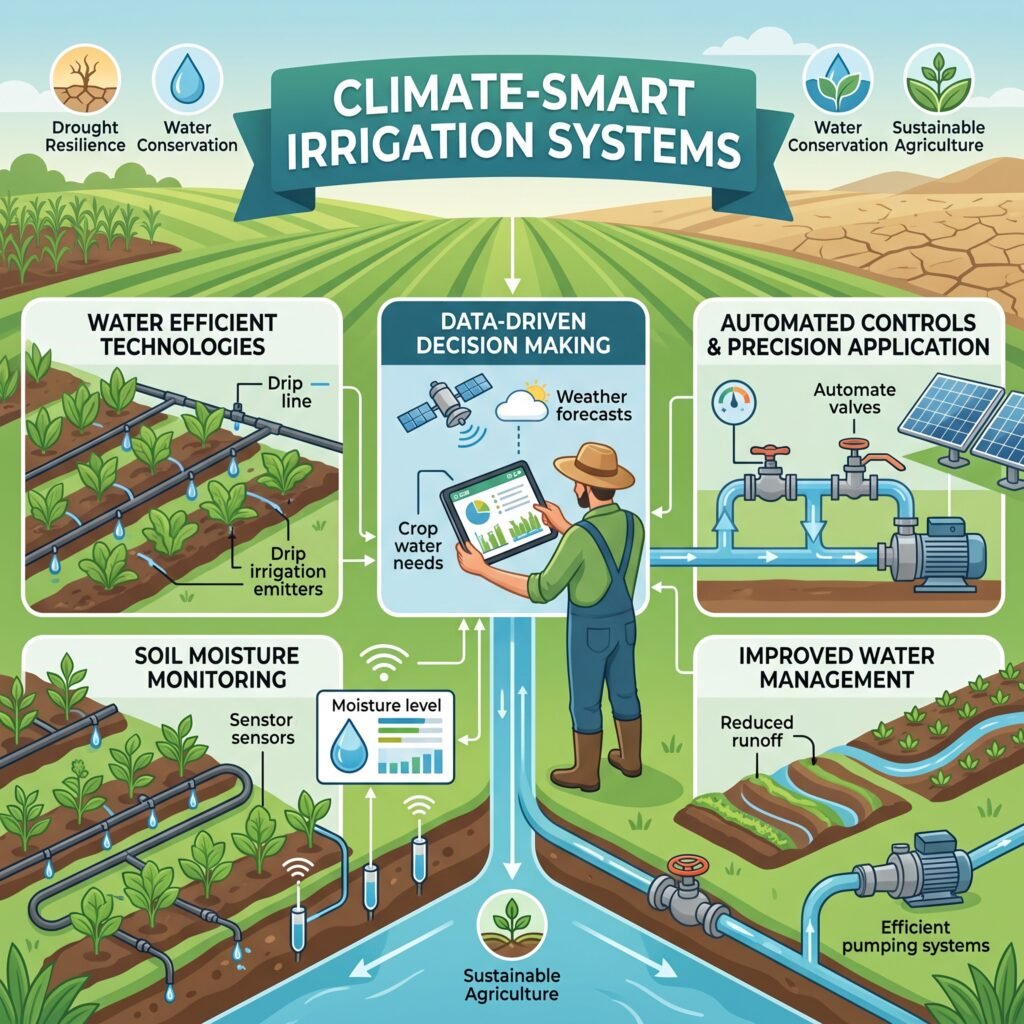
Climate-Smart Irrigation Systems are becoming increasingly important as agriculture faces growing pressure from water scarcity, drought, changing rainfall patterns, higher temperatures, and increasing food demand. These irrigation approaches combine efficient water management with modern technologies and agricultural practices to deliver the right amount of water to crops at the right time.
Traditional irrigation can support highly productive agriculture, but poorly managed systems may lose substantial amounts of water through evaporation, runoff, leakage, or excessive application. Climate-smart approaches seek to improve irrigation efficiency while maintaining crop productivity and protecting available water resources.
Rather than representing one specific technology, climate-smart irrigation can combine drip irrigation, soil-moisture monitoring, weather information, automated controls, efficient pumping, crop management, and data-based decision-making.
How Climate-Smart Irrigation Systems Work
Climate-Smart Irrigation Systems use information about soil conditions, crop water requirements, weather, and available water supplies to improve irrigation decisions.
A basic irrigation schedule may provide water according to predetermined times. A more advanced system can use soil-moisture sensors and weather information to determine whether crops actually require additional water.
When soil moisture falls below an appropriate level, irrigation can be activated. When sufficient moisture is available or rainfall is expected, watering may be reduced or delayed.
This approach can prevent unnecessary irrigation and help farmers respond more effectively to changing environmental conditions.
Why Climate-Smart Irrigation Is Important
Agriculture is a major user of freshwater worldwide. Improving agricultural water efficiency is therefore an important part of sustainable water-resource management.
Climate variability creates additional challenges. A farming region that historically received predictable seasonal rainfall may experience longer dry periods, irregular rainfall, or more intense heat. These changes can make traditional irrigation schedules less reliable.
Climate-smart management helps farmers make irrigation decisions according to actual conditions instead of relying entirely on fixed schedules.
Efficient irrigation can also help reduce pressure on rivers, reservoirs, and groundwater aquifers, particularly where agricultural withdrawals are high.
Drip Irrigation
Drip irrigation is one of the technologies that can contribute to climate-smart agriculture. It supplies water through pipes or tubes and applies it near plant root zones using emitters.
Because water is delivered relatively close to the roots, well-designed and properly managed drip systems can reduce some evaporation and runoff losses compared with less controlled application methods.
Drip irrigation is particularly useful for orchards, vineyards, vegetables, and many high-value crops. However, successful operation requires proper system design, filtration, pressure management, and maintenance.
Blocked emitters, damaged pipes, or incorrect irrigation scheduling can reduce system performance.
Soil-Moisture Sensors
Soil-moisture monitoring is another important component of Climate-Smart Irrigation Systems.
Sensors can provide information about how much water is present in the soil and whether plants may require irrigation. Instead of estimating conditions based only on time or visual observations, farmers can use measurements to support irrigation decisions.
Monitoring can help prevent both overwatering and underwatering. Excessive irrigation wastes water and can contribute to nutrient losses or waterlogging, while insufficient irrigation may reduce plant growth and crop yields.
Sensor information becomes especially valuable when combined with crop requirements and local weather data.
Weather-Based Irrigation Management
Weather strongly influences crop water demand. Temperature, rainfall, solar radiation, humidity, and wind can all affect how quickly water moves from soil and plants into the atmosphere.
Modern irrigation management can incorporate weather forecasts and observations into irrigation scheduling.
For example, if significant rainfall is expected, irrigation may be postponed. During prolonged hot and dry conditions, irrigation requirements may increase.
Using weather information makes the system more responsive to real environmental conditions and can improve water-use efficiency.
Smart Controllers and Automation
Automation can make Climate-Smart Irrigation Systems easier to manage.
Smart irrigation controllers can receive information from sensors, weather services, flow meters, and programmed crop requirements. The controller can then adjust irrigation timing or duration.
Some systems can be monitored remotely through computers or mobile devices. Farmers and irrigation managers can examine water use, system pressure, soil conditions, and equipment performance without manually inspecting every field.
Automation does not eliminate the need for human management. Instead, it provides additional information and control that can support better decisions.
Reducing Agricultural Water Waste
One of the primary objectives of climate-smart irrigation is reducing unnecessary water losses.
Water can be wasted through leaking pipes, excessive application, inappropriate irrigation timing, damaged equipment, poor field design, and inefficient distribution.
Regular maintenance is therefore as important as advanced technology.
Farmers can inspect pipes and emitters, monitor flow rates, repair leaks, maintain pumps, and evaluate irrigation uniformity. Even relatively simple improvements can contribute to better water management.
Combining maintenance with monitoring and appropriate irrigation scheduling can produce greater benefits than relying on technology alone.
Energy Efficiency and Irrigation
Water and energy are closely connected in irrigated agriculture. Pumps often require electricity or fuel to extract groundwater or move water through irrigation networks.
Improving irrigation efficiency can sometimes reduce the amount of water that must be pumped and distributed, potentially lowering energy requirements.
Efficient pumps, appropriate pipe sizing, pressure management, and renewable electricity can further improve the environmental performance of irrigation infrastructure.
Solar-powered pumping is increasingly used in some agricultural areas. However, low-cost pumping should still be combined with responsible groundwater management because easier access to pumping can increase withdrawals if water use is not properly controlled.
Protecting Groundwater Resources
Groundwater is a critical irrigation source in many agricultural regions. When withdrawals consistently exceed natural or managed recharge, groundwater levels can decline.
Climate-Smart Irrigation Systems can contribute to groundwater sustainability by improving information about crop water requirements and reducing unnecessary irrigation.
However, irrigation efficiency alone does not automatically guarantee lower total groundwater consumption. Farmers and water managers also need appropriate withdrawal management, monitoring, conservation policies, and long-term planning.
Protecting aquifers is particularly important because depleted groundwater systems may require long periods to recover.
Climate Resilience and Crop Production
Climate-smart irrigation can strengthen agricultural resilience by helping farmers manage periods of limited or unpredictable water availability.
Accurate irrigation scheduling can prioritize water when crops need it most. Farmers may also combine efficient irrigation with drought-tolerant crops, soil conservation, mulching, crop rotation, rainwater harvesting, and improved drainage.
Healthy soils are particularly important because soils with good structure and organic matter can often retain water more effectively.
For this reason, climate-smart irrigation should be viewed as part of a broader agricultural water-management strategy rather than an isolated technology.
Challenges of Climate-Smart Irrigation Systems
Despite their benefits, climate-smart technologies can present challenges.
Initial equipment costs may be significant for small farms. Sensors, controllers, drip systems, pumps, communication equipment, and maintenance can require financial investment.
Farmers may also need training to interpret data and operate new systems correctly. Rural areas with limited electricity, internet connectivity, technical support, or replacement parts may experience additional difficulties.
Solutions should therefore be appropriate for local economic, environmental, and agricultural conditions. A simple, well-maintained irrigation system can sometimes be more practical than highly sophisticated technology that cannot be supported locally.
The Future of Climate-Smart Irrigation Systems
The future of Climate-Smart Irrigation Systems is likely to involve greater integration of sensors, satellite observations, remote sensing, weather forecasting, automation, and data analytics.
Advanced systems may identify differences in soil moisture or crop conditions across individual fields and apply different amounts of water where necessary.
Artificial intelligence and predictive analytics may also support irrigation scheduling by analyzing weather, soil, crop, and historical water-use information.
However, technology should complement responsible water governance. Sustainable irrigation requires understanding how much water is available and ensuring that withdrawals remain compatible with long-term water-resource protection.
Conclusion
Climate-Smart Irrigation Systems provide an important approach to managing agricultural water under increasingly variable climatic conditions. By combining efficient irrigation methods with soil-moisture monitoring, weather information, smart controllers, good maintenance, and sustainable water management, farmers can make more informed decisions about when and how much to irrigate.
These systems can help reduce unnecessary water use, improve irrigation performance, support crop production, and strengthen resilience to drought and changing rainfall patterns.
The most effective approach combines technology with responsible management of rivers, reservoirs, soils, and groundwater. As agriculture adapts to future climate and water challenges, climate-smart irrigation will remain an important component of sustainable food production and water-resource management.Terms and Conditions https://www.unesco.org/en/query-list/n/natural-resources
Pingback: 5 Ways Marine Plants and Water Quality Improve Ecosystems