
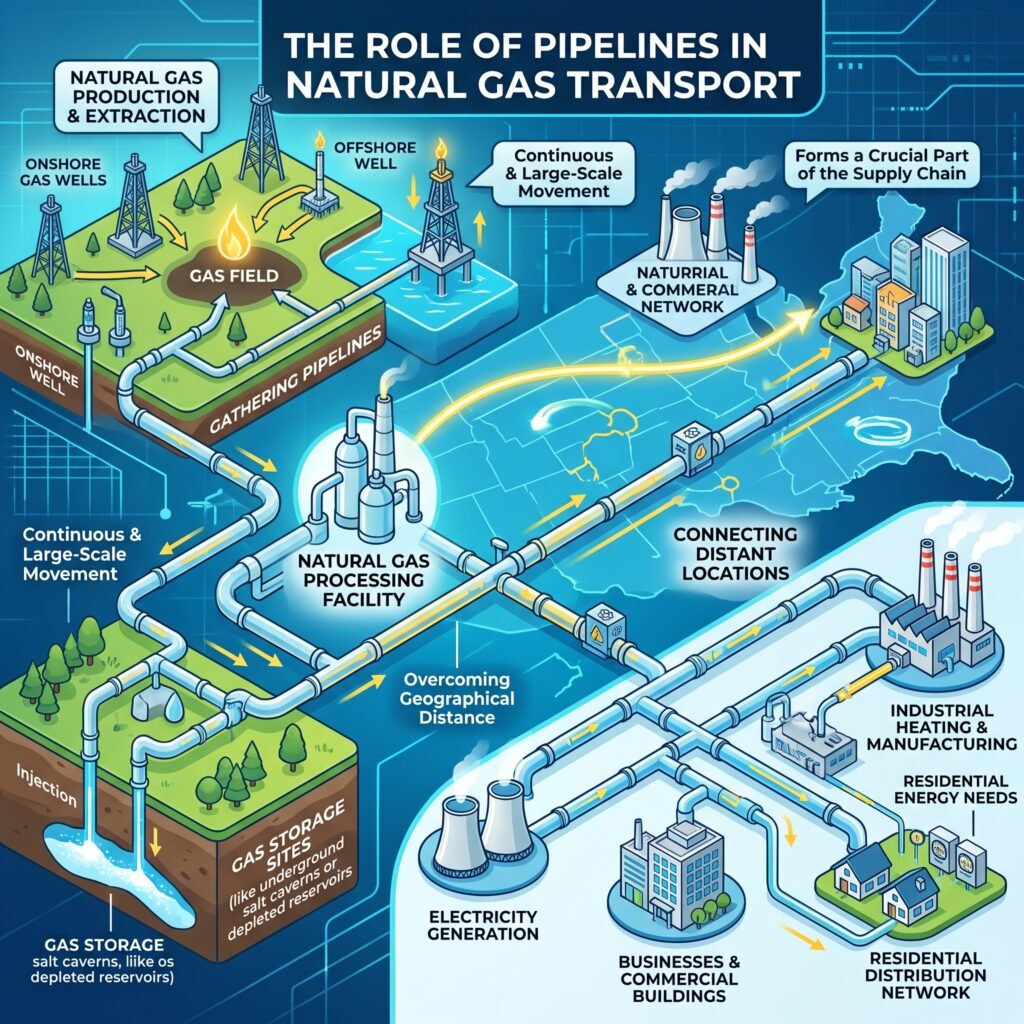
The role of pipelines in natural gas transport is essential to the modern energy system because pipelines provide a continuous and large-scale method for moving natural gas from production areas to processing facilities, storage sites, power plants, industries, businesses, and residential distribution networks. Unlike transportation systems that rely on trucks or ships for every stage of delivery, pipelines can move large quantities of gas continuously through interconnected networks.
Natural gas is widely used for electricity generation, industrial heating, manufacturing, and residential energy needs. However, gas fields are often located far from major population and industrial centers. Pipeline infrastructure connects these locations and forms an important part of the natural gas supply chain.
Understanding the Role of Pipelines in Natural Gas Transport
The role of pipelines in natural gas transport begins after natural gas is extracted from underground reservoirs. The produced gas may contain water vapor, carbon dioxide, hydrogen sulfide, natural gas liquids, and other substances that need to be removed or controlled.
Gathering pipelines first transport raw natural gas from individual production wells to processing facilities. After processing, the gas enters larger transmission pipelines designed to transport significant volumes over long distances.
Near major consumption areas, the gas is transferred into distribution systems. These networks reduce the pressure and deliver natural gas to local users. Therefore, pipelines create a physical connection between production, processing, transmission, storage, and consumption.
Main Types of Natural Gas Pipelines
Natural gas pipeline infrastructure can generally be divided into three major categories: gathering, transmission, and distribution pipelines.
Gathering pipelines connect natural gas wells with processing plants or larger pipeline networks. Their operating conditions vary according to the production field and infrastructure design.
Transmission pipelines are larger systems that transport processed natural gas across long distances. They may connect producing regions with cities, industrial centers, power plants, storage facilities, and international markets.
Distribution pipelines form the final stage of pipeline transportation. They carry natural gas from transmission networks to communities and individual consumers through progressively smaller pipelines.
Together, these systems allow natural gas to travel from the production field to its final destination.
Main Types of Natural Gas Pipelines
Natural gas pipeline infrastructure can generally be divided into three major categories: gathering, transmission, and distribution pipelines.
Gathering pipelines connect natural gas wells with processing plants or larger pipeline networks. Their operating conditions vary according to the production field and infrastructure design.
Transmission pipelines are larger systems that transport processed natural gas across long distances. They may connect producing regions with cities, industrial centers, power plants, storage facilities, and international markets.
Distribution pipelines form the final stage of pipeline transportation. They carry natural gas from transmission networks to communities and individual consumers through progressively smaller pipelines.
Together, these systems allow natural gas to travel from the production field to its final destination.
Pipelines and Energy Supply
One major reason the role of pipelines in natural gas transport is important is their contribution to reliable energy supply. Natural gas demand can change significantly depending on weather, electricity consumption, industrial activity, and seasonal heating requirements.
Pipeline networks allow suppliers to direct gas toward areas experiencing increased demand. Underground natural gas storage can also complement pipeline infrastructure. Gas may be stored when demand is relatively low and withdrawn during periods of higher consumption.
For natural-gas-fired power plants, dependable pipeline access can be particularly important because generators may require substantial quantities of fuel when electricity demand increases.
Efficiency of Pipeline Transportation
Pipelines are particularly suited to transporting large quantities of natural gas continuously. Once major infrastructure has been constructed, a pipeline network can operate for many years with inspection, maintenance, upgrades, and regulatory oversight.
Pipeline systems also reduce the need for continuous road transportation of gaseous fuel. However, pipeline efficiency should not be considered only in economic terms. Energy use at compressor stations, methane leakage, maintenance requirements, and infrastructure integrity also influence overall system performance.
Operators increasingly use digital monitoring, advanced sensors, predictive maintenance, and automated control systems to improve operational efficiency and identify abnormal conditions.
Pipeline Safety and Monitoring
Safety is a critical component of the role of pipelines in natural gas transport. Pipeline operators use multiple approaches to protect workers, communities, infrastructure, and the environment.
Pipeline integrity programs can include regular inspections, pressure monitoring, corrosion protection, maintenance, leak detection, and emergency response planning. Internal inspection devices, sometimes called smart pigs, can travel through suitable pipelines and collect information about corrosion, deformation, cracking, or other potential integrity concerns.
Operators may also conduct aerial, ground, and digital monitoring of pipeline corridors. When unusual changes in pressure or flow are detected, control systems and operators can investigate and take appropriate action.
Environmental Challenges of Natural Gas Pipelines
Although pipelines provide an effective transportation method, they also have environmental impacts. Construction can disturb land, vegetation, wildlife habitats, waterways, and surrounding ecosystems if projects are not properly planned and managed.
Methane emissions are another significant concern. Natural gas consists primarily of methane, a powerful greenhouse gas. Leakage can occur from different components of the natural gas supply chain, including pipelines, compressor stations, valves, and other equipment.
Reducing methane emissions therefore requires leak detection, timely repairs, improved equipment, careful maintenance, and accurate emissions measurement. Better monitoring technologies can help operators identify leaks more quickly.
Technology Transforming Natural Gas Pipelines
Digital technology is changing how pipeline networks are managed. Sensors can continuously collect operational information, while advanced software can analyze data to identify unusual patterns.
Supervisory Control and Data Acquisition (SCADA) systems allow operators to monitor and control important pipeline operations remotely. Geographic Information Systems (GIS) can help organizations map pipeline routes, infrastructure, environmental conditions, and maintenance information.
Artificial intelligence and predictive analytics may also support maintenance decisions by analyzing large amounts of operational data. These technologies can help operators identify equipment requiring attention before a serious failure occur
The Future Role of Pipelines in Natural Gas Transport
The future of natural gas pipelines will be influenced by energy demand, climate policies, methane regulations, technological development, infrastructure investment, and the expansion of renewable energy.
Existing gas infrastructure may continue serving electricity generation, industrial processes, heating, and other applications in many regions. At the same time, operators and governments face increasing pressure to reduce methane emissions and improve environmental performance.
Some pipeline systems are also being studied for potential future transportation of lower-carbon gases, including biomethane and hydrogen blends. However, using existing pipelines for different gases requires detailed technical assessment because materials, pressure requirements, equipment compatibility, and safety conditions can differ.
Conclusion
The role of pipelines in natural gas transport extends across almost every stage of the natural gas supply chain. Gathering systems connect wells with processing facilities, transmission pipelines move large volumes across long distances, and distribution networks deliver gas closer to final consumers.
Pipelines support reliable energy supply, industrial activity, electricity generation, and residential energy services. Modern monitoring, compressor technology, inspection systems, and digital controls have improved their operation, but safety, methane emissions, infrastructure integrity, and environmental impacts remain important challenges.
As energy systems evolve, improving pipeline efficiency, detecting leaks rapidly, maintaining infrastructure, and reducing emissions will be increasingly important. Understanding the role of pipelines in natural gas transport therefore provides valuable insight into how natural gas moves from underground resources to the places where energy is ultimately used.blog https://www.unesco.org/en/query-list/n/natural-resources
Pingback: 5 Effective Methods: How Hydrogen Sulfide Is Removed from Natural Gas