
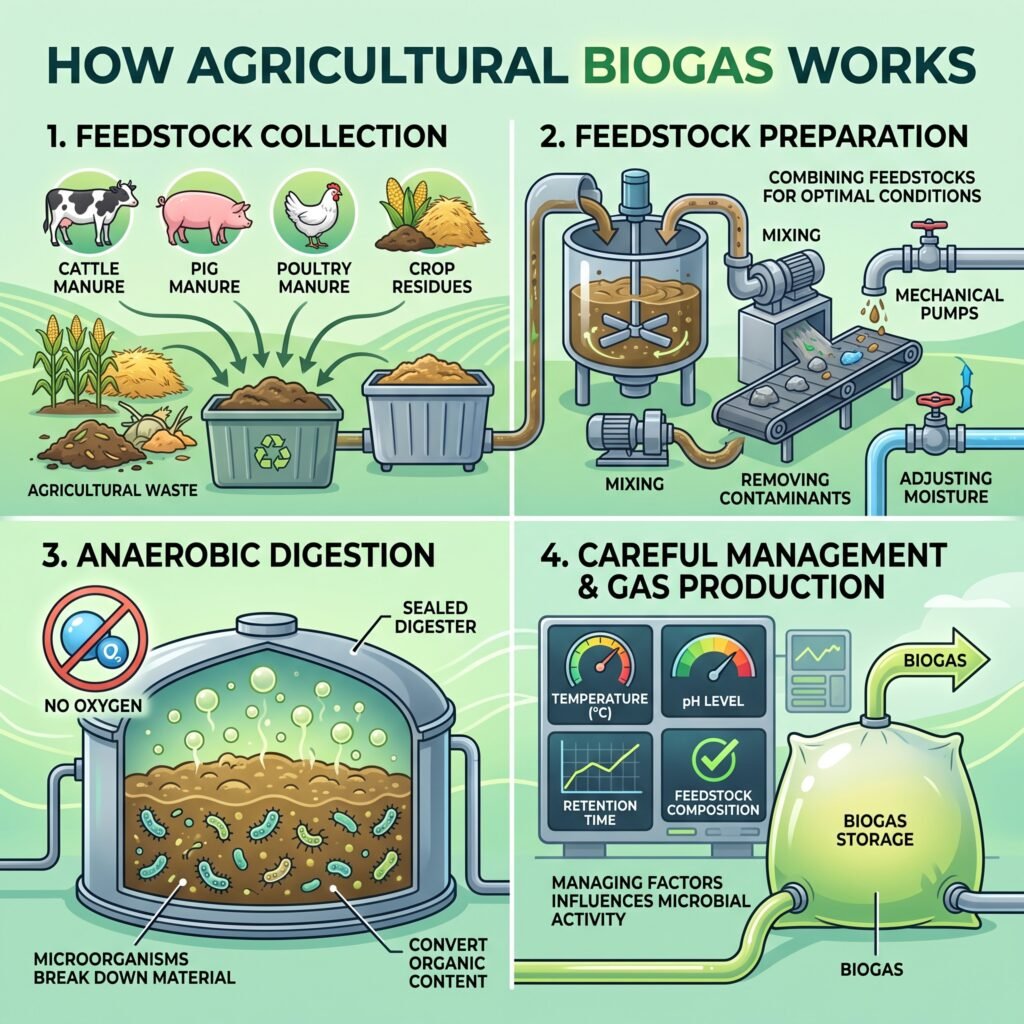
The Agricultural Biogas production process begins by collecting organic feedstocks. Animal manure from cattle, pigs, and poultry can be used, along with suitable crop residues and other biodegradable agricultural materials.
The feedstock is generally prepared before entering an anaerobic digester. Preparation may involve mixing, pumping, removing contaminants, adjusting moisture content, or combining several feedstocks to create appropriate conditions for digestion.
The prepared organic material is then transferred into a sealed digester where oxygen is largely excluded. Microorganisms naturally break down the material and gradually convert part of its organic content into biogas.
Temperature, pH, feedstock composition, retention time, and organic loading must be carefully managed because these factors influence microbial activity and gas production.
The Anaerobic Digestion Process
Anaerobic digestion is the biological foundation of Agricultural Biogas production. It is commonly described through four main stages.
The first stage is hydrolysis. Complex organic materials such as carbohydrates, proteins, and fats are broken into smaller compounds that microorganisms can process more easily.
The second stage, acidogenesis, converts these simpler compounds into organic acids, alcohols, hydrogen, carbon dioxide, and other substances.
During acetogenesis, microorganisms further convert intermediate compounds into substances such as acetate, hydrogen, and carbon dioxide.
Finally, methanogenesis occurs. Specialized microorganisms called methanogens convert suitable compounds into methane. This stage is particularly important because methane provides most of the useful energy contained in biogas.
What Does Agricultural Biogas Contain?
Raw Agricultural Biogas consists primarily of methane and carbon dioxide. Its exact composition varies depending on feedstock characteristics, digester technology, operating conditions, and biological activity.
The gas can also contain smaller quantities of water vapor, hydrogen sulfide, and other trace compounds. Some of these substances must be removed or reduced before the gas can be safely and efficiently used in certain equipment.
Gas-cleaning systems can remove moisture and unwanted compounds. More advanced upgrading technologies remove much of the carbon dioxide and other impurities, increasing the methane concentration.
The upgraded product is commonly called biomethane.
Agricultural Biogas from Animal Manure
Animal manure is an important feedstock for Agricultural Biogas systems. Large livestock operations can generate significant quantities of manure that require careful storage and management.
Instead of storing manure without energy recovery, farms can direct suitable manure into anaerobic digesters. Microorganisms convert part of its biodegradable organic matter into methane-rich biogas.
Capturing and using methane can provide environmental benefits compared with systems where methane would otherwise escape uncontrolled. However, these benefits depend heavily on minimizing methane leakage from digesters, storage tanks, pipelines, and other equipment.
Using Agricultural Biogas for Electricity and Heat
Once cleaned appropriately, Agricultural Biogas can be used to produce useful energy. One common approach is a combined heat and power system, or CHP.
A CHP unit burns biogas to generate electricity while recovering heat created during the process. Electricity can power farm buildings, pumps, lighting, ventilation systems, and other equipment.
Recovered heat can warm buildings, provide hot water, support farm processes, or maintain the temperature required by the anaerobic digester.
Some farms may produce more electricity than they consume. Whether surplus electricity can be exported to the grid depends on local infrastructure, regulations, contracts, and electricity-market arrangements.
Agricultural Biogas and Biomethane
Another important opportunity is upgrading Agricultural Biogas into biomethane. Raw biogas cannot always be used directly as a substitute for conventional natural gas because of its carbon dioxide and impurity content.
Biogas upgrading removes much of the carbon dioxide, hydrogen sulfide, moisture, and other unwanted components. The resulting biomethane has a much higher methane concentration.
Where it meets required technical standards, biomethane can potentially be injected into natural gas networks or used as a vehicle fuel.
This gives agricultural biogas producers additional options beyond generating electricity directly on the farm.
What Happens to the Digestate?
Biogas is not the only useful output of anaerobic digestion. After digestion, a nutrient-containing material called digestate remains.
Digestate can contain nitrogen, phosphorus, potassium, organic matter, and other nutrients. When its quality is suitable and regulations permit, it can be applied to agricultural land as a fertilizer or soil amendment.
Recycling these nutrients can reduce waste and contribute to more circular agricultural systems. However, digestate must be managed responsibly to prevent nutrient losses, water pollution, excessive application, odors, or other environmental problems.
Environmental Benefits of Agricultural Biogas
Agricultural Biogas can contribute to sustainable farming in several ways. It can transform organic residues into renewable energy, improve manure management, recover nutrients, and reduce reliance on some fossil energy sources.
Methane management is particularly important. Methane is a powerful greenhouse gas, so capturing methane that might otherwise escape from manure management can improve the climate performance of a well-designed biogas project.
However, biogas is not automatically carbon-neutral. Methane leakage, feedstock transportation, land-use effects, equipment efficiency, and digestate management all influence the environmental footprint.
For this reason, high-quality construction, regular maintenance, leak detection, and responsible feedstock management are essential.
Agricultural Biogas and Sustainable Farming
Agricultural Biogas supports the idea of a circular agricultural economy. In a conventional system, manure and crop residues may be considered primarily waste-management challenges. A biogas system can instead recover part of their energy value.
Farm waste enters the digester, biogas provides useful energy, and nutrients contained in suitable digestate can potentially return to agricultural soils.
This cycle can improve resource efficiency while helping farms integrate renewable energy production with agricultural operations.
The Future of Agricultural Biogas
The future of Agricultural Biogas will be influenced by improvements in digester technology, biomethane upgrading, methane-leak detection, automation, and farm waste management.
Sensors and automated control systems can monitor temperature, pH, gas production, methane concentration, and other operating conditions. Better monitoring can help maintain stable digestion and identify technical problems earlier.
Biomethane may also become increasingly important as countries seek renewable alternatives for sectors that currently depend on fossil natural gas.
Conclusion
Agricultural Biogas works by using anaerobic digestion to convert manure, crop residues, and other suitable biodegradable agricultural materials into renewable gas. Microorganisms perform the conversion inside sealed digesters, producing methane-rich biogas and digestate.
The biogas can generate electricity and heat or be upgraded into biomethane, while responsibly managed digestate can potentially recycle valuable nutrients back into agriculture.
When methane leakage is controlled and feedstocks and digestate are responsibly managed, Agricultural Biogas can combine renewable energy production, waste management, and nutrient recycling. It therefore represents an important technology for farms seeking greater resource efficiency and more sustainable agricultural production. Contact https://www.unesco.org/en/query-list/n/natural-resources