
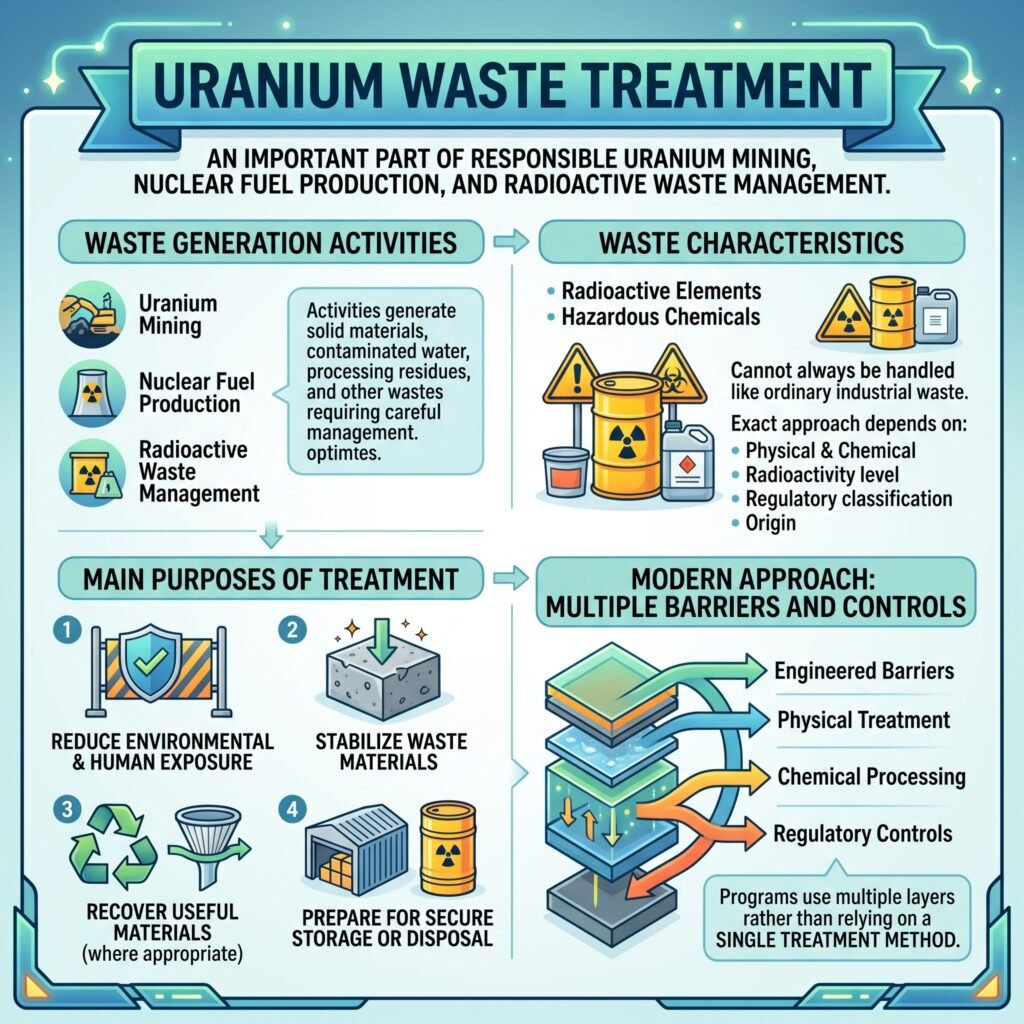
Uranium Waste Treatment is an important part of responsible uranium mining, nuclear fuel production, and radioactive waste management. Uranium-related activities can generate solid materials, contaminated water, processing residues, and other wastes that require careful management. Because some of these materials contain radioactive elements or hazardous chemicals, they cannot always be handled in the same way as ordinary industrial waste.
The main purpose of uranium waste treatment is to reduce environmental and human exposure, stabilize waste materials, recover useful materials where appropriate, and prepare remaining waste for secure storage or disposal. The exact approach depends on the waste’s physical and chemical characteristics, radioactivity level, regulatory classification, and origin.
Modern waste-management programs therefore use multiple barriers and controls rather than relying on a single treatment method.
What Is Uranium Waste Treatment?
Uranium Waste Treatment refers to the controlled processes used to manage waste containing uranium or materials associated with uranium operations. Treatment does not necessarily eliminate radioactivity. Instead, it can reduce waste volume, separate certain contaminants, convert waste into a more stable form, or make it more suitable for controlled storage and disposal.
Waste can arise during uranium mining and milling, nuclear fuel-cycle activities, research, industrial operations, and the decommissioning of facilities. Different waste streams require different management strategies.
A major principle is waste characterization. Before selecting an appropriate treatment and disposal pathway, specialists determine what the waste contains and evaluate its relevant radiological, chemical, and physical properties
Sources of Uranium Waste
Uranium-related waste can originate at several stages of resource development and nuclear fuel production. Mining operations, for example, can generate large quantities of waste rock. Milling produces tailings after uranium-bearing material has been processed.
Other operations may produce contaminated equipment, filters, protective materials, liquids, sludges, and residues. When facilities reach the end of their operating lives, decommissioning can generate additional materials requiring assessment.
These wastes are not all equally hazardous. Their characteristics can differ significantly, which is why classification and monitoring are essential parts of professional uranium waste management.
Uranium Mining and Mill Tailings
One of the largest waste streams associated with uranium production is mill tailings. These are the materials remaining after uranium has been extracted from mined ore.
Tailings can retain naturally occurring radioactive elements and other substances originally present in the ore. Consequently, long-term management focuses heavily on physical stability, water protection, erosion control, and limiting the movement of contaminants into the surrounding environment.
Modern tailings-management facilities are engineered and monitored to reduce these risks. Their design depends on local geology, climate, hydrology, regulations, and the characteristics of the material being managed.
How Uranium Waste Treatment Works
There is no single treatment technology suitable for every type of uranium waste. Treatment systems are selected according to the characteristics of each waste stream.
Physical processes may be used to separate solids from liquids or reduce the volume of certain wastes. Chemical treatment can help control or remove contaminants from some liquid waste streams. Stabilization techniques can convert waste into forms that are less likely to disperse or release contaminants.
For some wastes, immobilization is particularly important. The material may be incorporated into a stable matrix so that contaminants are less mobile. After treatment, suitable containers, engineered barriers, monitoring systems, and disposal facilities provide additional layers of protection.
Treatment of Uranium-Contaminated Water
Water management is a significant environmental consideration at uranium mining and processing sites. Water can come into contact with mineralized rock, tailings, processing areas, or other contaminated materials.
Treatment facilities can remove suspended solids and reduce concentrations of uranium and other contaminants before water is reused, managed further, or released where regulations permit.
Water quality must be monitored to determine whether treatment systems are performing as intended. Environmental monitoring may also include groundwater and surface-water observation around relevant facilities.
This combination of treatment and monitoring helps prevent uncontrolled contamination from spreading beyond managed areas.
Safe Storage and Containment
Treatment and storage perform different functions. Treatment changes or conditions the waste, while storage keeps it under controlled conditions for a defined period.
Storage systems are designed according to the characteristics and regulatory classification of the material. Important considerations can include containment integrity, radiation protection, environmental conditions, security, inspection, and record keeping.
For wastes requiring long-term isolation, engineered disposal systems may use several protective barriers. The objective is to prevent or greatly limit the movement of radioactive and hazardous substances into the environment over the required period.
Environmental Benefits of Uranium Waste Treatment
Effective Uranium Waste Treatment can significantly reduce environmental risks associated with uranium operations. Proper management can help protect groundwater, rivers, soils, ecosystems, workers, and nearby communities.
Another important benefit is reducing the mobility of contaminants. When waste is stabilized and securely contained, radioactive and chemical substances are less likely to migrate through water, wind, or erosion.
Waste treatment also supports responsible mine closure and facility decommissioning. Long-term planning is important because environmental management can continue after uranium production has stopped.
Worker and Public Safety
Radiation protection is an essential component of uranium waste management. Workers involved in handling radioactive materials follow controlled procedures intended to minimize unnecessary exposure.
Facilities may use radiation monitoring, controlled work areas, protective equipment, contamination controls, ventilation where appropriate, worker training, and occupational exposure programs.
Public protection is addressed through facility design, environmental monitoring, regulatory limits, and controlled waste-management practices. The overall goal is to keep exposure within applicable safety standards while preventing uncontrolled releases.
Regulation and Monitoring
Uranium waste is subject to national regulations, and nuclear and radiation-safety frameworks often incorporate internationally recognized principles. Regulatory requirements can cover waste classification, transportation, treatment, storage, disposal, environmental monitoring, facility licensing, and decommissioning.
Operators are generally responsible for demonstrating that their waste-management systems meet applicable requirements. Regulators may conduct inspections, review monitoring information, and require corrective measures when standards are not met.
Long-term records are particularly important because some radioactive waste must remain controlled and monitored over extended periods.
Technology and the Future of Uranium Waste Treatment
Technological development continues to improve Uranium Waste Treatment and radioactive waste management. Better sensors, automated monitoring systems, improved water-treatment technologies, and advanced waste characterization can help operators understand and control waste more effectively.
Research also focuses on improved waste forms and containment systems that can provide greater stability over long periods. Digital monitoring can help facilities identify changes in environmental conditions and equipment performance earlier.
Future progress will likely combine improved engineering with stronger environmental monitoring, waste minimization, responsible resource management, and rigorous safety standards.
Conclusion
Uranium Waste Treatment is a critical part of responsible uranium and nuclear-resource management. Uranium-related activities can produce waste ranging from mining residues and tailings to contaminated water and materials from facility operations.
Treatment methods are designed to reduce waste volume where appropriate, control contaminants, stabilize radioactive materials, and prepare wastes for secure storage or disposal. However, treatment alone is not enough. Effective management also requires engineered containment, environmental monitoring, worker protection, regulatory oversight, and long-term planning.
As technology advances, uranium waste management can become more efficient and better monitored. Maintaining strong safety and environmental standards remains essential for protecting people and ecosystems while uranium continues to contribute to nuclear energy production.About https://www.unesco.org/en/query-list/n/natural-resources
Pingback: Nuclear Power Plant Fuel: 5 Undeniable Benefits