
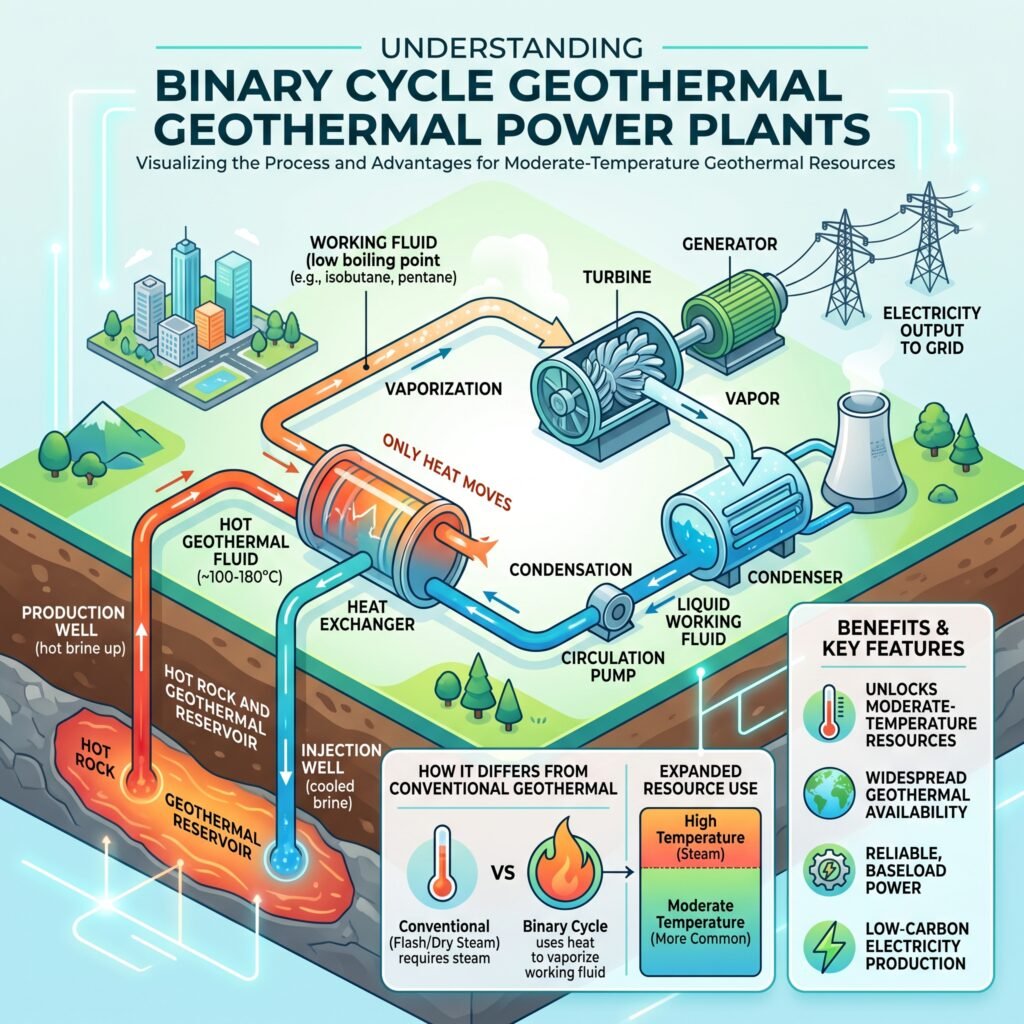
Binary Cycle Geothermal Power Plants are an important technology for producing renewable electricity from heat stored beneath the Earth’s surface. Unlike conventional geothermal plants that may use geothermal steam directly to drive a turbine, binary cycle systems transfer underground heat to a separate working fluid. This approach allows electricity to be generated from geothermal resources with temperatures that may be too low for traditional steam-based power generation.
The technology is especially valuable because moderate-temperature geothermal resources are more widely available than extremely hot steam reservoirs. By expanding the range of geothermal resources that can be used economically, binary cycle technology can contribute to reliable, low-carbon electricity production.
How Binary Cycle Geothermal Power Plants Work
Binary Cycle Geothermal Power Plants operate using two separate fluid circuits. The first contains geothermal water brought to the surface through production wells. The second contains a working fluid selected because it has a lower boiling point than water.
Hot geothermal water passes through a heat exchanger without normally mixing with the secondary working fluid. Heat moves from the geothermal water across the heat exchanger and causes the secondary fluid to vaporize. This vapor expands through a turbine connected to an electrical generator.
After leaving the turbine, the vapor enters a condenser, where it cools and returns to liquid form. The working fluid is then pumped back toward the heat exchanger so the cycle can begin again. Meanwhile, the geothermal water that has transferred much of its useful heat is generally returned underground through an injection well.
This closed-loop arrangement is one of the defining characteristics of binary cycle technology.
Main Components of a Binary Cycle Plant
Several interconnected components are required for efficient operation. Production wells bring hot geothermal fluids from underground reservoirs to the surface. A heat exchanger transfers thermal energy from the geothermal fluid to the secondary working fluid.
The vaporized working fluid powers a turbine, which drives a generator to produce electricity. A condenser then removes heat from the vapor so it becomes liquid again. Pumps circulate fluids through the system, while injection wells return geothermal water to the underground formation.
Cooling systems are also important because they help the working fluid condense after passing through the turbine. Plant design can vary according to resource temperature, environmental conditions, water availability, and the characteristics of the geothermal field.
Why Binary Cycle Technology Is Important
A major advantage of Binary Cycle Geothermal Power Plants is their ability to use lower-temperature geothermal resources than many conventional geothermal power technologies. This can increase the number of locations where geothermal electricity development is technically possible.
Binary plants can also provide steady electricity. Unlike solar and wind resources, geothermal heat is not directly dependent on sunshine or wind conditions. When a geothermal reservoir is properly managed, electricity generation can continue around the clock, making geothermal power useful for supplying dependable renewable energy.
The technology can therefore complement variable renewable energy sources within a diversified electricity system.
Environmental Benefits of Binary Cycle Geothermal Power Plants
The environmental performance of Binary Cycle Geothermal Power Plants is another important advantage. Because geothermal fluids and secondary working fluids can remain within controlled systems, binary plants can limit direct atmospheric releases compared with some geothermal technologies that handle steam differently.
Returning geothermal fluids underground also supports reservoir management and reduces the need to discharge geothermal water at the surface. Reinjection can help maintain underground pressure and contribute to the long-term management of geothermal resources.
Geothermal electricity generally requires a relatively small land footprint compared with some energy developments. However, environmental effects still need careful assessment. Drilling, construction, water management, noise, induced seismicity, and local ecosystems can all require monitoring and appropriate management.
Organic Rankine Cycle Technology
Many Binary Cycle Geothermal Power Plants use an Organic Rankine Cycle, commonly known as ORC. Instead of using water as the turbine working fluid, an ORC system uses an organic fluid with thermodynamic properties suitable for lower-temperature heat.
The geothermal resource heats this secondary fluid through a heat exchanger. Once vaporized, the working fluid drives a turbine before being condensed and circulated through the system again.
Another binary-cycle configuration is the Kalina cycle, which can use an ammonia-water mixture as the working fluid. Different technologies may be selected depending on geothermal temperature, project scale, operating conditions, efficiency requirements, and economic considerations.
Efficiency and Resource Temperature
The efficiency of a geothermal plant depends significantly on the temperature of the available resource. Higher temperatures generally provide greater potential for converting thermal energy into electricity. Binary systems make it possible to extract useful energy from resources that would otherwise be difficult to use for electricity production.
Engineers must optimize heat exchangers, turbines, pumps, condensers, and cooling systems to obtain the greatest practical output from the available geothermal heat.
Efficiency should not be considered only in terms of electricity generated. Reservoir sustainability, pumping requirements, cooling needs, equipment reliability, maintenance costs, and long-term plant performance are also important factors.
Challenges of Binary Cycle Geothermal Power Plants
Despite their advantages, Binary Cycle Geothermal Power Plants face technical and economic challenges. Geothermal exploration can be expensive because developers must identify suitable underground resources before commercial production begins.
Drilling geothermal wells also requires specialized equipment and expertise. Geological uncertainty can increase project risk because underground temperature, permeability, fluid chemistry, and flow rates may not be fully understood until exploration and drilling are completed.
Mineral scaling and corrosion can affect geothermal equipment. Pumps and heat exchangers require regular inspection and maintenance. The secondary working fluid must also be carefully selected, contained, and managed according to its physical, environmental, and safety characteristics.
High initial development costs can therefore be a significant barrier even though geothermal facilities may provide electricity for many years.
Binary Cycle Geothermal Power Plants and Clean Energy
Binary Cycle Geothermal Power Plants can play an important role in the transition toward cleaner electricity systems. Their ability to generate continuous power provides an advantage in energy systems that increasingly incorporate variable renewable sources.
Technological improvements in geothermal exploration, advanced drilling, reservoir modeling, heat exchangers, turbine systems, and enhanced geothermal systems could further expand opportunities for binary cycle generation.
Existing oil and gas drilling knowledge may also contribute technical experience relevant to deeper geothermal development, although every geothermal project requires careful geological and economic assessment.
Future of Binary Cycle Geothermal Power Plants
The future of Binary Cycle Geothermal Power Plants will depend on improvements in drilling technology, resource exploration, plant efficiency, project economics, and reservoir management. Advanced geothermal technologies may eventually make usable underground heat accessible in regions without conventional hydrothermal resources.
Smaller modular binary systems could also create opportunities for distributed geothermal electricity where suitable heat resources exist. In some projects, geothermal heat may be used for both electricity generation and direct applications such as district heating, industrial processes, agriculture, or other thermal uses.
Conclusion
Binary Cycle Geothermal Power Plants expand the potential of geothermal energy by generating electricity from moderate-temperature underground heat. Their two-fluid design transfers geothermal heat to a separate working fluid, allowing the turbine and generator to operate without directly using geothermal steam.
With reliable power production, relatively low operational emissions, reinjection capability, and access to a broader range of geothermal resources, binary cycle systems represent an important part of modern geothermal technology. Continued advances in drilling, reservoir engineering, and power conversion could make these plants increasingly valuable in the global transition toward dependable and sustainable energy.Contact https://www.oecd.org/en/topics/sub-issues/natural-resources-and-development.html