
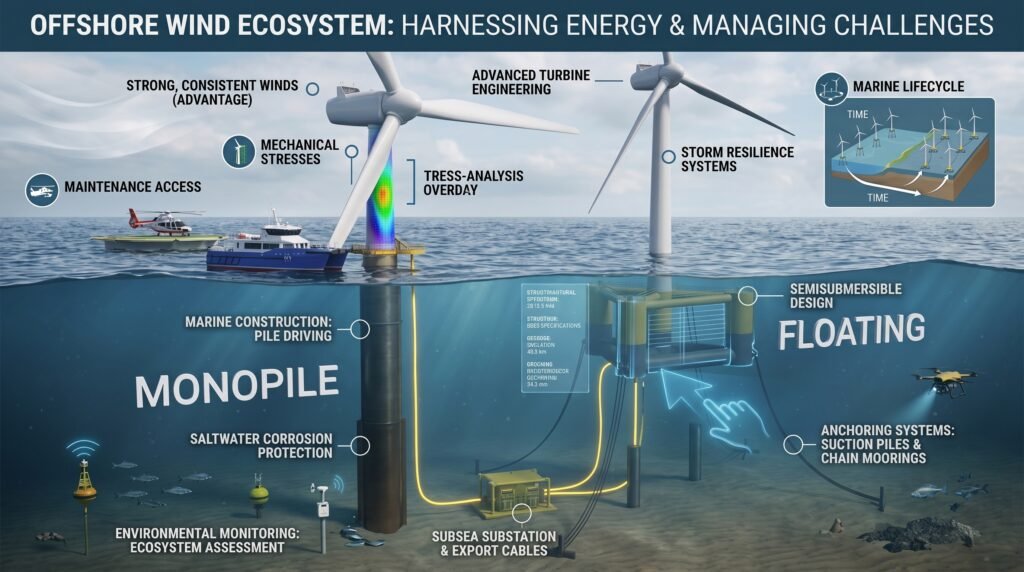
Offshore Wind Turbines at Sea are large renewable energy systems installed in oceans and other large bodies of water to capture strong and relatively consistent winds and convert their kinetic energy into electricity. Offshore wind has become an important part of the transition toward low-carbon electricity because coastal and marine areas can provide substantial wind resources while allowing developers to deploy large turbines and wind farms.
Unlike conventional onshore turbines, offshore wind turbines operate in demanding marine environments. Their structures must withstand waves, strong winds, saltwater corrosion, changing weather conditions, and long-term mechanical stresses. Modern offshore wind projects therefore combine advanced turbine engineering, marine construction, electrical transmission systems, environmental monitoring, and specialized maintenance technologies.
How Offshore Wind Turbines at Sea Work
The basic operating principle of Offshore Wind Turbines at Sea is similar to that of turbines installed on land. Wind flows across the turbine blades, creating aerodynamic forces that rotate the rotor. The rotor transfers mechanical energy through the drivetrain, and a generator converts this mechanical energy into electrical energy.
The electricity produced by multiple turbines is collected through subsea cables. These cables usually connect turbines to an offshore substation or other electrical infrastructure, where the electricity is prepared for transmission toward shore. Export cables then transport the power to an onshore grid connection.
Modern offshore turbines are increasingly designed with large rotor diameters and tall towers. Larger swept areas allow turbines to capture more wind energy, particularly where strong marine wind resources are available.
Why Build Wind Turbines Offshore?
One of the main advantages of offshore development is access to powerful wind resources. Open-water environments generally have fewer physical obstacles such as buildings, forests, and mountains. This can reduce turbulence and provide favorable conditions for electricity generation.
Offshore locations can also provide space for large wind farms without occupying extensive land areas. This is particularly important for densely populated coastal regions where land availability may be limited.
However, offshore development does not eliminate land requirements entirely. Projects still need ports, substations, grid connections, maintenance facilities, manufacturing infrastructure, and transmission systems.
Main Types of Offshore Wind Foundations
Offshore wind turbines can be divided into two broad categories according to how they are supported: fixed-bottom turbines and floating turbines.
Fixed-bottom offshore turbines use foundations connected directly to the seabed. Monopile foundations are widely used in suitable water depths and seabed conditions. Other designs include jackets and gravity-based structures. The appropriate foundation depends on factors such as water depth, soil characteristics, turbine size, waves, and engineering requirements.
Floating offshore wind technology provides another solution for deeper waters. A floating turbine is mounted on a buoyant platform that is held in position using mooring lines and anchors.
Floating technology could significantly expand the geographical potential of Offshore Wind Turbines at Sea because projects may eventually access strong winds in areas where fixed-bottom foundations are technically difficult or uneconomic.
Benefits of Offshore Wind Turbines at Sea
Offshore wind offers several important energy and environmental benefits. Electricity is generated without burning fossil fuels during normal turbine operation, meaning wind generation does not directly produce carbon dioxide from fuel combustion.
Another advantage is scale. Offshore environments can accommodate large turbines and extensive wind farms capable of supplying substantial amounts of renewable electricity. This electricity can contribute to residential, commercial, and industrial energy demand.
Offshore wind can also support energy diversification. Countries with suitable coastlines can develop domestic renewable electricity resources, potentially reducing dependence on imported fossil fuels and strengthening long-term energy security.
The industry may additionally create economic activity in turbine manufacturing, port development, marine engineering, construction, electrical infrastructure, operations, and maintenance.
Environmental Considerations
Although wind power is renewable, offshore projects still require careful environmental planning. Construction and operation can interact with marine ecosystems, fisheries, seabirds, marine mammals, seabed habitats, and coastal communities.
Underwater noise during some construction activities can affect marine animals. Turbine foundations and subsea cables may disturb seabed environments during installation. Birds can also encounter operating wind farms along migration or feeding routes.
For these reasons, environmental impact assessments, appropriate site selection, monitoring programs, construction controls, and mitigation measures are important parts of responsible offshore wind development.
Environmental impacts should be evaluated across the complete project lifecycle, including manufacturing, construction, operation, maintenance, and eventual decommissioning.
Challenges of Offshore Wind Energy
Building Offshore Wind Turbines at Sea is technically more complex than installing turbines on land. Marine construction requires specialized vessels, ports, foundations, subsea cables, and trained personnel.
Maintenance is another challenge. Technicians may need vessels or helicopters to reach turbines, while high waves and severe weather can restrict access. Saltwater and humid marine conditions also increase corrosion risks, requiring protective materials, coatings, monitoring, and preventive maintenance.
Transmission infrastructure represents another major consideration. Electricity generated offshore must be transported efficiently to consumers, which can require expensive subsea cables, offshore substations, and upgrades to onshore electricity networks.
Project developers must therefore balance wind resources, water depth, environmental conditions, grid availability, financing, supply chains, permitting requirements, and long-term operating costs.
Technology Improving Offshore Wind Turbines at Sea
Technological innovation continues to improve offshore wind energy. Modern turbines have become larger and more powerful, allowing individual machines to generate greater amounts of electricity under suitable conditions.
Digital monitoring systems can collect information about turbine performance, vibration, temperature, weather, and equipment condition. Predictive maintenance techniques can use this information to identify potential problems before major failures occur.
Drones, remotely operated vehicles, advanced sensors, robotics, and artificial intelligence also have potential roles in turbine and subsea infrastructure inspection. These technologies can improve monitoring while reducing some of the difficult work performed manually in marine environments.
Floating wind platforms are another important area of technological development. Continued improvements in platform design, mooring systems, installation methods, and maintenance could make deeper-water offshore wind increasingly practical.
Offshore Wind and the Clean Energy Transition
The expansion of Offshore Wind Turbines at Sea can complement other renewable technologies such as solar power, hydropower, geothermal energy, and onshore wind. A diversified electricity system can use different energy resources according to regional conditions and availability.
Offshore wind can also support the electrification of transportation, buildings, and industrial processes when combined with appropriate electricity networks and energy infrastructure. In some regions, renewable electricity from offshore wind may eventually contribute to hydrogen production through electrolysis.
Nevertheless, offshore wind should be developed as part of a broader energy strategy that includes grid modernization, storage, energy efficiency, environmental protection, and responsible resource management.
Future of Offshore Wind Turbines at Sea
The future of Offshore Wind Turbines at Sea will depend on technological progress, project economics, supply chains, transmission development, environmental management, and government energy policies. Larger turbines, improved foundations, digital maintenance, and floating platforms could expand the areas where offshore wind can be developed.
As countries work to reduce greenhouse gas emissions and increase renewable electricity production, offshore wind can provide an important source of large-scale clean energy. Careful planning will remain necessary to balance electricity production with marine conservation and other uses of ocean space.
Conclusion
Offshore Wind Turbines at Sea transform strong marine winds into renewable electricity using advanced turbines, foundations, subsea cables, and grid infrastructure. Their ability to access substantial offshore wind resources makes them an important technology for expanding renewable power generation.
Although offshore wind projects face challenges involving costs, marine construction, maintenance, transmission, and environmental impacts, continuing advances in engineering and floating wind technology are creating new opportunities. With responsible development and effective environmental management, Offshore Wind Turbines at Sea can play a significant role in building cleaner and more diversified energy systems.Home https://www.unesco.org/en/query-list/n/natural-resources
Pingback: 7 Benefits of Floating Wind Energy Systems for Renewable Power
Pingback: 5 Key Benefits of Utility-Scale Wind Farm Technology