
Introduction
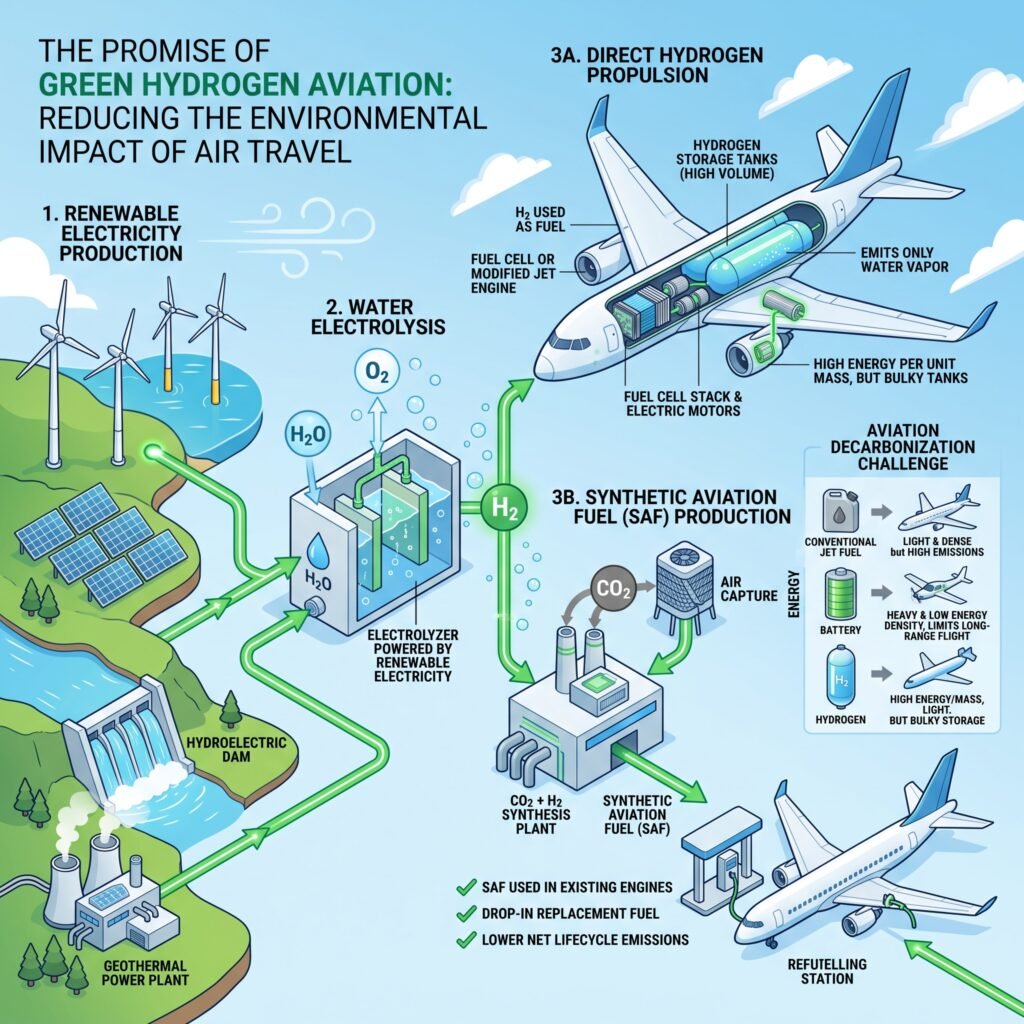
Green Hydrogen Aviation is an emerging approach to reducing the environmental impact of air travel. It involves producing hydrogen through water electrolysis powered by renewable electricity, such as solar, wind, hydroelectric, or geothermal power. The resulting hydrogen can power aircraft directly or help manufacture synthetic aviation fuels.
Aviation is particularly difficult to decarbonize because aircraft require fuels with high energy content while keeping weight as low as possible. Batteries can support smaller aircraft and short flights, but their weight currently limits their suitability for many long-distance operations. Green hydrogen offers high energy per unit of mass, although storing it aboard an aircraft requires larger and more complex tanks than conventional jet fuel.
Hydrogen aviation is therefore not simply a matter of replacing kerosene with another fuel. It requires new aircraft designs, propulsion systems, airport infrastructure, safety procedures, renewable-energy projects, and international certification standards
How Green Hydrogen Aviation Works
Green hydrogen is produced in an electrolyzer that uses electricity to separate water into hydrogen and oxygen. For the hydrogen to qualify as genuinely low-carbon, the electricity must come from renewable or other low-emission sources.
Once produced, hydrogen can be compressed as a gas or cooled to approximately −253°C to become a liquid. Liquid hydrogen is generally considered more suitable for larger aircraft because it occupies less space than compressed gaseous hydrogen. However, it still has a lower volumetric energy density than conventional jet fuel, requiring larger insulated tanks. Airbus identifies onboard cryogenic storage and hydrogen availability at airports among the major technical challenges facing commercial adoption. Airbus
Hydrogen can be used in aviation through three principal pathways:
- Fuel-cell electric propulsion
- Direct hydrogen combustion
- Hydrogen-derived synthetic aviation fuels
Each pathway presents different advantages, limitations, infrastructure requirements, and potential environmental effects.
Green Hydrogen Aviation Using Fuel Cells
Hydrogen fuel cells produce electricity through an electrochemical reaction between hydrogen and oxygen. This electricity powers electric motors that turn the aircraft’s propellers or fans. The primary operational by-products are water and heat.
Fuel-cell aircraft could provide quiet and efficient propulsion without releasing carbon dioxide from the fuel during flight. This technology may initially be most suitable for small passenger aircraft, regional services, training aircraft, and short-distance routes.
Fuel cells and electric motors are efficient, but a complete aviation propulsion system also requires hydrogen tanks, cooling equipment, power electronics, cables, and safety controls. These components add weight and must satisfy strict aviation reliability standards.
Progress has already moved beyond laboratory research. In September 2023, H2FLY completed a piloted flight of its HY4 demonstrator using a liquid-hydrogen fuel-cell propulsion system, according to the European Union Aviation Safety Agency
Hydrogen Combustion in Aircraft Engines
Hydrogen can also be burned in modified gas-turbine engines. This method may be attractive for larger and faster aircraft because gas turbines are already widely used and offer a high power output.
Burning hydrogen does not release carbon dioxide because hydrogen contains no carbon. It can also avoid sulfur emissions and soot associated with conventional kerosene. Nevertheless, hydrogen combustion should not automatically be described as completely emission-free. High-temperature combustion can form nitrogen oxides, while water-vapor emissions at altitude may influence cloud formation and climate.
Engineers must develop combustion chambers capable of controlling hydrogen’s flame speed, ignition characteristics, temperature, and potential nitrogen-oxide formation. Researchers must also study the total climate effects of water vapor and contrails under different routes and atmospheric conditions.
Synthetic Fuels Made with Green Hydrogen
Green hydrogen can be combined with captured carbon dioxide to produce synthetic hydrocarbons, sometimes called e-fuels, electrofuels, or synthetic aviation fuels. These fuels can be designed to resemble conventional jet fuel and may be usable in existing aircraft and airport systems after meeting technical standards.
This pathway offers an important advantage: airlines may not need entirely new aircraft fleets or cryogenic hydrogen tanks. Synthetic fuels may therefore support longer-distance flights where direct hydrogen propulsion remains difficult.
However, producing synthetic fuel requires several energy-intensive conversion stages. Carbon dioxide may also be released when the fuel is burned, although it can be partly balanced if the carbon used during production is captured from the atmosphere or an appropriate biogenic source. The full benefit depends on the electricity supply, carbon source, production efficiency, and lifecycle boundaries.
The International Energy Agency recognizes hydrogen-based fuels as one of the limited low-carbon options available to aviation and shipping. IEA
Environmental Benefits of Green Hydrogen Aviation
The most important potential benefit of Green Hydrogen Aviation is the reduction of fossil-fuel dependence. When hydrogen is produced with renewable electricity, it can lower lifecycle greenhouse-gas emissions compared with conventional jet fuel.
Additional potential benefits include:
- Eliminating in-flight carbon dioxide from direct hydrogen use
- Avoiding sulfur emissions from kerosene
- Reducing soot and some forms of air pollution
- Supporting renewable-energy development
- Creating new clean-energy industries and skilled employment
- Reducing dependence on imported petroleum
These benefits are not guaranteed merely because an aircraft uses hydrogen. Hydrogen produced from fossil fuels without effective emission controls may retain a substantial carbon footprint. Leakage, compression, liquefaction, transportation, water use, and airport operations must all be included in a professional lifecycle assessment.
Aircraft Design and Storage Challenges
Hydrogen contains more energy per kilogram than kerosene, but far less energy per unit of volume. Large, highly insulated tanks are therefore required to carry liquid hydrogen. Traditional aircraft store jet fuel inside their wings, but hydrogen tanks may need to be cylindrical or spherical and placed within the fuselage.
This could reduce passenger or cargo space and change an aircraft’s shape, weight distribution, balance, and aerodynamic performance. New designs may use wider fuselages, rear-mounted tanks, blended-wing bodies, or other configurations.
Cryogenic tanks must limit heat transfer and safely control hydrogen that gradually changes from liquid to gas. Pipes, pumps, valves, ventilation, leak-detection systems, and emergency procedures must work reliably throughout ground operations and flight. EASA describes safe and efficient onboard storage as one of the most complex engineering challenges facing hydrogen-powered aircraft. EASA
Airport Infrastructure and Safety
Airports currently have extensive systems for receiving, storing, and distributing kerosene. Green Hydrogen Aviation would require a different supply network, potentially including electrolyzers, pipelines, liquefaction facilities, insulated storage tanks, specialized refueling vehicles, and trained personnel.
Hydrogen is highly flammable and can escape through very small openings. Liquid hydrogen also presents cryogenic hazards. These properties do not mean that hydrogen cannot be used safely, but they require appropriate engineering, monitoring, ventilation, separation distances, staff training, and emergency planning.
Certification authorities must create standards covering aircraft systems and ground operations. EASA has stated that hydrogen aircraft will require changes in certification approaches because of the complexity and interaction of their systems. EASA certification workshop
Economic and Energy Challenges
Producing green hydrogen remains costly in many locations. Large-scale adoption would require abundant renewable electricity, electrolyzers, hydrogen liquefaction, storage equipment, distribution infrastructure, and long-term agreements between producers, airports, manufacturers, and airlines.
Hydrogen liquefaction consumes energy, while transporting and storing the fuel adds further cost. Using renewable electricity directly is more efficient where battery-electric flight is practical. Green hydrogen may be most valuable for routes and aircraft sizes that cannot be served effectively by batteries.
Water availability must also be considered. Electrolysis consumes purified water, and cooling or fuel production may create additional demand. Projects located in water-stressed areas should use responsible water planning, treated wastewater, or carefully managed desalination where appropriate.
The Future of Green Hydrogen Aviation
Green Hydrogen Aviation is progressing through research programs, ground tests, demonstrator flights, and certification studies. Initial commercial opportunities may appear in small aircraft, regional aviation, airport ground vehicles, and hydrogen-based synthetic fuels.
Larger passenger aircraft will require further advances in cryogenic tanks, propulsion efficiency, airport refueling, renewable-hydrogen production, safety regulation, and economic competitiveness. Hydrogen is unlikely to become the only solution for sustainable aviation. Battery-electric aircraft, operational efficiency, improved air-traffic management, sustainable aviation fuels, and reduced unnecessary fuel consumption will also have important roles.
Conclusion
Green Hydrogen Aviation offers a promising pathway for reducing aviation’s dependence on petroleum. Hydrogen can power fuel cells, fuel modified turbine engines, or provide the raw material for synthetic aviation fuels. Each approach could contribute to cleaner flight, but each also presents technical, economic, environmental, and regulatory challenges.
Its success will depend on renewable electricity, responsible water use, safe storage, suitable aircraft designs, airport infrastructure, and transparent lifecycle assessments. Green hydrogen should therefore be viewed as an important part of a broader aviation transition—not as a single or immediate solution to every aviation emission.blog
Pingback: 7 Essential Facts About Hydrogen-Powered Aircraft: How They Work
Pingback: 7 Benefits of Blue Hydrogen Power Plants for Clean Energy