
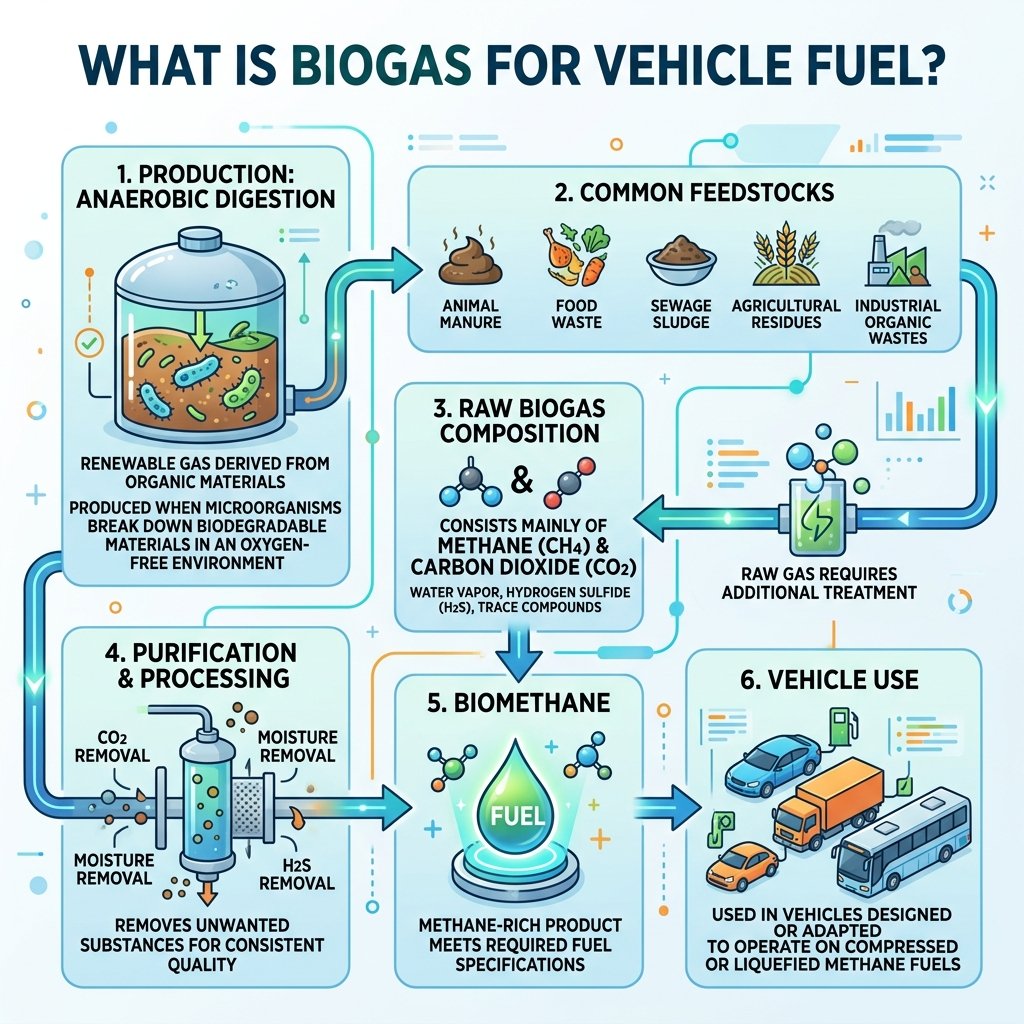
Biogas for Vehicle Fuel is the use of renewable gas derived from organic materials as an energy source for transportation. Biogas is produced when microorganisms break down biodegradable materials in an oxygen-free environment through a process known as anaerobic digestion. Common feedstocks include animal manure, food waste, sewage sludge, agricultural residues, and suitable industrial organic wastes.
Raw biogas consists mainly of methane and carbon dioxide, together with smaller amounts of water vapor, hydrogen sulfide, and other trace compounds. Because vehicles require fuel of consistent quality, raw biogas normally needs additional treatment before it can be widely used as a transport fuel.
After carbon dioxide, moisture, hydrogen sulfide, and other unwanted substances are removed, the methane-rich product is known as biomethane. When it meets the required fuel specifications, biomethane can be used in vehicles designed or adapted to operate on compressed or liquefied methane fuels
How Biogas for Vehicle Fuel Is Produced
The production of Biogas for Vehicle Fuel begins with collecting suitable organic feedstocks. These materials are transported or pumped into an anaerobic digester, where microorganisms gradually break down their biodegradable components.
Anaerobic digestion involves several biological stages, including hydrolysis, acidogenesis, acetogenesis, and methanogenesis. During the final stage, methane-producing microorganisms generate methane-rich biogas.
The raw gas is collected and sent to a cleaning and upgrading system. The goal is to increase its methane concentration and remove substances that could damage engines, storage equipment, or fuel infrastructure.
Once upgraded to the required standard, biomethane can be compressed or liquefied depending on its intended transportation application.
From Raw Biogas to Biomethane
Upgrading is one of the most important steps in preparing Biogas for Vehicle Fuel. Raw biogas contains too much carbon dioxide and other compounds for many vehicle applications.
Several technologies can separate methane from carbon dioxide and other unwanted components. These include membrane separation, water scrubbing, chemical absorption, and pressure swing adsorption.
The resulting biomethane has properties that can be similar to appropriately specified natural gas. This allows it to use some of the infrastructure and vehicle technologies developed for natural-gas transportation.
Fuel quality standards remain essential. Methane concentration, moisture, sulfur compounds, and other characteristics must meet applicable technical and safety requirements.
Compressed Biomethane for Vehicles
Biomethane can be compressed and stored in high-pressure cylinders for transportation applications. This fuel is often described as compressed biomethane or renewable compressed natural gas, depending on the market and regulatory system.
Buses, refuse-collection vehicles, delivery fleets, municipal vehicles, and some passenger cars can use compressed methane when equipped with compatible engines and storage systems.
Fleet applications can be particularly suitable because vehicles often return to a central depot. A dedicated refueling station can therefore serve many vehicles without requiring an extensive public fueling network.
Using locally produced biomethane may also connect municipal waste management with local transportation energy needs.
Environmental Benefits of Biogas for Vehicle Fuel
One potential advantage of Biogas for Vehicle Fuel is the productive use of organic waste. Food residues, manure, wastewater sludge, and other biodegradable materials can become renewable energy feedstocks instead of being viewed only as disposal problems.
Biogas systems may also capture methane that could otherwise escape during uncontrolled decomposition of certain wastes. Because methane is a powerful greenhouse gas, preventing these emissions can significantly influence the climate performance of biomethane.
Using biomethane instead of fossil natural gas can also reduce dependence on fossil carbon.
However, the environmental benefit varies considerably according to feedstock, production method, methane leakage, upgrading energy, transportation, and vehicle efficiency. Biomethane should therefore be assessed across its full life cycle rather than assumed to have zero emissions.
The Importance of Controlling Methane Leakage
Methane leakage is a critical issue for Biogas for Vehicle Fuel. Methane can escape during anaerobic digestion, gas storage, upgrading, compression, liquefaction, transportation, or refueling.
Even relatively small losses can weaken the greenhouse gas benefits of renewable methane.
Modern biogas facilities therefore require high-quality seals, storage systems, pipelines, monitoring equipment, and maintenance programs. Methane sensors and leak-detection technologies can help operators identify problems quickly.
Reducing leakage also has an economic benefit because every unit of methane lost to the atmosphere represents fuel that cannot be sold or used.
Biogas for Vehicle Fuel and Waste Management
Biogas for Vehicle Fuel can connect transportation with sustainable waste management. Cities, farms, wastewater facilities, and food industries continuously produce biodegradable waste.
Anaerobic digestion provides a pathway for treating suitable portions of these waste streams while recovering renewable energy.
For example, organic municipal waste can enter a biogas plant, where it produces renewable gas. After upgrading, the biomethane can potentially fuel municipal buses or waste-collection trucks.
This creates a circular system in which waste generated by a community contributes to energy used by local transportation services.
Biogas for Public Transport
Public transportation can be an important market for biomethane. City buses operate predictable routes and usually return to dedicated depots, making centralized refueling practical.
Where suitable infrastructure exists, replacing fossil methane with biomethane can reduce the fossil-energy component of bus operations.
Waste-collection fleets provide another interesting opportunity. Organic waste collected by municipal services can potentially contribute to biogas production, while the resulting biomethane fuels vehicles involved in waste management.
Such integrated systems demonstrate how renewable energy, transportation, and waste management can support each other.
Economic Considerations
The economics of Biogas for Vehicle Fuel depend on many factors. Feedstock availability, plant size, upgrading technology, fuel demand, infrastructure, energy prices, government policies, and financing costs all influence project viability.
Waste-derived biogas can have an advantage when producers already need to manage organic residues. Energy recovery may create additional value from an existing waste-management process.
However, upgrading, compression, liquefaction, storage, and refueling infrastructure require significant investment.
Projects are generally strongest when they combine reliable feedstock supplies with predictable fuel demand, such as municipal or commercial vehicle fleets.
Biogas for Vehicle Fuel and the Circular Economy
The circular economy seeks to recover value from materials that would otherwise become waste. Biogas for Vehicle Fuel fits this principle by converting suitable organic residues into useful transportation energy.
Anaerobic digestion also produces digestate. Depending on feedstock quality, processing, and regulations, digestate may contain nutrients that can be returned to agricultural soils.
A well-designed system can therefore connect organic waste management, renewable gas production, transportation, and nutrient recycling.
This integration can improve resource efficiency across agriculture, industry, cities, and transport systems.
The Future of Biogas for Vehicle Fuel
The future of Biogas for Vehicle Fuel will depend on its performance relative to other low-carbon transportation technologies. Battery-electric vehicles are expanding rapidly, while hydrogen and other renewable fuels are also being developed for specific applications.
Biomethane may be particularly useful where suitable organic waste resources already exist and methane-powered vehicle infrastructure is available. Heavy transport, buses, waste trucks, and specialized fleets may provide opportunities in certain regions.
Future improvements in anaerobic digestion, gas upgrading, methane monitoring, and fuel distribution could further improve efficiency.
Strong sustainability standards will remain important to ensure that biomethane development prioritizes appropriate feedstocks and minimizes methane leakage.
Conclusion
Biogas for Vehicle Fuel provides a pathway for converting manure, food waste, wastewater sludge, and other suitable organic materials into renewable transportation energy. Anaerobic digestion first produces raw biogas, which can then be cleaned and upgraded into biomethane.
Biomethane can be compressed for buses, cars, and fleet vehicles or liquefied for some heavy-duty transportation applications. Its strongest sustainability advantages can occur when waste-derived feedstocks are used and methane leakage is carefully controlled.
Biogas will not replace every transportation fuel or technology. Nevertheless, when responsibly produced and used in suitable applications, it can contribute to waste recovery, renewable energy production, lower fossil-fuel dependence, and a more circular transportation system.About https://www.unesco.org/en/query-list/n/natural-resources
Pingback: 7 Incredible Uses of Marine Plants in Industry
Pingback: 7 Ways Marine Biotechnology for Energy Can Revolutionize Biofuels