
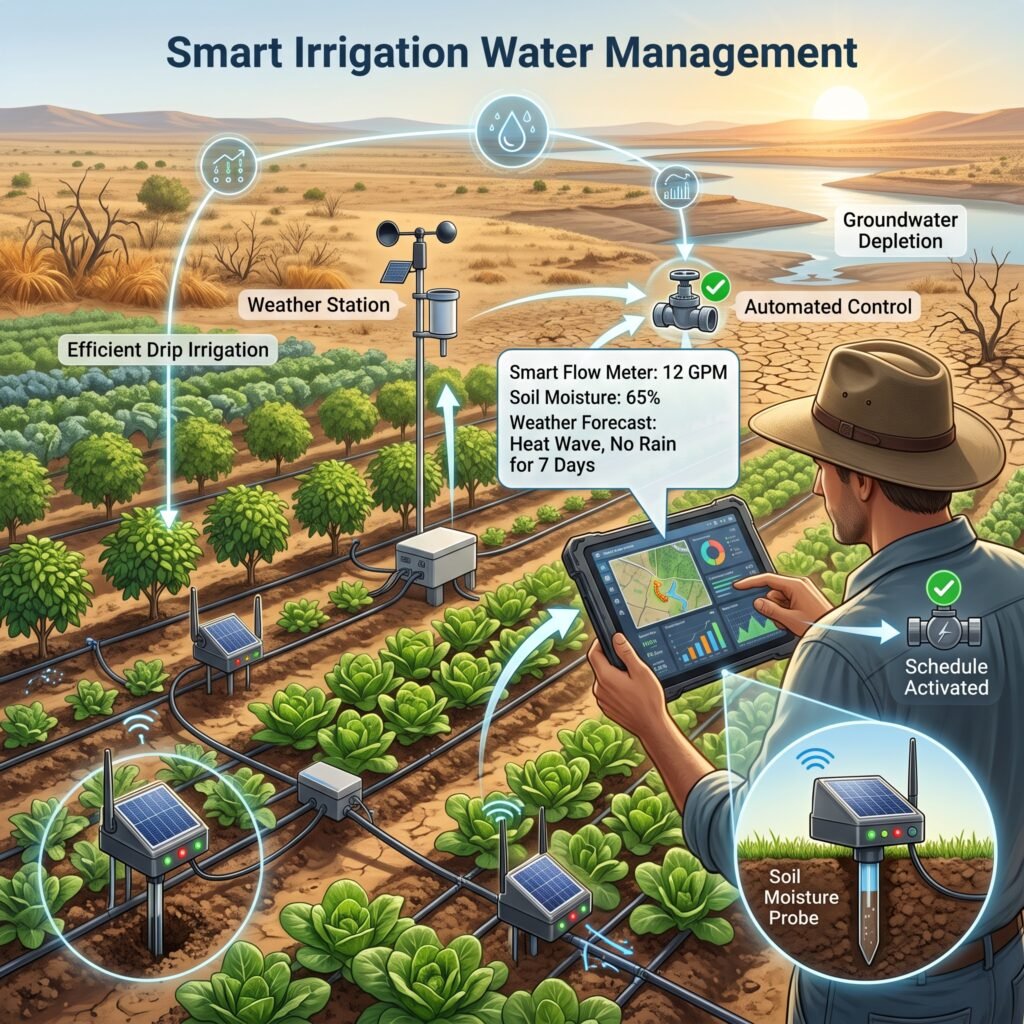
Smart Irrigation Water Management is an advanced approach to agricultural water use that combines efficient irrigation methods with sensors, weather information, automation, and data-driven decision-making. Its main purpose is to provide crops with the appropriate amount of water at the right time while reducing unnecessary water losses.
Agriculture depends heavily on reliable water resources, but farmers in many regions face increasing pressure from drought, groundwater depletion, irregular rainfall, rising temperatures, and competition for freshwater. Traditional irrigation methods can remain useful, but poorly managed irrigation may waste water through evaporation, runoff, leakage, or excessive application.
Smart irrigation provides farmers with better information about when crops actually need water. Instead of irrigating according to a fixed schedule alone, farmers can use information about soil moisture, weather conditions, crop requirements, and water availability.
How Smart Irrigation Water Management Works
Smart Irrigation Water Management connects irrigation infrastructure with monitoring and control technologies. A typical system may include soil-moisture sensors, weather stations, flow meters, smart controllers, pumps, valves, and irrigation equipment.
Sensors collect information from the field. A controller or management platform can then use that information to determine whether irrigation is necessary.
For example, if soil moisture is already sufficient, the system can delay irrigation. If the soil becomes too dry, irrigation can be activated according to predetermined crop requirements.
Some advanced systems can also consider rainfall forecasts. If significant rain is expected, unnecessary watering can be reduced or postponed.
This makes irrigation more responsive to actual field conditions.
Soil-Moisture Sensors
Soil-moisture sensors are an important technology in modern irrigation management. They measure conditions within the soil and help farmers determine whether crops require additional water.
Without monitoring, farmers may irrigate based mainly on visual observations or fixed schedules. These approaches can sometimes result in overwatering or underwatering.
Overwatering wastes water and energy and can contribute to nutrient movement below the root zone. Excess water can also create poor soil conditions for some crops. Underwatering, on the other hand, can stress plants and reduce productivity.
Accurate soil-moisture information helps farmers make more informed irrigation decisions.
Weather-Based Irrigation
Weather conditions strongly influence agricultural water demand. Temperature, rainfall, humidity, solar radiation, and wind can affect how quickly water is lost from soil and vegetation.
Smart irrigation systems can use local weather observations or forecasts when determining irrigation schedules.
During cool or rainy periods, crops may require less irrigation. During hot, dry conditions, their water requirements may increase.
Weather-based management therefore helps irrigation systems respond dynamically instead of applying the same amount of water regardless of environmental conditions.
Drip Irrigation Technology
Drip irrigation is commonly associated with Smart Irrigation Water Management because it can deliver water directly or very close to crop root zones.
A drip system normally consists of pipes, smaller tubes, filters, pressure-control equipment, and emitters. Water passes through the system and is released gradually near individual plants or crop rows.
When properly designed and maintained, drip irrigation can reduce runoff and some evaporation losses compared with less controlled irrigation methods.
However, efficient equipment alone does not guarantee efficient water use. Farmers must still determine how much water crops require and how frequently irrigation should occur.
Combining drip irrigation with sensors and intelligent scheduling can provide greater control.
Smart Controllers and Automation
Smart irrigation controllers help automate water delivery. They can receive information from sensors, weather data, timers, and programmed crop requirements.
The controller uses this information to adjust irrigation duration and timing.
Automation can be particularly useful for large farms where manually monitoring every section of agricultural land would require significant time and labor.
Remote monitoring can also allow farmers to check irrigation performance using computers or mobile devices. Depending on the system, operators may be able to identify unusual flow rates, equipment failures, pressure problems, or potential leaks.
Reducing Water Waste
Water conservation is one of the major benefits of Smart Irrigation Water Management.
Agricultural water can be lost through leaking pipes, damaged irrigation equipment, evaporation, runoff, excessive application, and poor scheduling.
Smart technologies can help identify some of these problems. For example, flow meters can detect unusual changes in water movement. Pressure sensors can identify abnormalities within irrigation networks.
However, technology should be supported by regular maintenance. Pipes, pumps, filters, valves, and emitters need inspection and repair to maintain efficient performance.
Reducing water losses can help farmers conserve freshwater while potentially lowering pumping and operating costs.
Groundwater and Smart Irrigation
Groundwater provides an important source of irrigation water in many agricultural regions. Farmers use wells to extract water stored in underground aquifers.
Problems can develop when groundwater is withdrawn faster than it is naturally or artificially replenished. Long-term over-extraction can contribute to falling groundwater levels and higher pumping requirements.
Smart irrigation can help reduce unnecessary withdrawals by improving irrigation scheduling and measuring actual crop water needs.
However, increased irrigation efficiency must be combined with responsible groundwater management. Water-saving technologies alone cannot protect aquifers if total groundwater withdrawals continue to exceed sustainable levels.
Monitoring, regulation, recharge protection, and long-term water planning remain essential.
Smart Irrigation and Climate Change
Climate change increases the importance of adaptable agricultural water systems. Higher temperatures, shifting rainfall patterns, drought, and extreme weather can make water availability less predictable.
Smart Irrigation Water Management can help farmers respond to these changing conditions by using real-time information rather than depending exclusively on historical irrigation schedules.
During drought, precise irrigation can help prioritize limited water supplies. During periods of rainfall, automated systems may reduce irrigation.
Smart irrigation can also be combined with other climate-resilient agricultural practices, including soil conservation, mulching, rainwater harvesting, drought-tolerant crops, and improved drainage.
Benefits of Smart Irrigation Water Management
Smart irrigation can provide several environmental and operational benefits when systems are appropriately designed and managed.
It can improve irrigation scheduling, reduce unnecessary water application, support crop productivity, provide better information about field conditions, and improve control over water distribution.
Farmers may also benefit from improved detection of leaks or equipment problems.
At the environmental level, efficient irrigation can reduce pressure on freshwater resources. This is particularly important in areas where agriculture competes with households, ecosystems, and industries for limited water supplies.
Challenges of Smart Irrigation
Despite its advantages, smart irrigation has limitations.
Advanced equipment can require significant initial investment. Sensors, automated valves, controllers, communications equipment, and software may be expensive for some farmers.
Technical knowledge is another consideration. Sensors must be installed correctly, equipment needs maintenance, and collected data must be interpreted appropriately.
Internet connectivity and electricity may also be limited in some rural areas.
For this reason, smart irrigation solutions should match local conditions. A reliable and affordable system that farmers can maintain may provide better long-term results than a complicated system that cannot be properly supported.
Future of Smart Irrigation Water Management
The future of Smart Irrigation Water Management is closely connected with precision agriculture and digital technology.
Satellite imagery, remote sensing, drones, connected sensors, artificial intelligence, weather forecasting, and advanced data analysis may increasingly help farmers understand variations within individual fields.
Future systems could automatically identify areas experiencing water stress and adjust irrigation accordingly. Instead of applying identical quantities of water across an entire field, precision irrigation can target areas according to actual requirements.
Data analytics may also help predict crop water demand using historical and real-time information.
These developments could make agricultural water management more precise, but sustainable outcomes will still depend on responsible management of overall water withdrawals.
Sustainable Agriculture and Water Security
Water security and food production are closely connected. Growing populations require agricultural systems capable of producing food without placing unsustainable pressure on freshwater resources.
Smart irrigation can contribute to this goal by helping farmers use available water more carefully.
Governments, agricultural organizations, researchers, technology providers, and farmers can support adoption through training, infrastructure investment, technical assistance, and responsible water policies.
Protecting rivers, reservoirs, wetlands, and groundwater aquifers should remain part of the broader strategy.
Conclusion
Smart Irrigation Water Management combines modern irrigation technology with better information and responsible agricultural practices. Soil-moisture sensors, weather-based scheduling, drip irrigation, automated controllers, flow monitoring, and data analytics can help farmers make more precise decisions about water application.
The goal is not simply to use advanced technology. The larger objective is to provide crops with the water they need while reducing unnecessary losses and protecting freshwater resources.
As climate variability, population growth, and water scarcity increase pressure on agriculture, smart irrigation can become an increasingly valuable component of sustainable farming. When combined with groundwater protection, efficient energy use, soil management, and long-term water planning, it can help build more resilient agricultural systems for the future.About https://www.unesco.org/en/query-list/n/natural-resources