
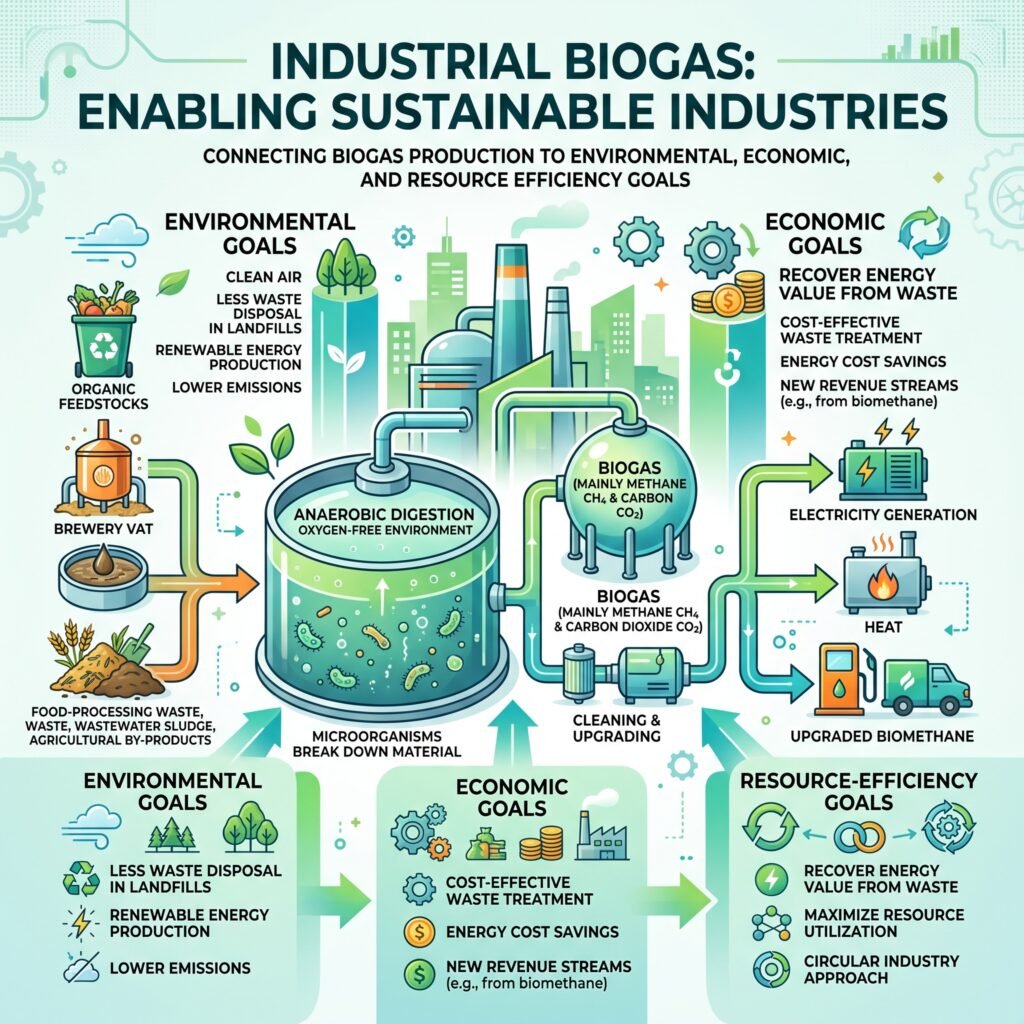
Industrial Biogas and Sustainability describes the connection between industrial biogas production and the environmental, economic, and resource-efficiency goals of modern industries. Industrial biogas is produced when biodegradable organic materials are broken down by microorganisms in an oxygen-free environment through a process called anaerobic digestion.
Food-processing residues, beverage-industry waste, wastewater sludge, agricultural by-products, and other suitable organic materials can serve as feedstocks. Instead of treating these materials only as waste requiring disposal, anaerobic digestion can recover part of their energy value.
The resulting biogas contains mainly methane and carbon dioxide. After appropriate cleaning, biogas can provide heat, generate electricity, or be upgraded into biomethane. This ability to combine waste treatment with renewable energy production makes industrial biogas an important technology within sustainable industrial development.
How Industrial Biogas Supports Sustainability
The relationship between Industrial Biogas and Sustainability begins with resource recovery. Conventional industrial systems often follow a linear model in which raw materials enter production processes and waste is eventually discarded.
Biogas technology can help create a more circular system. Suitable organic residues are collected and transferred to anaerobic digesters, where microorganisms convert biodegradable matter into biogas.
Energy recovered from this gas can potentially be used within the same industrial facility. The remaining digestate may also contain valuable nutrients and organic matter, although its final use depends on feedstock quality, treatment methods, environmental standards, and local regulations.
This approach helps industries extract additional value from materials that might otherwise become waste.
Industrial Biogas and Organic Waste Management
Organic waste management is one of the strongest connections between Industrial Biogas and Sustainability. Food and beverage manufacturing, dairy processing, breweries, sugar production, agricultural processing, and wastewater treatment can generate significant biodegradable waste streams.
If these materials are poorly managed, they may create odors, water-quality problems, greenhouse gas emissions, and disposal costs.
Anaerobic digestion offers a controlled treatment option for appropriate organic materials. The process reduces biodegradable material while simultaneously generating renewable gas.
However, not every industrial waste stream is suitable for digestion. Feedstock testing is important because chemicals, plastics, heavy metals, excessive salts, or other contaminants can interfere with digestion or affect digestate quality.
Renewable Energy from Industrial Biogas
Renewable energy production is another major benefit associated with Industrial Biogas and Sustainability.
Methane contained in biogas stores chemical energy. After suitable treatment, industrial facilities can use this gas in boilers for process heat or in engines and turbines for electricity generation.
Combined heat and power, or CHP, systems are particularly useful because they generate electricity while recovering heat that would otherwise be wasted. The recovered thermal energy can support industrial processes, hot-water production, facility heating, or digester operation.
Producing energy close to where it is consumed can also reduce dependence on externally supplied energy. The economic benefit depends on gas production, facility energy demand, equipment efficiency, energy prices, and local regulations.
Industrial Biogas and Greenhouse Gas Reduction
Climate performance is an important consideration when evaluating Industrial Biogas and Sustainability.
Organic materials can produce methane when they decompose under uncontrolled anaerobic conditions. Methane is a powerful greenhouse gas. Capturing methane in an engineered biogas facility and using it as an energy source can therefore prevent some uncontrolled emissions.
Biogas may also replace part of the fossil fuels used for industrial heat or electricity.
Nevertheless, industrial biogas should not automatically be considered carbon-neutral. Methane leakage from digesters, pipelines, storage tanks, engines, and upgrading facilities can substantially reduce its climate benefits.
High-quality equipment, regular maintenance, leak detection, gas monitoring, and responsible operating practices are therefore essential for sustainable biogas production.
Industrial Biogas and the Circular Economy
The circular economy aims to keep materials and resources in productive use while reducing unnecessary waste. Industrial Biogas and Sustainability fit strongly within this concept.
Consider a food-processing facility that generates biodegradable residues. Instead of disposing of those residues, the company can send suitable materials to an anaerobic digester.
The digester produces biogas that can provide energy. At the same time, digestate remaining from the process may contain recoverable nutrients.
This creates a cycle involving production, waste collection, biological treatment, renewable energy generation, and potential nutrient recovery.
Industrial biogas therefore demonstrates how waste streams can become resources within a more circular industrial system.
Biomethane and Sustainable Industry
Raw biogas normally contains significant amounts of carbon dioxide as well as water vapor, hydrogen sulfide, and other trace compounds. Advanced upgrading systems can remove many of these unwanted components.
The resulting methane-rich renewable gas is called biomethane.
Depending on national standards and infrastructure, biomethane can potentially be injected into gas networks, used as a transportation fuel, or supplied to industrial processes that require gaseous energy.
Biomethane can be especially relevant to industries where direct electrification is technically difficult. However, its sustainability depends on factors such as feedstock sourcing, methane leakage, processing energy requirements, and the fossil fuel it replaces.
Industrial Biogas and Resource Efficiency
Improving resource efficiency is another objective linking Industrial Biogas and Sustainability.
Industrial facilities consume energy and raw materials while producing both products and waste streams. Recovering energy from suitable organic residues allows companies to obtain additional value from materials already entering their operations.
Wastewater provides an important example. Some industrial wastewater contains high concentrations of biodegradable organic matter. Anaerobic treatment can potentially reduce organic pollution while simultaneously producing biogas.
Integrated systems can therefore combine wastewater treatment, waste management, energy recovery, and environmental protection.
Digestate and Nutrient Recovery
Anaerobic digestion produces both biogas and digestate. Digestate can contain nitrogen, phosphorus, potassium, organic matter, and other components inherited from the original feedstock.
When quality standards are satisfied, appropriately processed digestate may have value as fertilizer or a soil amendment.
This can support nutrient recycling and reduce the loss of useful resources.
However, responsible management is essential. Digestate contaminated with unsuitable substances may not be appropriate for agricultural application. Storage and land application must also be carefully managed to minimize nutrient runoff, ammonia emissions, odors, and water pollution.
Technology Improving Industrial Biogas and Sustainability
Modern technology is improving the performance of Industrial Biogas and Sustainability systems. Sensors and automated monitoring can track digester temperature, pH, pressure, gas flow, methane concentration, and other operational conditions.
Digital controls can help operators maintain stable biological conditions and detect performance problems earlier.
Methane monitoring is particularly important. Advanced leak-detection technologies can help identify locations where valuable gas is escaping, allowing operators to repair equipment and reduce emissions.
Biogas upgrading technologies are also becoming increasingly important as facilities seek to produce higher-quality biomethane.
Economic Benefits and Industrial Competitiveness
Sustainability is not limited to environmental performance. Industrial biogas projects can also provide economic benefits when designed for appropriate conditions.
Companies may reduce organic waste-treatment costs, generate some of their own energy, and potentially develop additional revenue streams from electricity, heat, biomethane, or other recovered resources.
However, economic performance varies significantly between projects. Construction costs, feedstock availability, maintenance, energy prices, financing, regulations, and available infrastructure must all be evaluated before investment.
A successful project therefore requires both environmental assessment and careful economic planning.
The Future of Industrial Biogas and Sustainability
The future of Industrial Biogas and Sustainability will likely be influenced by circular-economy policies, renewable gas development, improved anaerobic digestion, advanced biomethane upgrading, and stronger methane-emission controls.
Industries with reliable organic waste streams may increasingly view waste as a potential energy and material resource.
Digital monitoring and automation could further improve plant performance, while better methane detection can help ensure that environmental benefits are not undermined by leakage.
Integration with renewable electricity and other low-carbon technologies may also allow biogas to become part of broader industrial decarbonization strategies.
Conclusion
Industrial Biogas and Sustainability are closely connected through renewable energy production, organic waste management, methane control, resource efficiency, and the circular economy.
Anaerobic digestion allows suitable industrial organic residues to be transformed into useful biogas rather than being treated solely as waste. That gas can provide electricity and heat or be upgraded into biomethane, while responsibly managed digestate can potentially support nutrient recovery.
The sustainability benefits, however, depend on careful feedstock selection, efficient technology, methane-leak prevention, environmental controls, and responsible digestate management.
When properly designed and operated, industrial biogas can help industries reduce waste, recover valuable resources, improve energy efficiency, and move toward cleaner and more circular production systems.Contact https://www.insee.fr/en/metadonnees/definition/c2198