
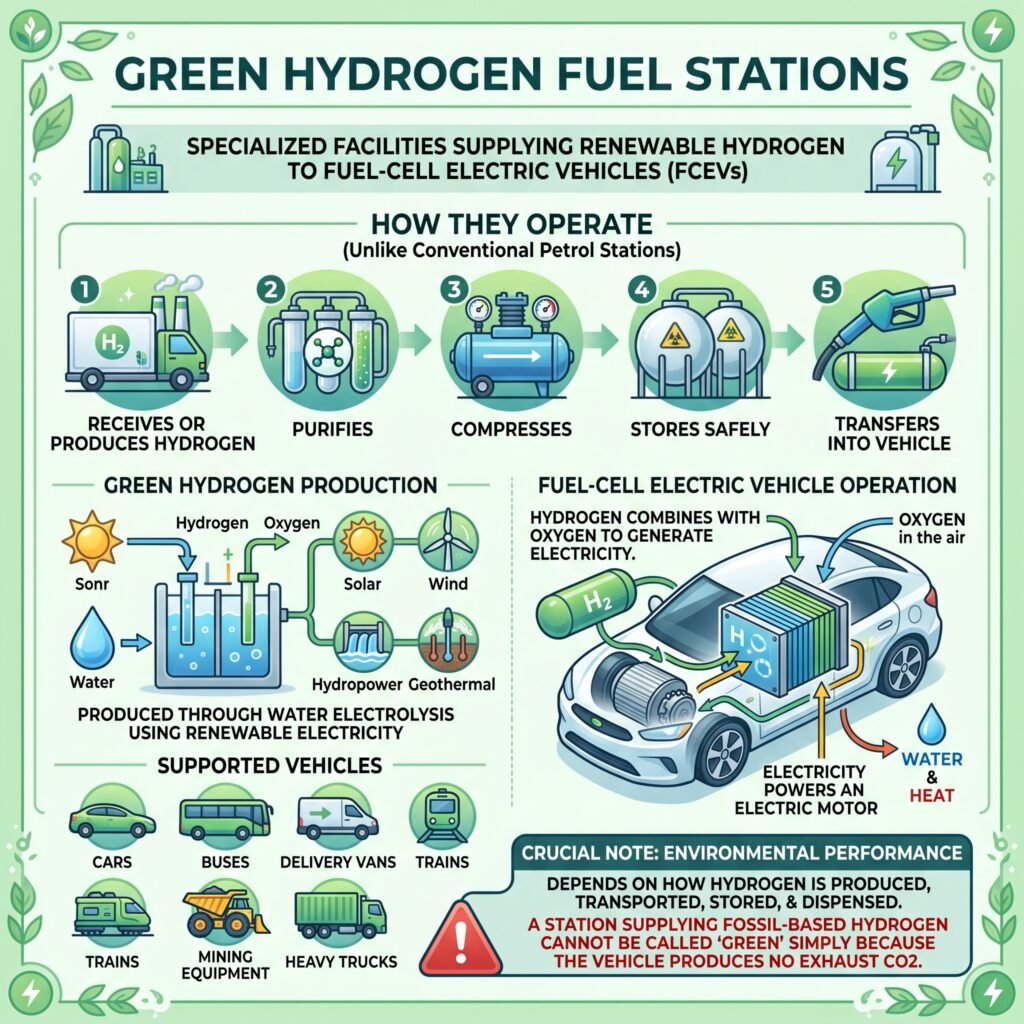
Green Hydrogen Fuel Stations are specialized facilities that supply renewable hydrogen to fuel-cell electric vehicles. Unlike conventional petrol stations, these facilities must receive or produce hydrogen, purify it, compress it, store it safely, and transfer it into a vehicle’s high-pressure tank.
Green hydrogen is produced through water electrolysis using renewable electricity from sources such as solar, wind, hydropower, or geothermal energy. When used in a fuel-cell vehicle, hydrogen combines with oxygen to generate electricity. The electricity powers an electric motor, while water and heat are the main products at the vehicle.
Hydrogen stations could support cars, buses, delivery vans, trains, mining equipment, and heavy trucks. However, their true environmental performance depends on how the hydrogen is produced, transported, stored, and dispensed. A station supplying fossil-based hydrogen should not be described as a green hydrogen station merely because the vehicle itself produces no exhaust carbon dioxide.
How Green Hydrogen Fuel Stations Work
Green Hydrogen Fuel Stations operate through several interconnected systems. A typical facility includes a hydrogen supply, purification equipment, compressors, high-pressure storage vessels, cooling technology, safety controls, and fuel dispensers.
The hydrogen may be produced directly at the station or delivered from an external production facility. Before it reaches a vehicle, the gas must meet strict purity requirements because contaminants can damage fuel-cell components.
The hydrogen is then compressed and moved into storage vessels. When a driver connects the dispenser to the vehicle, the station controls pressure, temperature, flow rate, and communication with the vehicle. The process resembles conventional refueling from the driver’s perspective, but the technology behind it is significantly different.
According to the U.S. Department of Energy, hydrogen delivery infrastructure can include pipelines, tube trailers, liquid hydrogen, compressors, bulk storage, and dispensing equipment. U.S. Department of Energy
On-Site Green Hydrogen Production
Some Green Hydrogen Fuel Stations can produce hydrogen on-site using an electrolyzer. The electrolyzer uses electricity to split purified water into hydrogen and oxygen. If the electricity comes from verified renewable sources, the resulting fuel can have relatively low lifecycle greenhouse-gas emissions.
On-site production can reduce the need to transport hydrogen over long distances. It may also allow a station to use locally generated solar or wind electricity. However, the station requires adequate electrical capacity, water treatment, an electrolyzer, compression equipment, storage, and suitable space.
Renewable electricity is not always available at the exact time vehicles need fuel. A station may therefore use grid electricity, energy storage, hydrogen storage, or a combination of these options. Operators must assess the carbon intensity of grid electricity rather than assuming that every electrolyzer automatically produces green hydrogen.
Responsible water planning is also necessary. Electrolysis requires purified water, and additional water may be used for cooling or treatment. Stations in water-stressed areas should evaluate treated wastewater, responsible desalination, and other locally appropriate supplies.
Delivered Hydrogen Supply
Instead of producing hydrogen on-site, a station can receive it from a centralized plant. Gaseous hydrogen may arrive in high-pressure tube trailers or through pipelines. Liquid hydrogen can be transported in insulated cryogenic tankers.
Centralized production can benefit from larger renewable-energy projects and economies of scale. Nevertheless, delivery adds transportation costs, energy consumption, and logistical requirements. Tube trailers carry limited quantities compared with conventional liquid-fuel tankers, while dedicated hydrogen pipelines require high initial investment.
Liquid hydrogen offers greater volumetric density than compressed gas, but it must be cooled to extremely low temperatures. The Department of Energy explains that liquid hydrogen storage requires cryogenic conditions because hydrogen boils at approximately −252.8°C at atmospheric pressure. Hydrogen Storage
Compression and Storage Systems
Hydrogen has a low density under normal conditions, so Green Hydrogen Fuel Stations usually compress it before storage and dispensing. High-pressure vessels maintain a supply that can be transferred rapidly when vehicles arrive.
Light-duty fuel-cell cars commonly use hydrogen stored at pressures as high as 700 bar. Many buses, trucks, and other heavy vehicles use systems around 350 bar, although vehicle requirements vary. The station’s dispenser must be compatible with the vehicle’s pressure, connection, and communication standards.
Compression consumes electricity and generates heat. During fast refueling, the hydrogen may be precooled to control the temperature inside the vehicle’s tank. These processes increase station energy use and must be included when calculating cost, efficiency, and total emissions.
Storage capacity must reflect expected demand. Too little storage can cause shortages during busy periods, while oversized equipment increases project cost. Careful planning considers the number of vehicles, kilograms required per day, refueling patterns, delivery schedules, and equipment downtime.
Hydrogen Dispensing and Vehicle Refueling
A hydrogen dispenser includes a nozzle, hose, control system, meter, breakaway device, and safety mechanisms. The nozzle locks securely to the vehicle’s receptacle before fuel begins to flow.
The station and vehicle may exchange information to manage the fill safely. Automated controls monitor temperature, pressure, and flow throughout the process. The station stops dispensing when the target level is reached or when the system detects an abnormal condition.
Fuel-cell electric cars can be refueled quickly compared with many battery-charging sessions. The U.S. Alternative Fuels Data Center states that certain light-duty fuel-cell vehicles can refuel in about five minutes, although actual times depend on the vehicle, station condition, tank capacity, and demand. Alternative Fuels Data Center
Heavy trucks and buses require more hydrogen, so their stations may need higher daily capacity, larger storage systems, multiple dispensers, and specialized fueling protocols.
Safety at Green Hydrogen Fuel Stations
Hydrogen is flammable, has a wide ignition range, and can escape through small openings. Safe operation therefore requires careful engineering rather than fear or carelessness.
Green Hydrogen Fuel Stations may include:
- Hydrogen and flame detectors
- Automatic emergency shutoff systems
- Pressure-relief devices
- Electrical grounding and bonding
- Strong natural or mechanical ventilation
- Protective barriers around equipment
- Breakaway couplings on dispenser hoses
- Controlled separation distances
- Fire-response systems and warning signs
- Regular inspection and preventive maintenance
Hydrogen is lighter than air and generally rises rapidly when released outdoors. Station designs aim to prevent gas from accumulating beneath roofs, inside equipment enclosures, or in other confined spaces. Staff and emergency responders also need training appropriate to hydrogen’s pressure, flammability, and cryogenic risks.
Stations must comply with applicable building, fire, electrical, pressure-vessel, fuel-quality, and measurement regulations. Requirements differ by country and region, so project developers must work with the relevant authorities.
Environmental Benefits and Limitations
The main advantage of Green Hydrogen Fuel Stations is their potential to supply low-carbon fuel for transport applications that may be difficult to electrify directly. Fuel-cell vehicles produce no carbon dioxide at the tailpipe and can help reduce urban air pollution associated with diesel engines.
Hydrogen may be particularly useful for fleet vehicles with long operating hours, centralized depots, demanding routes, or limited time for refueling. Possible applications include buses, heavy trucks, port equipment, warehouse vehicles, and some trains.
However, green hydrogen is not automatically the most efficient option for every vehicle. Producing hydrogen through electrolysis, compressing it, transporting it, and converting it back into electricity creates energy losses. Battery-electric vehicles normally use renewable electricity more directly and efficiently.
Hydrogen should therefore be assessed where its operating advantages justify the additional conversion steps. Professional comparisons should examine lifecycle emissions, vehicle duty cycles, infrastructure cost, energy efficiency, reliability, and local renewable resources.
Economic Challenges
Building Green Hydrogen Fuel Stations requires substantial investment. Major expenses may include electrolyzers, compressors, high-pressure storage tanks, cooling systems, dispensers, safety equipment, land, grid connections, permitting, and maintenance.
A common difficulty is the relationship between vehicles and infrastructure. Consumers may hesitate to buy fuel-cell vehicles when few stations exist, while investors may hesitate to build stations without enough vehicles. Fleet projects can reduce this problem by creating predictable demand at a depot or along a specific freight corridor.
Equipment reliability is equally important. A region with only a few stations can experience serious disruption when one compressor or dispenser is unavailable. Redundant components, spare parts, trained technicians, and reliable hydrogen deliveries can improve service.
The Future of Green Hydrogen Fuel Stations
Future development is likely to focus on transport applications where hydrogen offers clear operational value. Heavy-duty freight corridors, bus depots, ports, industrial centers, airports, mines, and logistics hubs may provide stronger early markets than widely dispersed private cars.
Larger stations could combine renewable electricity, electrolysis, battery storage, hydrogen production, fleet refueling, and industrial energy supply. Standardized equipment and mass manufacturing may also reduce costs over time. The International Energy Agency notes that electrolyzers, fuel cells, and refueling equipment can benefit from increased manufacturing scale. IEA
Conclusion
Green Hydrogen Fuel Stations connect renewable-energy production with hydrogen-powered transportation. They can produce or receive hydrogen, compress and store it, and safely dispense it into fuel-cell vehicles.
Their success depends on clean electricity, reliable technology, strict safety standards, responsible water use, suitable locations, and sufficient vehicle demand. They are unlikely to replace every petrol station or electric charger. Instead, Green Hydrogen Fuel Stations may become a targeted part of a broader clean-transport system, especially for buses, trucks, industrial fleets, and other demanding transport operations.About