
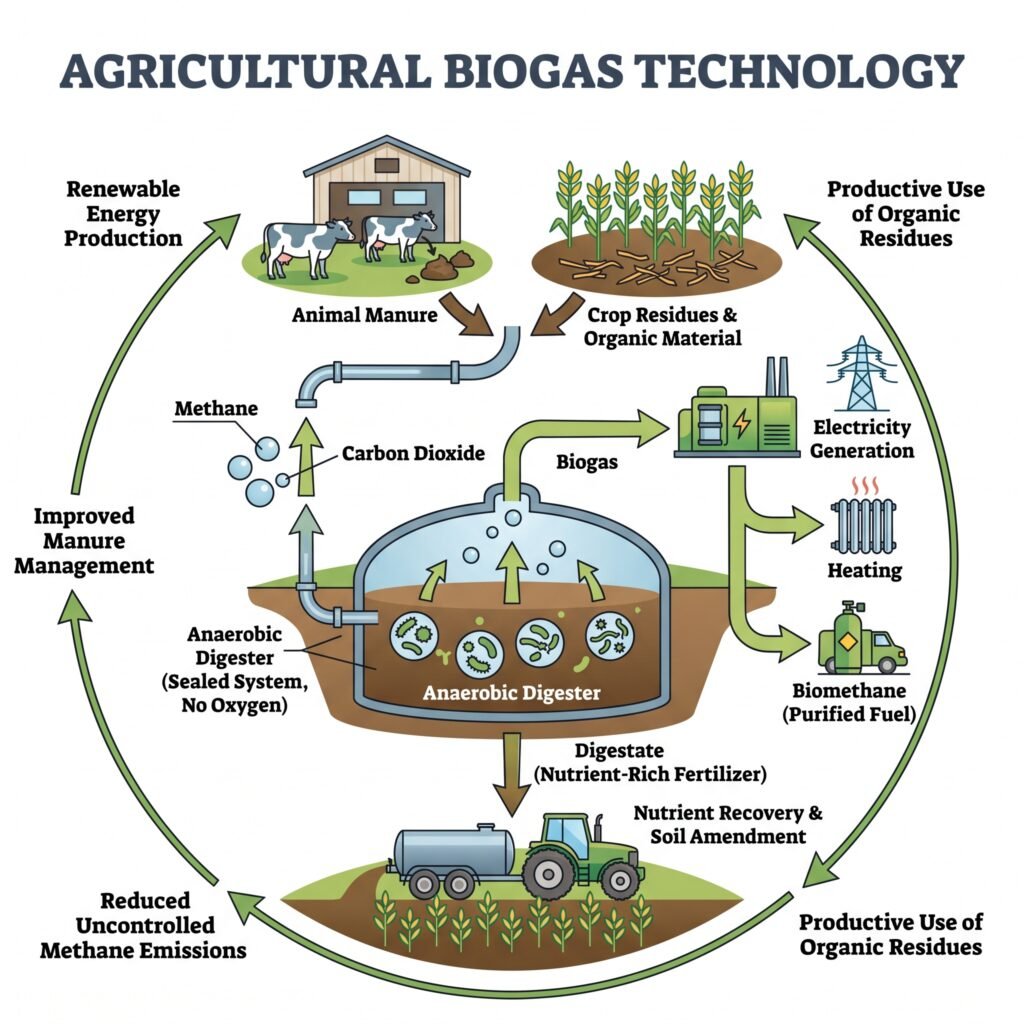
Agricultural Biogas Technology is a renewable energy technology that converts animal manure, crop residues, and other suitable biodegradable agricultural materials into biogas through anaerobic digestion. The process takes place inside a sealed system where microorganisms break down organic matter in the absence of oxygen.
The resulting biogas consists mainly of methane and carbon dioxide, along with smaller quantities of other gases and water vapor. Methane gives biogas its energy value and allows it to be used for heating, electricity generation, or, after additional purification, as biomethane.
Agricultural biogas systems provide more than renewable energy. They can also improve manure management, recover nutrients, reduce uncontrolled methane emissions, and help farms make productive use of organic residues.
How Agricultural Biogas Technology Works
The basic process behind Agricultural Biogas Technology begins with feedstock collection. Farms may collect cattle manure, pig manure, poultry residues, crop materials, and other suitable organic feedstocks.
The material is prepared before being transferred into an anaerobic digester. Depending on the system, preparation may involve mixing, removing unwanted materials, adjusting moisture levels, or combining different feedstocks.
Inside the digester, microorganisms perform several biological processes that gradually convert biodegradable material into biogas. The major stages are hydrolysis, acidogenesis, acetogenesis, and methanogenesis.
During the final stage, methane-producing microorganisms generate methane-rich gas. The biogas is collected at the top of the digester and transported through pipes for cleaning, storage, or energy production.
Anaerobic Digesters in Agricultural Biogas Technology
The anaerobic digester is the central component of an agricultural biogas facility. It provides controlled conditions where microorganisms can process organic material efficiently.
Different digester designs are available depending on farm size, feedstock characteristics, climate, and production objectives. Common systems include covered lagoons, plug-flow digesters, and complete-mix digesters.
Temperature is particularly important. Many digesters operate under mesophilic conditions, while some use higher thermophilic temperatures. Stable temperatures generally support consistent microbial activity.
Operators must also monitor pH, organic loading rate, retention time, feedstock composition, and other conditions. Poor management can reduce methane production or disrupt biological activity.
Biogas Cleaning and Processing Technology
Raw agricultural biogas cannot always be used immediately. It may contain hydrogen sulfide, water vapor, carbon dioxide, and trace contaminants that can damage equipment or reduce fuel quality.
Biogas cleaning technology is therefore an important part of modern systems. Moisture removal protects pipelines and engines, while hydrogen sulfide treatment can reduce corrosion and harmful emissions.
The required level of treatment depends on how the biogas will be used. Gas intended for a boiler may require less processing than gas being upgraded to biomethane.
Effective cleaning helps improve equipment reliability and increases the range of potential uses for agricultural biogas.
Agricultural Biogas Technology for Electricity
Electricity generation is one of the most established applications of Agricultural Biogas Technology. Cleaned biogas can fuel an engine connected to an electrical generator.
Many facilities use combined heat and power systems, commonly called CHP. These systems simultaneously generate electricity and recover useful heat.
Electricity can power pumps, ventilation equipment, lighting, milking systems, processing equipment, and other farm operations. Depending on local regulations and grid arrangements, surplus electricity may sometimes be exported to the electricity network.
The recovered heat can warm farm buildings, provide hot water, support processing activities, or maintain the digester at its required operating temperature.
Producing Biomethane from Agricultural Biogas
Modern Agricultural Biogas Technology can go beyond direct heat and electricity generation. Biogas can be upgraded into a higher-quality renewable fuel called biomethane.
Biogas upgrading removes much of the carbon dioxide, hydrogen sulfide, moisture, and other unwanted components. Technologies used for upgrading can include membrane separation, pressure swing adsorption, water scrubbing, and other gas-separation methods.
The resulting biomethane contains a much higher concentration of methane.
When biomethane meets applicable quality and safety standards, it may be injected into gas networks or used as a renewable transportation fuel. This creates additional markets for agricultural energy producers.
Digestate and Nutrient Recovery
Anaerobic digestion does not convert all organic material into gas. A nutrient-containing material called digestate remains after the digestion process.
Digestate can contain nitrogen, phosphorus, potassium, and organic matter. When its composition is suitable and local regulations permit, farmers may use properly managed digestate as a fertilizer or soil amendment.
This creates an important connection between Agricultural Biogas Technology and the circular economy. Nutrients contained in agricultural residues can potentially be returned to farmland rather than being completely discarded.
However, responsible digestate management is essential. Poor storage or excessive application can contribute to nutrient losses, water pollution, ammonia emissions, and other environmental problems.
Environmental Benefits of Agricultural Biogas Technology
One major environmental advantage of Agricultural Biogas Technology is improved methane management. Animal manure can release methane when stored under anaerobic conditions. Capturing that methane in a controlled digester and using it for energy can reduce uncontrolled emissions.
Biogas can also substitute for some fossil energy used for electricity, heating, or transportation.
However, the environmental performance of a biogas plant depends heavily on its design and operation. Methane leakage from digesters, storage facilities, upgrading equipment, or pipelines can significantly reduce climate benefits.
Regular inspections, methane monitoring, good maintenance, and appropriate gas-storage systems are therefore essential components of professional biogas management.
Smart Technology and Modern Biogas Farms
Digital technologies are increasingly improving Agricultural Biogas Technology. Sensors can continuously measure important parameters such as temperature, pH, gas flow, methane concentration, pressure, and digester performance.
Automated control systems can help operators adjust feedstock inputs and operating conditions. Data analysis can also identify changes in performance before they develop into larger technical problems.
Methane-detection equipment is especially valuable because leaks represent both lost energy and increased greenhouse gas emissions.
As automation improves, agricultural biogas plants can become more efficient, measurable, and reliable.
Agricultural Biogas Technology and Sustainable Farming
Agricultural biogas fits naturally within sustainable and circular farming systems. Instead of viewing manure and biodegradable residues only as waste, farms can treat them as resources containing energy and nutrients.
Organic material enters the digester, biogas provides renewable energy, and properly managed digestate can return nutrients to agricultural soils.
This approach can improve resource efficiency while integrating waste management, renewable energy production, and nutrient recycling within the same agricultural system.
The Future of Agricultural Biogas Technology
The future of Agricultural Biogas Technology is likely to involve better digesters, advanced gas upgrading, automated monitoring, improved methane-leak detection, and more efficient nutrient recovery.
Biomethane could become particularly important where governments and industries are seeking renewable alternatives to fossil natural gas. Farms with reliable supplies of manure and suitable organic residues may therefore play an increasingly important role in renewable gas production.
Nevertheless, successful projects require careful planning. Feedstock availability, construction costs, energy markets, methane control, digestate management, regulations, and local infrastructure must all be considered.
Conclusion
Agricultural Biogas Technology provides a practical method for converting manure and suitable organic farm residues into renewable energy through anaerobic digestion. Modern systems combine digesters, gas-cleaning equipment, generators, biomethane upgrading technologies, storage systems, and digital monitoring.
The technology can generate electricity and heat, produce biomethane, improve manure management, and support nutrient recycling through digestate.
When properly designed and managed, Agricultural Biogas Technology can help farms reduce waste, recover valuable resources, manage methane emissions, and participate in the transition toward more sustainable and circular energy systems.Contact https://www.britannica.com/science/natural-resource