
Introduction
Hydrogen-Powered Aircraft are emerging as a potential solution for reducing aviation’s dependence on fossil-based jet fuel. These aircraft use hydrogen to generate propulsion through fuel cells or modified turbine engines. When produced through electrolysis powered by renewable energy, hydrogen can reduce lifecycle greenhouse-gas emissions compared with conventional aviation fuel.
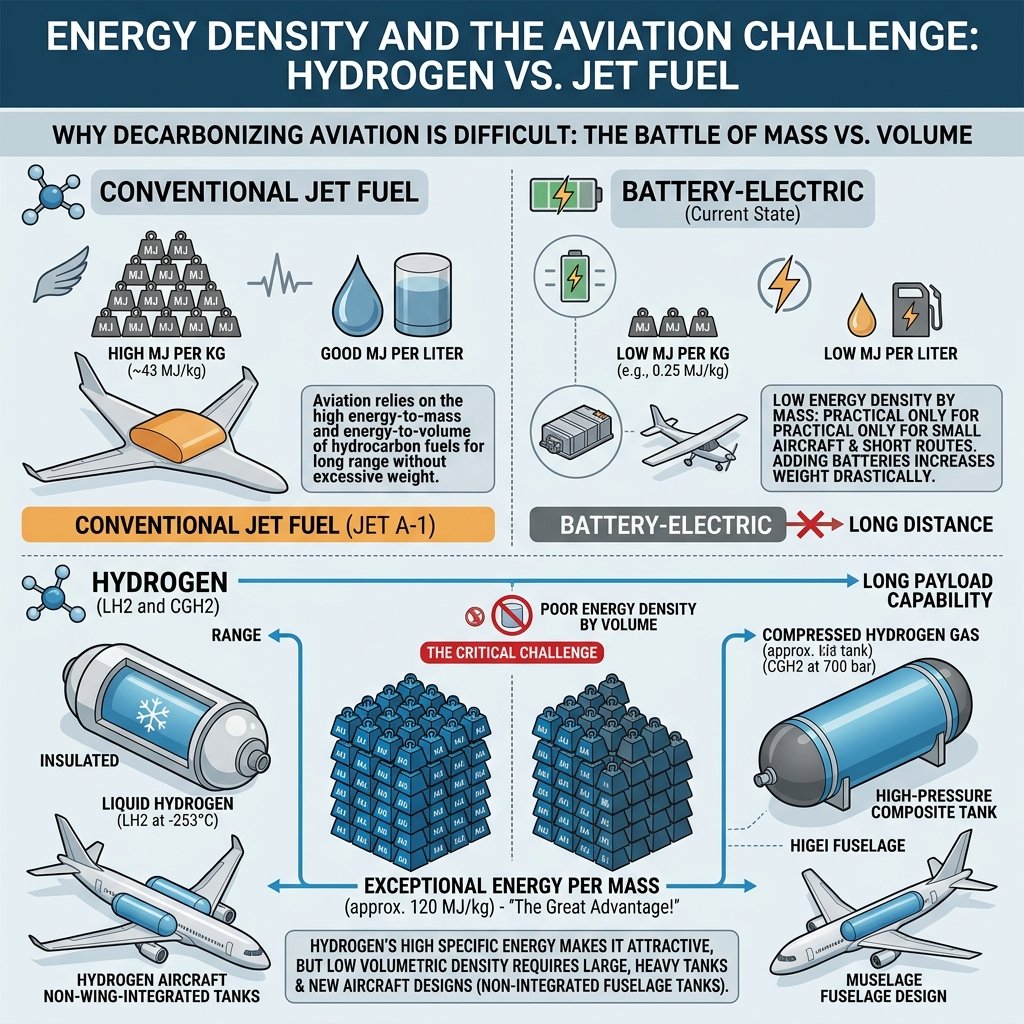
Aviation is difficult to decarbonize because aircraft must carry enough energy to travel long distances without becoming excessively heavy. Battery-electric propulsion may be practical for small aircraft and short routes, but current batteries generally store much less energy per kilogram than aviation fuel. Hydrogen contains a large amount of energy by mass, making it attractive for aviation. However, its low energy density by volume creates significant storage and aircraft-design challenges.
How Hydrogen-Powered Aircraft Work
Hydrogen-Powered Aircraft can use hydrogen through two principal propulsion systems: fuel-cell electric propulsion and direct hydrogen combustion.
In a fuel-cell system, hydrogen stored aboard the aircraft is supplied to a fuel-cell stack. Inside the stack, it reacts electrochemically with oxygen taken from the atmosphere. This reaction produces electricity, water, and heat. The electricity powers motors that turn propellers or fans.
In direct combustion, hydrogen is burned inside a modified gas-turbine engine. The expanding hot gases drive the turbine and generate thrust in a process resembling that of a conventional jet engine. However, the combustion system must be redesigned to accommodate hydrogen’s different ignition and flame characteristics.
Hydrogen can also be used indirectly to manufacture synthetic aviation fuels. These fuels may work in conventional aircraft, but they should be distinguished from aircraft that carry and use hydrogen directly.
Fuel-Cell Hydrogen-Powered Aircraft
Fuel-cell propulsion may be particularly suitable for smaller aircraft and regional routes. Fuel cells convert hydrogen into electricity without burning it, allowing the aircraft to avoid carbon dioxide, soot, and sulfur emissions during operation.
A complete fuel-cell propulsion system includes hydrogen tanks, fuel-cell stacks, electric motors, power electronics, heat exchangers, cooling equipment, and batteries. A battery may provide additional energy during takeoff and store electricity recovered or generated during other operating stages.
Fuel cells are generally quieter than turbine engines because they power electric motors with fewer rapidly moving components. Lower noise could benefit communities surrounding regional airports.
However, fuel-cell systems must become lighter and more powerful for larger commercial aircraft. Engineers must improve power density, thermal management, reliability, and system integration while meeting strict aviation safety requirements.
In September 2023, H2FLY conducted a piloted flight of its HY4 demonstrator using liquid-hydrogen fuel-cell propulsion, demonstrating that the technology has progressed beyond basic laboratory research. European Union Aviation Safety Agency
Hydrogen Combustion in Turbine Engines
Direct hydrogen combustion could offer greater power for larger and faster aircraft. Manufacturers can build modified gas turbines that burn hydrogen instead of kerosene.
Because hydrogen contains no carbon, burning it does not directly release carbon dioxide, carbon monoxide, or soot created by carbon-based aviation fuels. Nevertheless, hydrogen combustion should not be described as entirely emission-free. High combustion temperatures can produce nitrogen oxides, which affect air quality and the atmosphere.
Hydrogen combustion also releases water vapor. At high altitudes, water emissions may contribute to contrail formation and climate effects. Researchers must therefore evaluate both carbon dioxide and non-carbon-dioxide effects before determining the complete environmental performance of Hydrogen-Powered Aircraft.
Advanced combustion chambers, temperature management, and control systems could limit nitrogen-oxide formation. Extensive testing will be necessary before hydrogen turbine engines can be approved for widespread passenger service.
Storing Hydrogen Aboard Aircraft
Hydrogen’s greatest aviation advantage is its high energy content by mass. Its greatest challenge is its low energy content by volume. Even liquid hydrogen requires substantially more tank space than conventional jet fuel for an equivalent amount of energy.
Hydrogen can be stored as a compressed gas, but the tanks would be large and heavy for many commercial aircraft. Liquid hydrogen is considered a more promising option because it occupies less space. It must, however, be maintained at approximately −253°C.
Liquid-hydrogen tanks require strong insulation, pressure-control equipment, pipes, pumps, valves, ventilation, and leak-detection systems. Traditional aircraft store fuel inside their wings, but cylindrical or spherical hydrogen tanks may need to be installed inside or behind the passenger cabin.
This change could reduce passenger or cargo capacity and affect the aircraft’s balance and aerodynamic design. Future models may have wider fuselages, rear-mounted tanks, blended-wing bodies, or other unconventional shapes. EASA describes safe and efficient onboard hydrogen storage as one of the most complex engineering challenges facing hydrogen aviation. EASA hydrogen-tank research
Environmental Benefits of Hydrogen-Powered Aircraft
When hydrogen is produced using renewable electricity, Hydrogen-Powered Aircraft could deliver several environmental benefits:
- Reduced lifecycle greenhouse-gas emissions
- No in-flight carbon dioxide from direct hydrogen use
- Elimination of sulfur emissions from the fuel
- Little or no soot from hydrogen propulsion
- Lower dependence on petroleum
- Potentially quieter regional aircraft
- Greater demand for renewable energy
These benefits depend on the hydrogen-production pathway. Most hydrogen has historically been manufactured from fossil fuels. Using fossil-based hydrogen without effective emissions control would significantly reduce the climate advantage.
Professional environmental assessments must include electricity generation, water treatment, electrolysis, liquefaction, compression, transportation, storage, airport operations, leakage, and in-flight emissions. The label “hydrogen-powered” alone does not guarantee that an aircraft has a low total carbon footprint.
Airport Infrastructure Requirements
Airports would require major infrastructure changes to support Hydrogen-Powered Aircraft. Liquid hydrogen may need to be transported in specialized tankers or produced near the airport using renewable electricity and electrolyzers.
New infrastructure could include:
- Hydrogen production facilities
- Liquefaction plants
- Cryogenic storage tanks
- Insulated pipelines and refueling trucks
- Leak and flame-detection systems
- Ventilation and emergency equipment
- Dedicated maintenance facilities
- Training for airport and emergency personnel
Hydrogen is highly flammable and can escape through very small openings. Liquid hydrogen can also cause cryogenic injuries or damage unsuitable materials. These risks can be managed through engineering, operating standards, inspections, staff training, and emergency procedures.
Economic and Technical Challenges
The development of Hydrogen-Powered Aircraft requires substantial investment. Aircraft manufacturers must design new propulsion systems and airframes, while airports and energy companies must establish hydrogen supply networks.
Green hydrogen and liquefaction can be expensive and energy-intensive. Airlines may also hesitate to purchase hydrogen aircraft before an adequate fueling network exists, while airports may avoid building infrastructure until airlines create reliable demand.
International standards will be essential. Aircraft must be certified for hydrogen storage, propulsion, maintenance, passenger safety, emergency response, and ground handling. EASA has noted that hydrogen technology’s complex integration will require an appropriate certification approach and cooperation among authorities. EASA
Future of Hydrogen-Powered Aircraft
Early commercial applications will likely focus on small aircraft, cargo services, island connections, and regional passenger routes. Fuel-cell systems may serve shorter distances, while hydrogen combustion could eventually support larger aircraft.
Long-distance aviation remains more challenging because the necessary hydrogen tanks could significantly affect aircraft size and passenger capacity. Sustainable aviation fuels, operational improvements, efficient aircraft, and other technologies will therefore remain important alongside hydrogen.
Conclusion
Hydrogen-Powered Aircraft could help create a cleaner aviation system by using fuel cells or hydrogen-burning turbines. Their principal advantages include eliminating in-flight carbon dioxide from direct hydrogen use and reducing dependence on petroleum.
However, hydrogen storage, renewable production, infrastructure, cost, safety, certification, and non-carbon climate effects remain important challenges. Hydrogen-Powered Aircraft are a promising technology, but their environmental value will depend on careful engineering and genuinely low-carbon hydrogen throughout the complete fuel lifecycle. https://naturalresourc.com/green-hydrogen-aviation/