
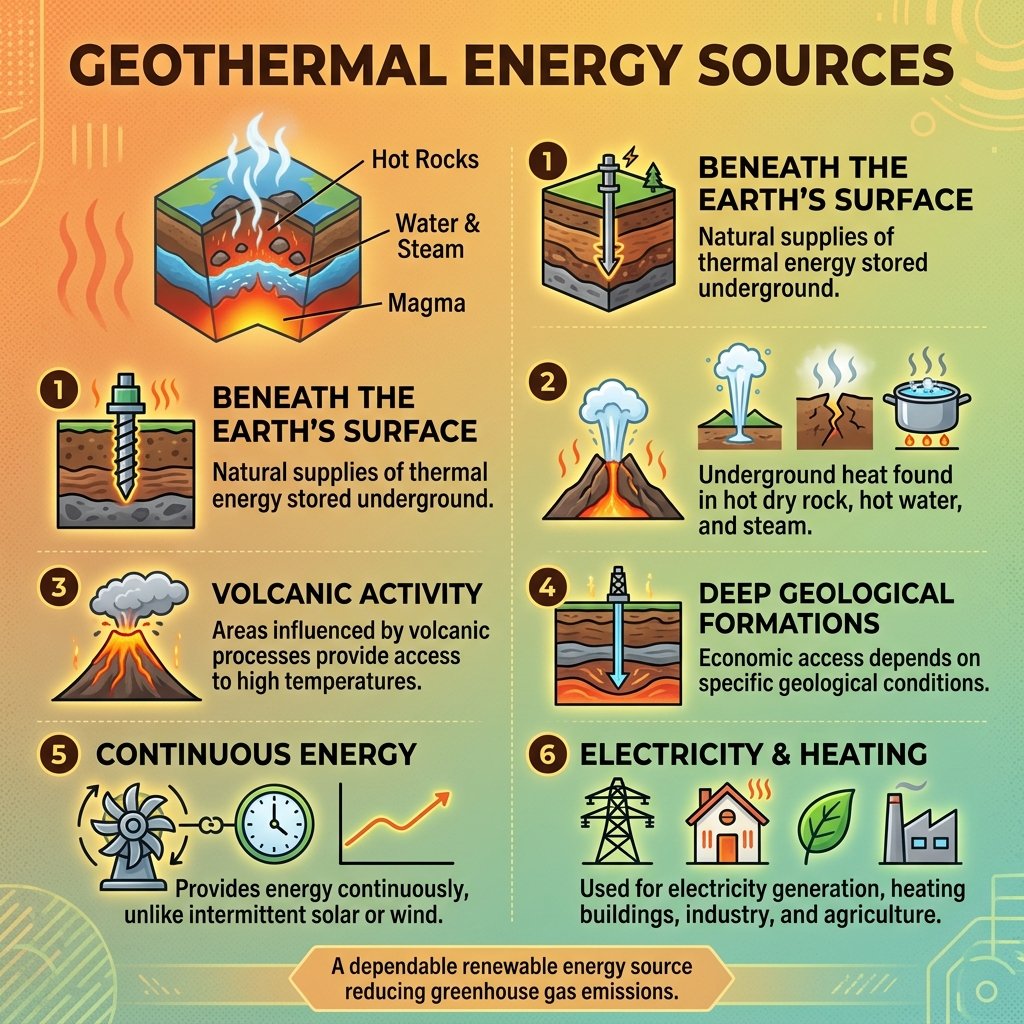
Geothermal Energy Sources are natural supplies of thermal energy stored beneath the Earth’s surface. This underground heat can be found in hot rocks, water, steam, deep geological formations, and areas influenced by volcanic activity. When geological conditions allow people to access this heat economically, it can be used for electricity generation, heating buildings, industrial processes, agriculture, and other applications.
The word geothermal comes from terms meaning Earth and heat. Unlike solar and wind energy, which depend directly on changing weather conditions, geothermal resources can often provide energy continuously. This makes geothermal energy particularly valuable as countries seek dependable renewable energy sources while reducing greenhouse gas emissions from energy production.
How Geothermal Energy Sources Are Formed
Geothermal Energy Sources originate primarily from heat within the Earth. Part of this heat is left from the planet’s formation, while a substantial portion is continually generated by the natural radioactive decay of elements within the Earth’s interior.
Heat gradually moves toward the surface through geological materials. In some locations, tectonic and volcanic activity brings high-temperature material relatively close to the surface. Water can travel through cracks and permeable rocks, become heated underground, and accumulate within geothermal reservoirs.
The usefulness of a geothermal resource depends on several characteristics, including temperature, depth, permeability, fluid availability, geological structure, and accessibility.
1. Hydrothermal Geothermal Resources
Hydrothermal resources are among the best-known geothermal resources. They occur where underground heat, water, and sufficiently permeable rock exist together.
Groundwater moves through fractures and porous formations, absorbs heat from surrounding rocks, and may form reservoirs containing hot water or steam. Wells can then access these fluids for energy production.
High-temperature hydrothermal resources can support electricity generation. Lower-temperature resources may be better suited to direct heating, greenhouses, aquaculture, industrial processes, or district heating systems.
Hydrothermal systems have historically been central to commercial geothermal development.
Hot-Water Geothermal Reservoirs
Hot-water reservoirs contain naturally heated water trapped within permeable underground formations. Temperatures differ significantly depending on geological conditions and depth.
When high-pressure geothermal water is brought toward the surface, pressure changes can cause some of it to turn into steam. Flash-steam geothermal plants use this principle to produce vapor capable of driving a turbine.
Moderate-temperature water can also be valuable. Binary-cycle plants transfer heat from geothermal water to a secondary fluid with a lower boiling point. The secondary fluid vaporizes and drives a turbine while the geothermal fluid remains in a separate circuit.
This technology expands the range of Geothermal Energy Sources that can potentially produce electricity.
3. Natural Steam Resources
Some geothermal reservoirs naturally contain significant quantities of steam. These resources can support dry-steam power plants, where geothermal steam is directed toward a turbine connected to an electrical generator.
Dry-steam systems are relatively straightforward compared with technologies requiring additional vaporization processes. However, suitable natural steam fields are geographically limited.
Because geological conditions must be favorable, not every region can develop conventional steam-based geothermal electricity.
4. Hot Dry Rock Resources
Large quantities of underground heat are stored in rocks that contain insufficient natural water or permeability for conventional geothermal development. These hot-rock resources represent a potentially enormous source of thermal energy.
Advanced geothermal approaches can create or improve pathways through which fluids circulate underground. Water introduced into the system absorbs heat from hot rock and can then be brought back toward the surface.
These concepts are commonly associated with Enhanced Geothermal Systems (EGS). EGS technology could expand geothermal development beyond areas containing naturally productive hydrothermal reservoirs.
However, projects require sophisticated drilling, geological characterization, reservoir engineering, seismic monitoring, and careful environmental management.
5. Magma-Related Heat Sources
Magma represents one of Earth’s most intense underground heat sources. It consists of extremely hot molten or partially molten rock beneath the surface.
Conventional geothermal facilities do not normally extract energy directly from magma because temperatures and drilling conditions can be exceptionally challenging. Instead, magma can heat nearby rocks and underground water, helping create high-temperature geothermal systems.
This explains why regions with volcanic activity often have significant geothermal potential. Countries located near active tectonic boundaries can therefore possess particularly favorable geothermal resources.
6. Shallow Geothermal Energy Sources
Not all geothermal applications require extremely hot underground reservoirs. Relatively shallow ground maintains temperatures that can be used for heating and cooling buildings.
Ground-source heat pumps exchange heat with the ground through buried pipes. During colder periods, they can transfer heat from the ground into a building. During warmer periods, the process can be reversed to move heat from the building into the ground.
Ground-source heat pumps do not require volcanic activity and can therefore be installed in far more locations than conventional geothermal power plants.
They represent an important distinction between using geothermal resources for electricity production and using stable ground temperatures for heating and cooling.
Geothermal Energy Sources for Electricity Generation
Electricity generation requires geothermal resources with suitable temperatures and other geological characteristics. Three established plant configurations are dry steam, flash steam, and binary cycle.
Dry-steam plants use geothermal steam directly. Flash-steam plants obtain steam by reducing the pressure of high-temperature geothermal water. Binary-cycle facilities transfer geothermal heat to another working fluid.
The appropriate technology depends on the characteristics of the resource rather than one system being universally suitable.
Environmental Benefits of Geothermal Energy Sources
One major advantage of geothermal energy is its relatively low operational greenhouse gas emissions compared with fossil-fuel electricity generation. Geothermal facilities can also provide continuous electricity, helping complement variable renewable technologies such as wind and solar power.
Another benefit is land-use efficiency. Geothermal facilities can produce substantial amounts of energy from relatively concentrated sites.
Geothermal fluids can often be reinjected underground after their heat has been extracted. Reinjection can support reservoir pressure and contribute to responsible long-term resource management.
However, geothermal energy is not environmentally impact-free. Projects can involve land disturbance, water management, mineral-rich fluids, gases, drilling impacts, noise, and induced seismicity. Appropriate site assessment, engineering, monitoring, and regulation are therefore essential.
Challenges of Developing Geothermal Energy Sources
The greatest challenge is often finding economically productive resources. Exploration requires geological, geophysical, and geochemical studies before expensive drilling begins.
Drilling costs can become substantial, especially for deep resources. Developers also face geological uncertainty because underground temperature, permeability, and fluid flow cannot always be predicted perfectly before wells are drilled.
Equipment may encounter corrosion or mineral scaling because geothermal fluids can contain dissolved minerals and chemicals. Careful engineering and maintenance are therefore necessary.
Despite these challenges, improvements in drilling, reservoir modeling, materials, and advanced geothermal technologies continue to expand development opportunities.
Future of Geothermal Energy Sources
The future of Geothermal Energy Sources extends beyond conventional volcanic regions. Enhanced geothermal systems, deeper drilling techniques, advanced exploration, improved binary-cycle technologies, and better reservoir modeling could allow more countries to access underground heat.
Geothermal resources can also support more than electricity production. District heating, industrial heat, greenhouse agriculture, food processing, aquaculture, and building heating and cooling provide additional opportunities.
Combining electricity generation with direct heat applications can improve the overall utilization of geothermal resources.
Conclusion
Geothermal Energy Sources include underground hot water, steam reservoirs, hot rocks, shallow ground heat, and geological systems heated by deep Earth processes. These resources can provide electricity as well as direct heating and cooling.
Hydrothermal resources currently support much of conventional geothermal power production, while binary-cycle technology allows moderate-temperature resources to be utilized. Enhanced geothermal systems could further increase the geographical reach of geothermal energy in the future.
With appropriate exploration, engineering, reservoir management, and environmental safeguards, geothermal energy can provide reliable renewable power and heat for decades. Its ability to operate continuously makes it an important complement to solar, wind, hydroelectric, and other low-carbon technologies in a diversified energy system.https://naturalresourc.com/binary-cycle-geothermal-power-plants/ https://www.unesco.org/en/query-list/n/natural-resources
Pingback: 7 Amazing Ways How Earth Produces Heat