
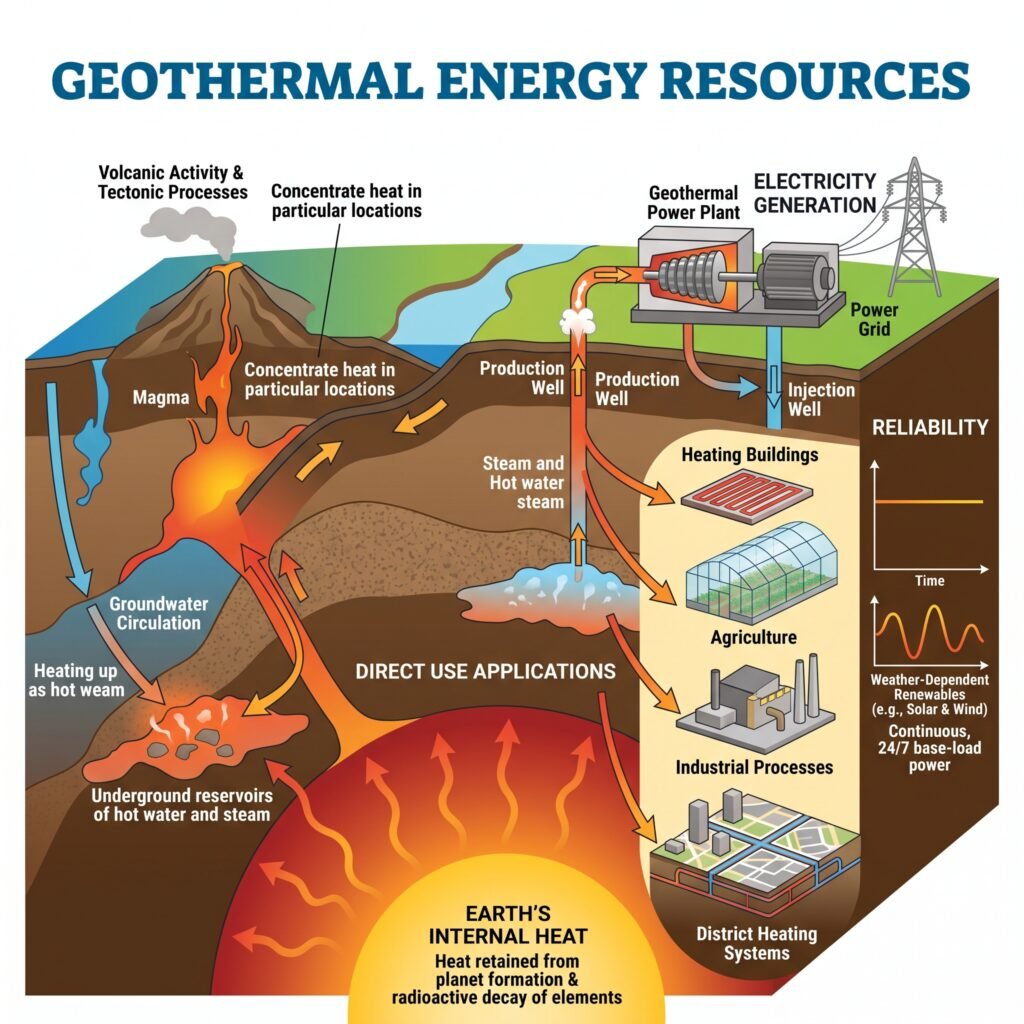
Geothermal Energy Resources are naturally occurring sources of thermal energy stored beneath the Earth’s surface. This heat exists in underground rocks, water, steam, and deeper geological formations. In suitable locations, geothermal resources can be developed to generate electricity, heat buildings, support industrial processes, and provide thermal energy for agriculture and district heating systems.
Earth’s internal heat comes primarily from energy retained from the planet’s formation and heat continuously generated by the radioactive decay of naturally occurring elements. This thermal energy gradually moves toward the surface. Geological structures, groundwater circulation, volcanic activity, and tectonic processes can concentrate accessible heat in particular locations.
One important feature of geothermal energy is reliability. Unlike solar and wind resources, underground heat does not depend directly on daily weather conditions. Properly managed geothermal systems can therefore provide continuous renewable energy for many years.
How Geothermal Energy Resources Are Formed
Geothermal Energy Resources develop through interactions among underground heat, geological formations, and, in many conventional systems, water.
Heat moves outward from Earth’s interior through the mantle and crust. In tectonically or volcanically active areas, very hot rocks or magma can occur relatively close to the surface. Groundwater circulating through fractures and permeable rock formations absorbs this heat.
Under suitable geological conditions, heated water and steam can accumulate in geothermal reservoirs. These reservoirs may then be accessed through wells.
However, not every underground heat source is economically usable. Temperature, depth, permeability, fluid availability, drilling costs, and local geology determine whether a resource can be practically developed
Hydrothermal Geothermal Resources
Hydrothermal systems are among the most established geothermal resources used commercially. They contain naturally heated water or steam within permeable underground formations.
Three basic components are important: a heat source, geothermal fluid, and geological pathways that allow the fluid to circulate.
High-temperature hydrothermal resources can be particularly valuable for electricity generation. Wells bring hot water or steam toward the surface, where its thermal energy can be converted into mechanical energy and then electricity.
Lower-temperature hydrothermal resources may instead be used directly for heating buildings, greenhouses, aquaculture facilities, or industrial operations.
Hot-Water Geothermal Reservoirs
Hot-water reservoirs are important Geothermal Energy Resources. They form when underground water absorbs heat from surrounding geological formations and becomes trapped or circulates within permeable rocks.
Flash-steam power plants can use sufficiently hot, high-pressure geothermal water. When pressure decreases as the fluid reaches surface equipment, part of the water converts into steam. The steam can then drive a turbine connected to a generator.
Moderate-temperature geothermal water can also generate electricity through binary-cycle technology.
In a binary-cycle plant, geothermal water transfers its heat through a heat exchanger to a secondary working fluid. This fluid has suitable thermodynamic properties that allow it to vaporize and drive a turbine without directly mixing with the geothermal fluid.
Natural Steam Resources
Some geothermal fields contain naturally occurring steam. These resources can supply dry-steam geothermal power plants.
Steam from underground wells is directed toward a turbine. As the steam expands through the turbine, it produces mechanical rotation that drives an electrical generator.
Natural steam resources can provide an efficient route to geothermal electricity, but suitable reservoirs are relatively uncommon compared with broader underground heat resources.
Their development depends heavily on favorable geological conditions.
Hot Rock and Enhanced Geothermal Resources
Enormous quantities of thermal energy are stored in underground rocks, including formations that do not contain enough naturally circulating water or permeability for conventional geothermal production.
Enhanced Geothermal Systems, commonly called EGS, aim to access some of this heat.
Instead of relying entirely on naturally productive hydrothermal reservoirs, EGS projects seek to create or improve subsurface fluid pathways. Fluid can circulate through hot rock, absorb thermal energy, and return toward the surface through production wells.
EGS could significantly expand the geographical availability of Geothermal Energy Resources. However, the technology requires advanced drilling, reservoir engineering, subsurface monitoring, and careful management of induced seismicity and other environmental considerations.
Shallow Geothermal Resources
Geothermal energy is not limited to extremely hot, deep reservoirs.
The relatively stable temperature of shallow ground can be used for building heating and cooling through ground-source heat pumps.
During colder periods, a heat-pump system transfers thermal energy from the ground into a building. During warmer periods, the process can be reversed, transferring heat from the building into the ground.
These systems differ from geothermal power plants because they generally do not require high-temperature underground resources or produce electricity directly.
Their wider geographical applicability makes shallow geothermal resources important for improving building energy efficiency.
Geothermal Energy Resources for Electricity
Different power-plant technologies are designed for different geothermal conditions.
Dry-steam plants use geothermal steam directly. Flash-steam plants use high-temperature geothermal water that produces steam after pressure reduction. Binary-cycle plants transfer geothermal heat to another working fluid.
Selecting the correct technology depends on reservoir temperature, pressure, depth, fluid chemistry, flow rate, environmental requirements, and project economics.
Advances in binary-cycle technology are especially important because they allow electricity production from some moderate-temperature resources that would not be suitable for conventional steam plants.
Direct Uses of Geothermal Resources
Electricity generation represents only one application of geothermal energy.
Geothermal heat can be used directly for district heating, greenhouses, agricultural drying, aquaculture, industrial processes, and some commercial facilities.
Direct use can be highly efficient because thermal energy does not first need to be converted into electricity.
In locations with suitable geothermal resources, a single resource may sometimes support multiple applications. For example, high-temperature heat could first contribute to electricity generation before remaining lower-temperature heat is used for another purpose.
Such cascading use can improve overall resource utilization.
Environmental Benefits and Management
One important benefit of Geothermal Energy Resources is their potential to provide energy with relatively low operational greenhouse gas emissions compared with fossil-fuel systems.
Geothermal power also offers continuous generation and generally requires no continuous delivery of combustible fuel.
However, geothermal projects are not environmentally impact-free. Development can involve drilling, land disturbance, water management, mineral-rich fluids, noise, gases, and induced seismicity.
Reinjection is an important management practice in many geothermal fields. After useful heat is extracted, geothermal fluids can be returned underground through injection wells. This can support reservoir pressure and reduce surface disposal of geothermal fluids.
Careful monitoring is essential for maintaining long-term reservoir performance.
Challenges of Geothermal Energy Resources
High upfront costs are among the primary challenges facing geothermal development. Geological exploration, test drilling, production wells, pipelines, and power-generation infrastructure require significant investment.
Exploration also involves uncertainty. A promising geological area does not guarantee that every drilled well will provide commercially useful temperatures and flow rates.
Mineral scaling and corrosion can create additional operational challenges because geothermal fluids may contain dissolved minerals and chemically reactive substances.
Advanced geological surveys, reservoir modeling, improved drilling technologies, and long-term monitoring can help manage these risks
Future of Geothermal Energy Resources
The future of Geothermal Energy Resources could extend far beyond conventional volcanic regions.
Enhanced geothermal systems, deeper drilling, improved subsurface imaging, advanced binary-cycle plants, and better reservoir engineering could make underground heat accessible in more geographical locations.
Geothermal energy could increasingly work alongside solar, wind, hydropower, and energy storage. Because geothermal facilities can provide steady electricity, they may be particularly useful in renewable electricity systems containing large amounts of variable generation.
Geothermal heat could also help decarbonize buildings and industrial processes where direct thermal energy is required.
Conclusion
Geothermal Energy Resources include hydrothermal reservoirs, underground hot water, natural steam, hot rocks, and shallow ground heat. These resources provide multiple opportunities for producing renewable electricity and useful thermal energy.
Conventional hydrothermal resources already support geothermal power generation, while binary-cycle technology can utilize some moderate-temperature resources. Enhanced geothermal systems could eventually provide access to a much larger quantity of underground heat.
Although geothermal development involves exploration risks, drilling costs, environmental considerations, and reservoir-management challenges, advances in science and engineering continue to improve its potential. With responsible development, geothermal resources can contribute reliable electricity, sustainable heating, and long-term diversification of global energy systems.https://naturalresourc.com/what-is-geothermal-energy-a-complete-beginners-guide-what-is-geothermal-energy/ https://www.unesco.org/en/query-list/n/natural-resources