
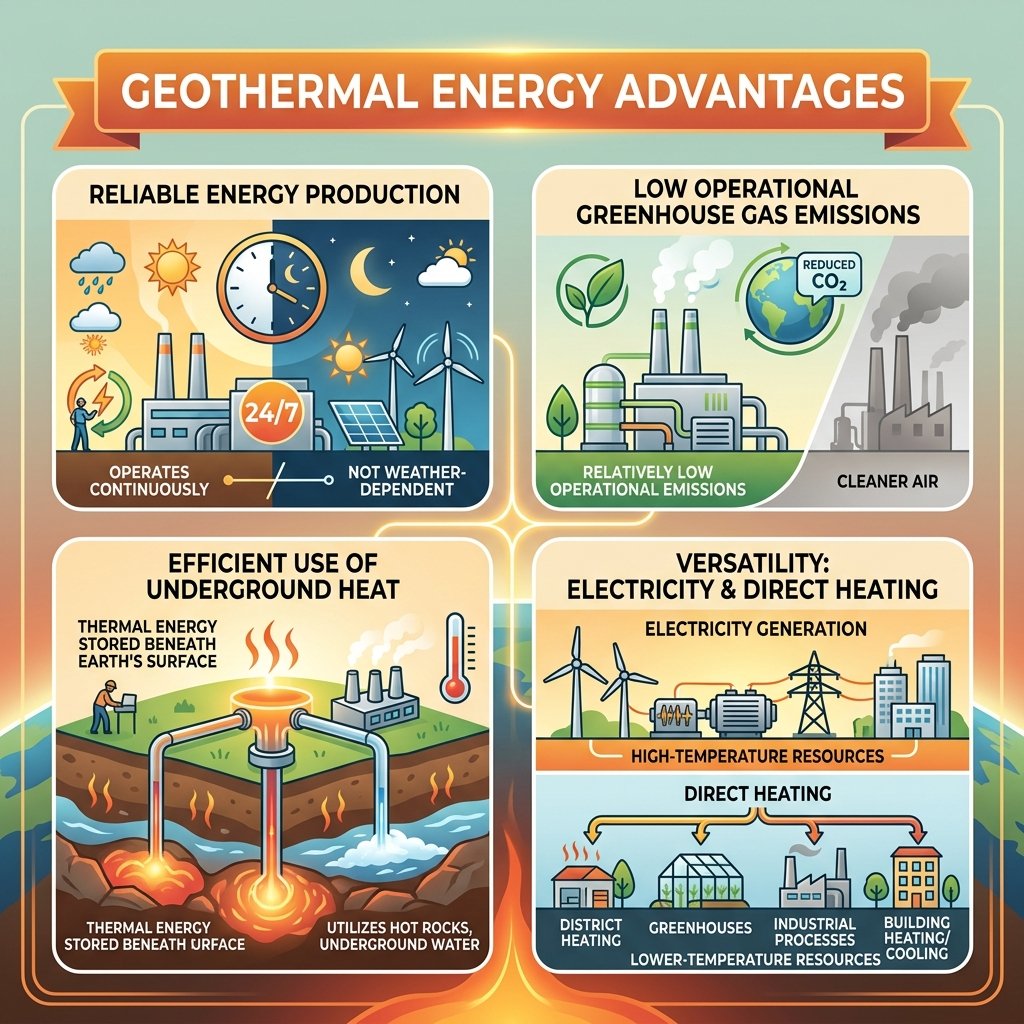
Geothermal Energy Advantages include reliable energy production, relatively low operational greenhouse gas emissions, efficient use of underground heat, and the ability to provide both electricity and direct heating. Geothermal energy uses thermal energy stored beneath the Earth’s surface, where hot rocks, underground water, steam, and geological formations can provide useful energy.
Unlike solar and wind resources, geothermal energy does not depend directly on sunshine or wind conditions. Suitable geothermal facilities can operate continuously throughout the day and across seasons. This reliability makes geothermal power particularly valuable in electricity systems that need dependable generation alongside variable renewable resources.
Geothermal energy is also versatile. High-temperature resources can generate electricity, while lower-temperature resources can support district heating, greenhouses, industrial processes, and building heating and cooling.
Geothermal Energy Advantages for Reliable Power
One of the most significant Geothermal Energy Advantages is the ability to provide steady electricity. A geothermal power plant can generally operate day and night because the underground heat resource is continuously available.
Solar electricity production changes with sunlight, while wind generation depends on wind conditions. Geothermal plants are less directly affected by daily weather variations.
This characteristic allows geothermal power to contribute firm or dispatchable generation, depending on plant and reservoir design. Reliable geothermal generation can therefore complement solar, wind, hydropower, energy storage, and other technologies within a diversified electricity system.
1. Renewable Energy from Earth
Geothermal energy is generally classified as renewable when resources are responsibly managed. Earth’s interior contains enormous quantities of thermal energy, including heat remaining from planetary formation and heat continually produced through natural radioactive decay.
Geothermal development captures a small portion of this underground energy.
Proper reservoir management is essential. In many geothermal projects, fluids brought to the surface are reinjected underground after useful heat has been extracted. Reinjection can help maintain reservoir pressure and support long-term resource productivity.
2. Low Operational Greenhouse Gas Emissions
Another important advantage is geothermal energy’s relatively low greenhouse gas emissions compared with conventional fossil-fuel electricity generation.
Geothermal power is not completely emission-free. Some geothermal reservoirs naturally contain gases that may be released during operation, and emissions also occur during construction, drilling, manufacturing, and transportation.
Nevertheless, geothermal electricity can offer substantial climate benefits when it replaces more carbon-intensive energy sources. Binary-cycle systems can further limit direct atmospheric releases because geothermal fluids generally remain within a controlled system before reinjection.
3. Continuous Electricity Generation
The continuous availability of underground heat is particularly useful for power grids.
Geothermal plants can achieve high utilization because they are not restricted to daylight hours or dependent on short-term wind conditions. Maintenance and reservoir management still affect production, but the underlying energy resource is available around the clock.
Continuous generation can help utilities maintain electricity supply while integrating increasing amounts of variable renewable energy.
4. Efficient Land Use
Land requirements are another consideration among Geothermal Energy Advantages. Geothermal power facilities can produce substantial electricity from a relatively concentrated development area.
Most of the energy resource exists underground. Surface infrastructure typically includes wells, pipelines, power-generation equipment, cooling systems, roads, and supporting facilities.
Actual environmental impacts vary considerably by project. Careful site planning is still necessary to protect habitats, water resources, landscapes, and nearby communities.
5. Heating and Cooling Applications
Geothermal resources are useful for much more than electricity.
Moderate- and lower-temperature geothermal water can provide heat directly to buildings, industrial facilities, agricultural operations, greenhouses, and district heating networks. Using heat directly can avoid some of the energy losses involved in converting thermal energy into electricity.
Ground-source heat pumps provide another application. They use relatively stable shallow-ground temperatures to heat and cool buildings. During winter, heat can be transferred from the ground into a building. During warmer periods, the system can move heat from the building back into the ground.
This broad range of applications increases geothermal energy’s usefulness.
6. Long Operating Life
Geothermal facilities can operate for decades when their reservoirs and infrastructure are appropriately managed.
The long operating period can help spread initial investment costs across many years of energy production. However, long-term performance depends on geological conditions, reinjection strategies, well maintenance, fluid chemistry, and reservoir management.
Operators must continuously monitor temperature, pressure, flow rates, and other reservoir characteristics to prevent excessive resource decline.
Sustainable management is therefore essential for realizing the long-term Geothermal Energy Advantages of a project.
7. Reduced Dependence on Fossil Fuels
Countries with economically accessible geothermal resources can use them to reduce dependence on coal, oil, or natural gas for electricity and heat.
Developing domestic geothermal resources can diversify an energy system and reduce exposure to some imported-fuel risks. Unlike fossil fuels, geothermal power plants do not require continuous deliveries of combustible fuel.
However, equipment, drilling materials, specialized services, and construction resources may still depend on international supply chains.
Geothermal energy should therefore be viewed as one component of a broader strategy for energy security and diversification.
8. Multiple Geothermal Technologies
Different technologies can use geothermal resources with different characteristics.
Dry-steam plants can use naturally occurring geothermal steam. Flash-steam facilities use high-temperature geothermal water that partially converts to steam when pressure decreases.
Binary-cycle power plants can utilize moderate-temperature resources by transferring geothermal heat to a secondary working fluid with a lower boiling point. The vaporized secondary fluid then powers a turbine.
These technological options allow developers to select systems according to resource temperature, pressure, fluid chemistry, geological conditions, and economic requirements.
9. Economic and Employment Benefits
Geothermal development can support economic activity through exploration, drilling, construction, engineering, plant operation, maintenance, geological services, and environmental monitoring.
Projects may create skilled employment opportunities and encourage investment in regions with strong geothermal potential.
Economic benefits vary significantly between projects and countries. Initial exploration and drilling can be expensive, and unsuccessful wells represent financial risk. Therefore, geological research and resource assessment are crucial before large-scale development begins.
Once a productive facility is operating, however, it does not require continual purchases of fossil fuel, which can provide greater predictability for some operating costs.
10. Supporting a Diverse Renewable Energy System
One of the broader Geothermal Energy Advantages is its ability to work alongside other renewable resources.
An energy system does not necessarily need to choose between geothermal, solar, wind, and hydropower. These technologies can complement one another because their operating characteristics differ.
Solar generation is strongest during suitable daylight conditions, wind resources vary by location and weather, and geothermal can provide relatively consistent production.
Combining multiple energy technologies with storage, transmission, demand management, and efficient electricity networks can improve overall system resilience.
Challenges to Consider
Despite its benefits, geothermal energy also has limitations. Suitable conventional geothermal resources are not distributed equally around the world.
Exploration and deep drilling require significant upfront investment. Geological uncertainty can make projects financially risky before productive wells are confirmed.
Geothermal fluids may contain dissolved minerals and gases that require careful management. Mineral scaling and corrosion can affect equipment. Some geothermal developments can also be associated with induced seismicity, particularly where subsurface fluid pressures are changed.
Responsible geothermal development therefore requires geological assessment, environmental review, appropriate regulation, reservoir monitoring, and careful engineering.
Future Geothermal Energy Advantages
Technological progress could make geothermal energy available in more locations.
Enhanced Geothermal Systems (EGS) seek to access underground heat where natural permeability or fluid availability is insufficient for conventional geothermal production. Improvements in deep drilling, subsurface imaging, reservoir modeling, and advanced power systems may reduce technical barriers.
Advanced geothermal development could potentially expand electricity and heat production beyond traditional volcanic and hydrothermal regions.
Geothermal technologies may also provide industrial heat and support district energy systems, creating opportunities beyond conventional electricity generation.
Conclusion
Geothermal Energy Advantages extend from reliable renewable electricity and relatively low operational emissions to efficient heating, long-term energy production, and reduced dependence on combustible fuels.
Geothermal power is especially valuable because underground heat is continuously available and can complement variable renewable resources such as solar and wind. Different technologies—including dry steam, flash steam, binary cycle, ground-source heat pumps, and emerging enhanced geothermal systems—allow Earth’s heat to be used in different ways.
Geothermal energy is not without environmental, geological, and economic challenges. Exploration costs, drilling risks, reservoir management, fluid chemistry, and induced seismicity require careful attention. When projects are properly designed and responsibly managed, however, geothermal resources can make an important contribution to a reliable, diversified, and lower-carbon energy future.Binary Cycle Geothermal Power Plants https://www.unesco.org/en/query-list/n/natural-resources