
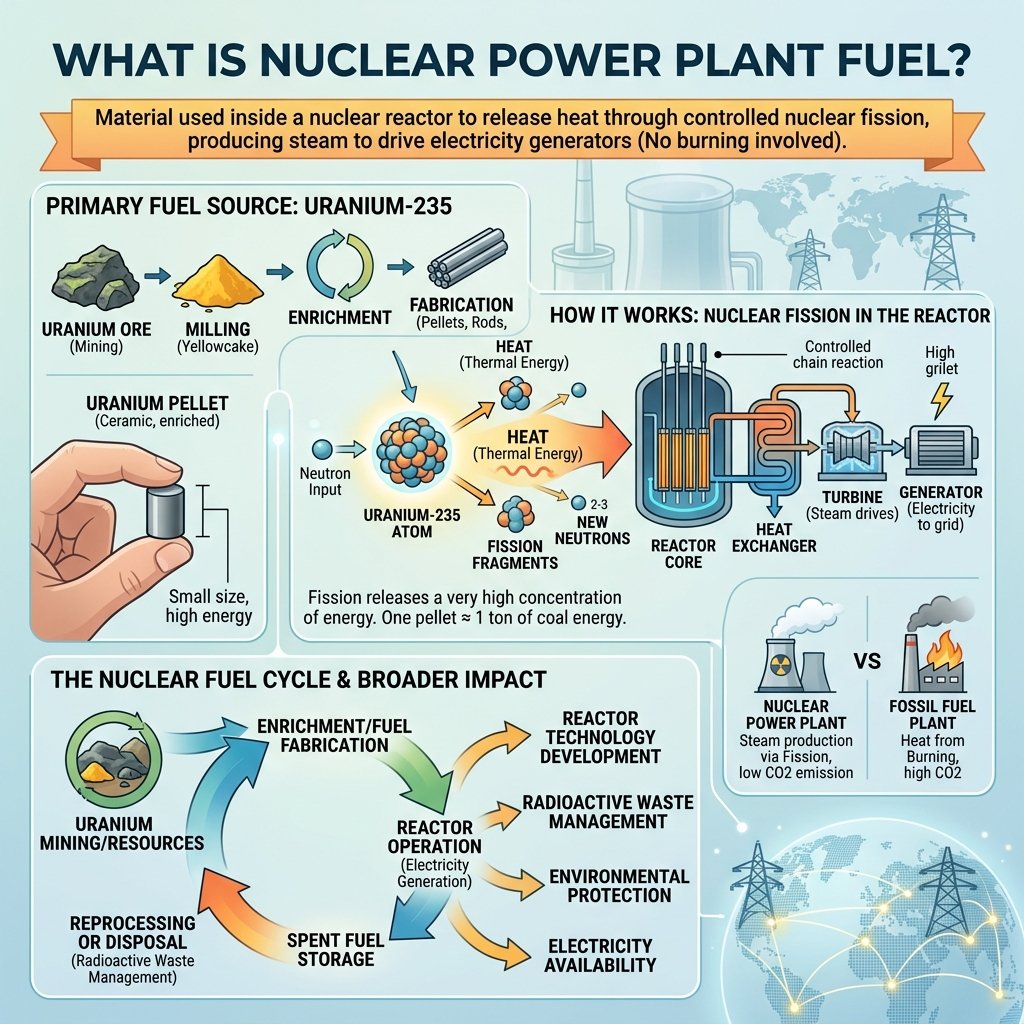
Nuclear Power Plant Fuel is the material used inside a nuclear reactor to release heat through a controlled process known as nuclear fission. This heat is then used to produce steam, which drives turbines connected to electrical generators. Unlike fossil-fuel power stations, nuclear plants do not generate electricity by burning coal, oil, or natural gas. Instead, they obtain thermal energy from changes occurring within atomic nuclei.
Uranium is the most widely used fuel in commercial nuclear power plants. It contains isotopes, particularly uranium-235, that can undergo fission when interacting with neutrons. Because nuclear fuel contains a very high concentration of energy, relatively small quantities can support substantial electricity production.
Understanding nuclear fuel is important because it connects several major areas of nuclear energy, including uranium resources, reactor technology, electricity generation, fuel-cycle management, radioactive waste, and environmental protection.
Uranium as Nuclear Power Plant Fuel
Uranium is a naturally occurring element found in rocks and mineral deposits around the world. Natural uranium consists mainly of uranium-238, with a much smaller proportion of uranium-235.
For many commercial reactor designs, uranium undergoes industrial processing before becoming usable reactor fuel. After uranium ore is extracted and processed into a concentrated uranium product, additional fuel-cycle stages prepare the material for a specific reactor design.
In many light-water reactors, uranium is enriched so that the proportion of uranium-235 is higher than in natural uranium. The enriched material can then be converted into uranium dioxide powder and manufactured into small ceramic fuel pellets.
These processes are performed in specialized, regulated facilities because nuclear materials require strict quality assurance, radiation protection, safeguards, security, and environmental controls.
How Nuclear Power Plant Fuel Is Used
Nuclear Power Plant Fuel and Its Importance
A typical uranium fuel pellet is small, but nuclear fuel has extremely high energy density. Fuel pellets are arranged inside sealed metal tubes known as fuel rods. Multiple fuel rods are grouped together to create fuel assemblies.
Fuel assemblies are positioned inside the reactor core according to the reactor’s engineered design. During normal operation, controlled fission reactions inside the fuel release thermal energy.
When a uranium-235 nucleus undergoes fission, it splits into smaller nuclei and releases energy along with additional neutrons. Some of these neutrons can interact with other fissile nuclei, allowing a controlled chain reaction to continue.
The reactor’s control and safety systems regulate this process. The resulting heat is transferred through the reactor’s cooling system and ultimately used to produce electricity.
Nuclear Power Plant Fuel and Electricity Generation
The main purpose of Nuclear Power Plant Fuel is to provide a dependable source of heat for electricity generation.
In a pressurized water reactor, for example, water circulating through the reactor core absorbs heat from the fuel. This heated primary-system water transfers its thermal energy through steam generators to a separate water circuit. Steam from the secondary system drives a turbine, and the turbine turns an electrical generator.
Boiling water reactors use a different configuration in which water boils within the reactor vessel and the resulting steam is directed toward the turbine system.
Although reactor technologies differ, the underlying energy conversion is similar: nuclear fission produces heat, heat supports steam production, and turbines and generators convert that energy into electricity.
Fuel Rods and Fuel Assemblies
Fuel rods are engineered to contain nuclear fuel and help retain radioactive fission products during reactor operation. In many reactor designs, uranium dioxide pellets are placed inside tubes made from zirconium-based alloys or other qualified materials.
Fuel assemblies organize many individual rods into carefully engineered structures. Their design must consider heat transfer, coolant flow, mechanical stability, neutron behavior, material performance, and reactor safety.
Fuel does not remain in a reactor indefinitely. Utilities periodically shut reactors down for refueling and maintenance. Some fuel assemblies are removed while others may be repositioned according to an approved fuel-management strategy. Fresh fuel is then introduced where required.
Nuclear Fuel Efficiency and Energy Density
One of nuclear energy’s most important technical characteristics is the extremely high energy density of its fuel.
Fossil-fuel plants require continuous deliveries of large quantities of combustible material. Nuclear reactors, by comparison, can operate for long periods using comparatively small volumes of nuclear fuel.
This does not mean nuclear electricity has no environmental footprint. Uranium mining, fuel processing, enrichment, plant construction, transportation, decommissioning, and waste management all have environmental and resource implications.
However, nuclear power plants generally have low operational greenhouse-gas emissions because electricity production does not depend on continuously burning carbon-based fuels.
Nuclear Power Plant Fuel Cycle
The Nuclear Power Plant Fuel cycle describes the stages associated with producing, using, and managing nuclear fuel.
It begins with uranium exploration and mining, followed by milling and conversion. Depending on the reactor technology, enrichment may follow. Fuel fabrication then converts suitable nuclear material into engineered fuel assemblies.
The assemblies are transported under regulated conditions to nuclear power stations and loaded into reactors. After their useful operating period, they are removed and classified as spent nuclear fuel.
The later stages vary by national policy and fuel-cycle strategy. Some countries primarily pursue direct disposal after interim storage, while others reprocess certain spent-fuel materials for potential reuse.
Spent Nuclear Fuel Management
Spent nuclear fuel remains highly radioactive after removal from a reactor and continues producing decay heat. It therefore requires controlled handling, cooling, shielding, security, and long-term management.
Initially, spent fuel is commonly stored in water-filled pools at nuclear facilities. Water provides cooling and radiation shielding. After sufficient cooling, some spent fuel can be transferred to engineered dry-storage systems.
For long-term management, geological disposal is an important strategy under development or implementation in several countries. Deep geological repositories are designed around multiple protective barriers intended to isolate radioactive material from people and the environment over very long periods.
Nuclear Fuel Safety
Safety is central to every stage involving Nuclear Power Plant Fuel. Fuel manufacturing, transportation, reactor operation, storage, and waste management operate within extensive regulatory frameworks.
Nuclear facilities use multiple engineered barriers, monitoring systems, operational procedures, quality standards, emergency arrangements, and radiation-protection measures. International safeguards also play an important role in verifying that nuclear materials used for peaceful purposes remain properly accounted for.
Effective fuel management therefore requires cooperation among plant operators, regulators, scientists, engineers, governments, and international organizations.
Advanced Nuclear Fuels
Research continues into advanced fuels intended to improve reactor performance and safety. One important area is accident-tolerant fuel, which seeks improved performance under severe operating conditions compared with conventional fuel systems.
Advanced reactor concepts may also use different fuel forms or compositions. Some designs are being developed around high-assay low-enriched uranium, while others investigate fuels based on particles, metallic materials, molten salts, or alternative fuel cycles.
These technologies are at different stages of research, demonstration, licensing, and commercialization, so their future role will depend on technical performance, economics, regulation, fuel availability, and national energy policies.
Environmental Importance of Nuclear Power Plant Fuel
Nuclear fuel plays an important role in discussions about energy security and climate change because nuclear reactors can provide large quantities of low-carbon electricity while operating independently of weather conditions.
At the same time, responsible management must address uranium extraction, worker protection, radioactive materials, spent fuel, decommissioning, and long-term waste disposal. These responsibilities extend well beyond the operating lifetime of an individual reactor.
For this reason, evaluating nuclear energy requires examining the entire fuel cycle rather than considering electricity generation alone
Future of Nuclear Power Plant Fuel
The future of Nuclear Power Plant Fuel will be closely connected to developments in advanced reactors, small modular reactors, fuel recycling technologies, waste-management systems, and improved fuel materials.
Research aims to increase fuel performance, improve safety characteristics, use nuclear resources efficiently, and develop reliable approaches for managing spent fuel and radioactive waste.
Nuclear fuel will therefore remain a major scientific and engineering subject as countries evaluate different pathways for reliable, secure, and lower-carbon electricity systems.
Conclusion
Nuclear Power Plant Fuel is the energy-producing material at the heart of nuclear electricity generation. Uranium-based fuel is manufactured into pellets, fuel rods, and assemblies that operate within carefully controlled reactor systems. Nuclear fission releases heat, which can then be converted into steam and ultimately electricity.
The nuclear fuel cycle extends from uranium production through fuel fabrication, reactor operation, spent-fuel storage, and eventual recycling or disposal. Although nuclear fuel offers exceptional energy density and supports low-carbon electricity generation, it also requires rigorous safety, security, environmental protection, regulatory oversight, and long-term radioactive-waste management.
Understanding the complete nuclear fuel cycle provides a stronger foundation for evaluating the role nuclear power may play in future energy systems. https://naturalresourc.com/uranium-waste-treatment/ https://www.unesco.org/en/query-list/n/natural-resources