
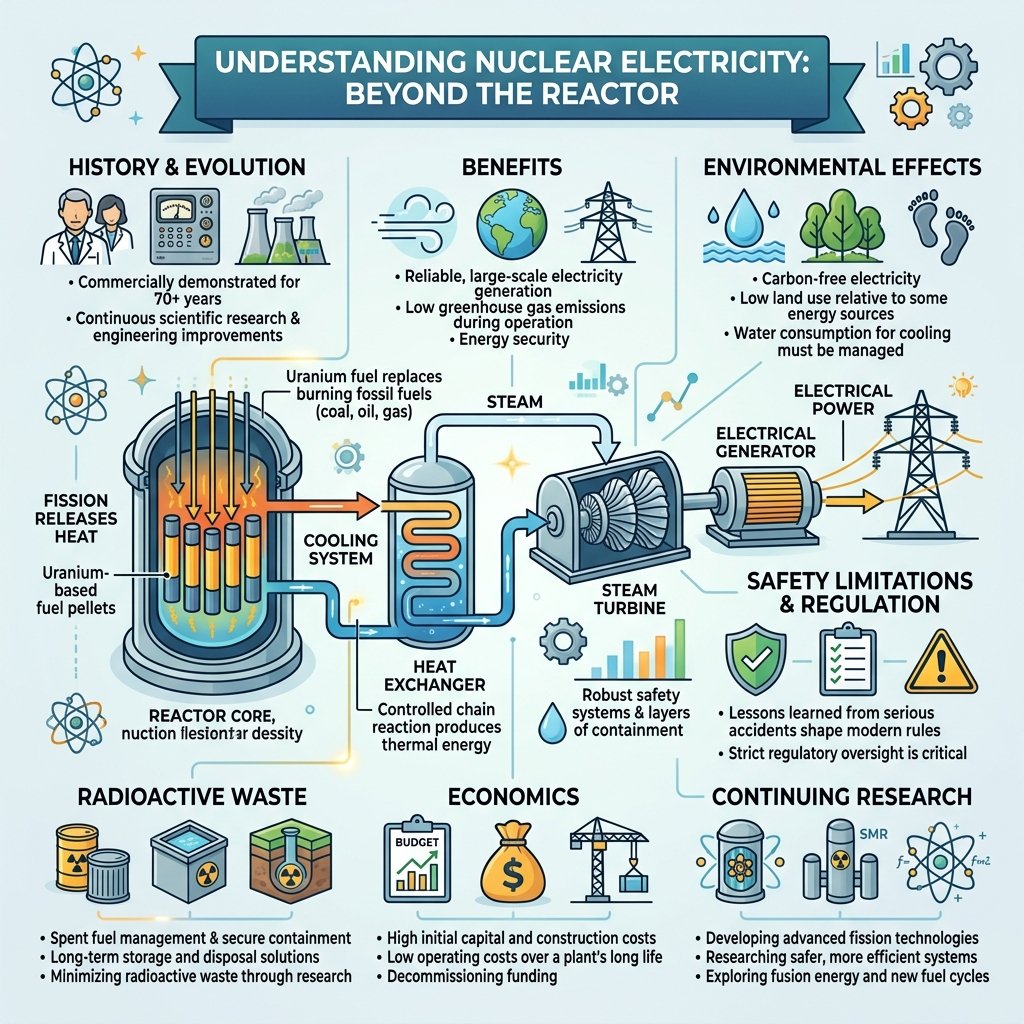
Nuclear Power Plants for Electricity use energy released from controlled nuclear fission to produce heat and ultimately generate electrical power. Instead of burning coal, oil, or natural gas, most commercial nuclear reactors use uranium-based fuel.
Inside the reactor, fission releases heat. A cooling system transfers this thermal energy, and in most conventional nuclear plants it is ultimately used to produce steam. The steam drives a turbine connected to an electrical generator.
This basic principle has been commercially demonstrated for more than seven decades. However, modern nuclear power is the result of continuous scientific research, engineering improvements, operational experience, regulation, and lessons learned from serious accidents.
Understanding nuclear electricity therefore requires more than describing how a reactor works. Its history, benefits, environmental effects, safety limitations, radioactive waste, economics, and continuing research must also be examined.
History of Nuclear Power Plants for Electricity
The scientific foundations of nuclear power developed during the first half of the twentieth century. A decisive discovery came in 1938–1939, when nuclear fission was identified and scientifically explained. Scientists subsequently recognized that splitting certain heavy atomic nuclei could release substantial amounts of energy.
The transition from nuclear physics to electricity production took place gradually.
An important milestone occurred in the United States in 1951, when Experimental Breeder Reactor I (EBR-I) demonstrated that energy from nuclear fission could be converted into electricity.
The development of grid-scale nuclear electricity followed shortly afterward.
According to historical information published by the International Atomic Energy Agency (IAEA), the reactor at Obninsk in the Soviet Union began operation on 27 June 1954, producing approximately 5 MW of electrical power. The IAEA describes it as the first nuclear reactor designed for electricity generation
Further developments followed rapidly. Shippingport in the United States became operational in 1957 as an early commercial pressurized-water reactor plant. Calder Hall in the United Kingdom also represented an important early stage in nuclear electricity development. By 1960, boiling-water reactor technology had entered operation at Dresden in the United States.
These developments established the technological foundations from which the modern nuclear electricity industry grew.
How Nuclear Power Plants for Electricity Work
The central process in most existing nuclear power plants is nuclear fission.
Fuel containing fissile material such as uranium-235 is placed inside the reactor core. When a suitable neutron interacts with a uranium-235 nucleus, the nucleus can split into smaller nuclei. This reaction releases energy and additional neutrons.
Those neutrons may produce further fission reactions, creating a chain reaction.
A power reactor is engineered to keep this reaction controlled rather than allowing it to increase without regulation. Reactor control systems, coolant systems, fuel structures, containment barriers, monitoring equipment, and other safety systems work together to maintain appropriate operating conditions.
The heat generated in the reactor is transferred to water or another coolant.
In a Pressurized Water Reactor (PWR), high-pressure primary water carries heat from the reactor to steam generators. A separate water circuit produces steam that drives the turbine.
In a Boiling Water Reactor (BWR), water is heated and boils within the reactor vessel, producing steam that can be directed toward the turbine.
The turbine rotates a generator, which converts mechanical energy into electricity for the power grid.
Why Nuclear Power Became Important
One major advantage of nuclear fuel is its exceptionally high energy density. A relatively small quantity of nuclear material can provide large amounts of energy compared with conventional fossil fuels.
Nuclear plants can also operate for long periods and are not dependent on immediate sunlight or wind conditions. This makes them capable of providing large amounts of dispatchable or continuously available electricity, depending on how a country’s electricity system operates.
Another important consideration is climate change.
Nuclear reactors do not burn fossil fuels during electricity generation. Their direct operational carbon dioxide emissions are therefore very low. Life-cycle emissions are not zero because uranium mining, fuel processing, construction, transportation, maintenance, and decommissioning all require resources and energy.
For this reason, nuclear energy is more accurately described as a low-carbon electricity source, rather than a completely emission-free technology.
Benefits of Nuclear Power Plants for Electricity
Nuclear Power Plants for Electricity can provide several significant benefits.
They can generate large quantities of electricity from relatively small quantities of fuel and maintain electricity production over long operating periods. Their low operational greenhouse-gas emissions can also contribute to electricity-sector decarbonization.
Nuclear generation can improve energy-system diversity by reducing dependence on a single fuel or technology. Countries with nuclear capacity may combine it with hydroelectricity, wind, solar, storage, natural gas, and other resources according to their electricity needs.
However, these benefits should not be considered separately from the technology’s costs and risks.
Nuclear Accidents and Lessons Learned
The history of nuclear energy also contains serious accidents. They are essential to understanding how nuclear safety developed.
Three Mile Island in 1979, Chernobyl in 1986, and Fukushima Daiichi in 2011 each influenced nuclear engineering, regulation, emergency planning, operator training, and public understanding of nuclear risk.
Fukushima provides an especially important modern example.
On 11 March 2011, the operating Fukushima Daiichi reactors shut down following a major earthquake. However, the subsequent tsunami flooded critical infrastructure, contributing to the loss of electrical power and cooling capabilities. Reactor cores in Units 1, 2, and 3 overheated and suffered severe fuel damage. Hydrogen explosions also damaged reactor buildings.
The accident was classified at the highest level of the International Nuclear and Radiological Event Scale.
Research and regulatory reviews after Fukushima led countries to reassess external hazards, backup electrical supplies, cooling capabilities, severe-accident management, emergency preparedness, and defence-in-depth.
The OECD Nuclear Energy Agency emphasizes an important scientific point: an accident can never be completely ruled out.
Therefore, responsible nuclear safety does not mean claiming that an accident is impossible. It means reducing probabilities, providing multiple protective barriers, preparing for failures, and continually improving systems as new evidence becomes available.
Nuclear Power Plants for Electricity and Modern Safety
Modern nuclear safety uses the principle known as defence-in-depth.
Instead of relying on one component to prevent an accident, nuclear plants employ multiple levels of protection. These include fuel design, reactor control, cooling systems, physical containment barriers, backup equipment, operating procedures, monitoring, independent regulation, and emergency response arrangements.
If one level fails, additional layers are intended to prevent or mitigate severe consequences.
The Fukushima accident demonstrated that engineers must also consider combinations of extreme events and circumstances beyond assumptions used in the original plant design.
Consequently, safety should be understood as a process of continuous improvement rather than a problem that engineering has permanently “solved.”
What Research Is Being Conducted Today?
Research into nuclear electricity has not stopped.
Scientists, engineers, regulators, laboratories, and international organizations continue investigating advanced fuels, materials capable of tolerating higher temperatures, severe-accident behavior, improved modelling, passive safety systems, long-term reactor operation, radioactive-waste management, and decommissioning.
Post-Fukushima research has examined accident-tolerant fuels, including materials intended to withstand severe conditions longer and reduce undesirable chemical reactions such as excessive hydrogen production.
Research is also advancing Small Modular Reactors (SMRs) and several advanced reactor concepts.
Some proposed reactors incorporate passive safety features that rely more heavily on physical phenomena such as gravity, natural circulation, or pressure differences rather than requiring continuous powered intervention for certain safety functions.
However, an important distinction is necessary: not every proposed advanced reactor has been commercially demonstrated at large scale.
A technology being researched, licensed, demonstrated, or proposed should not be presented to readers as though it already has decades of commercial operating evidence.
The Future of Nuclear Electricity
The future role of Nuclear Power Plants for Electricity remains an active technological, economic, environmental, and political question.
Research may produce safer fuels, improved reactor designs, more efficient construction methods, better waste-management technologies, and advanced monitoring systems. SMRs and Generation IV reactor concepts could change how nuclear plants are designed and deployed.
Nevertheless, their eventual contribution will depend on demonstrated safety, construction costs, financing, regulatory approval, supply chains, fuel availability, waste solutions, public acceptance, and actual operating performance.
These are areas where evidence from future projects will matter more than predictions.
Conclusion
Nuclear Power Plants for Electricity developed from fundamental discoveries in nuclear physics into an industry capable of producing large quantities of electricity. Early electricity-generation experiments in the 1950s demonstrated the concept, and subsequent reactor development led to commercial nuclear power systems around the world.
Nuclear power offers important advantages, including high fuel energy density, reliable electricity production, and low operational greenhouse-gas emissions. At the same time, it carries genuine challenges involving high capital costs, severe-accident risk, radioactive waste, decommissioning, security, and long-term environmental responsibilities.
Past accidents have shown why nuclear technology should never be described as risk-free. They have also produced important scientific and engineering lessons that have influenced modern plant design, regulation, emergency preparedness, and continuing safety research.
The strongest assessment of nuclear electricity therefore avoids both exaggeration and dismissal. Its benefits should be supported by evidence, its risks should be acknowledged, and technologies still under development should be clearly distinguished from those already demonstrated in commercial operation.https://www.unesco.org/en/query-list/n/natural-resources