
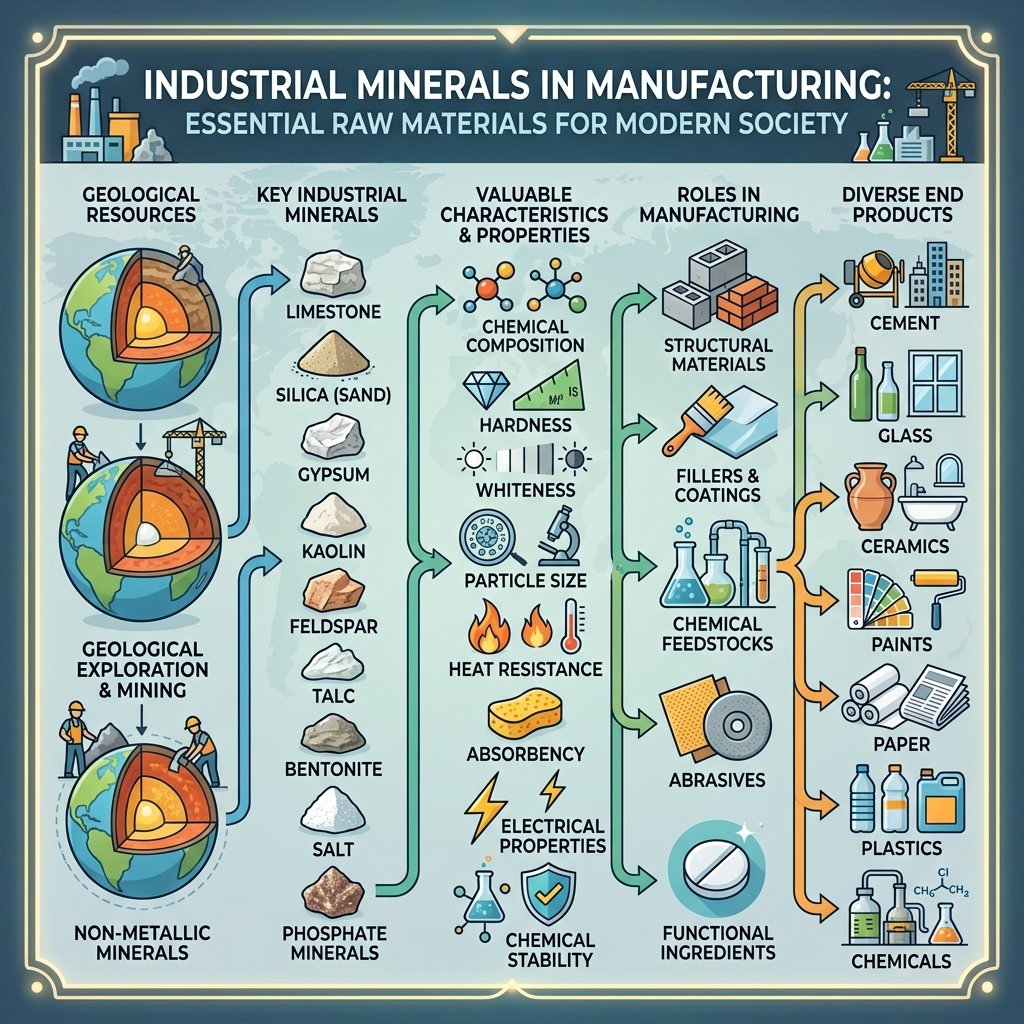
Industrial Minerals in Manufacturing are essential raw materials used to produce many of the materials and products that support modern society. Minerals such as limestone, silica, gypsum, kaolin, feldspar, talc, bentonite, salt, and phosphate minerals provide specific physical and chemical properties required by manufacturing industries.
Unlike metallic ores, which are primarily mined to recover metals, industrial minerals are often valuable because of characteristics such as chemical composition, hardness, whiteness, particle size, heat resistance, absorbency, electrical properties, or chemical stability. These characteristics allow manufacturers to use industrial minerals as structural materials, fillers, coatings, chemical feedstocks, abrasives, and functional ingredients.
From cement and glass to ceramics, paints, paper, plastics, and chemicals, industrial minerals form an important connection between geological resources and manufacturing.
Importance of Industrial Minerals in Manufacturing
Industrial Minerals in Manufacturing perform different functions depending on the properties of each mineral. Some become major components of finished products, while others are added in smaller quantities to improve performance.
For example, limestone provides calcium carbonate used in cement production and numerous manufactured products. Silica is a major ingredient in glass. Kaolin is important in ceramics and paper, while feldspar is widely used in ceramic and glass manufacturing.
The economic importance of these minerals therefore extends beyond mining. Once processed, they become inputs to manufacturing supply chains that produce higher-value materials and consumer goods.
Limestone and Cement Manufacturing
Limestone is one of the most important industrial mineral resources used by manufacturing industries. It consists mainly of calcium carbonate and is a fundamental raw material for cement production.
In cement manufacturing, carefully prepared limestone is combined with other materials and heated at high temperatures to produce clinker. The clinker is subsequently ground with gypsum and other permitted constituents to manufacture cement.
Limestone is also processed to produce quicklime and hydrated lime. These materials are used in construction, environmental treatment, steelmaking, mineral processing, and various chemical industries.
Calcium carbonate derived from limestone can additionally serve as a filler in paper, plastics, paints, and other products.
Silica in Glass Manufacturing
Silica sand is another major example of Industrial Minerals in Manufacturing. High-quality silica sand consists predominantly of silicon dioxide and is a fundamental raw material for many types of glass.
During glass manufacturing, silica is combined with other ingredients and heated until a molten material forms. Controlled cooling and forming processes then create products such as bottles, windows, containers, fiberglass, and specialized glass.
The quality of silica is important. Iron and other impurities can affect glass color and performance. Consequently, manufacturers may require silica deposits with particular chemical compositions and particle-size characteristics.
Silica dust generated during mining or processing can create occupational health hazards when respirable crystalline silica is inhaled. Industrial operations therefore require appropriate exposure controls and worker-protection measures.
Clay and Kaolin in Manufacturing
Clay minerals have supported manufacturing for thousands of years and remain important today. Kaolin, a clay rich in the mineral kaolinite, is widely used in ceramics and also has applications in paper, paints, plastics, and other products.
In ceramics, clay provides plasticity during shaping and develops strength after firing. Kaolin’s fine particle size, relatively light color, and mineral characteristics make it useful for products requiring controlled appearance and performance.
Other clays are used to manufacture bricks, tiles, pipes, refractories, and construction products.
The exact industrial application depends on mineral composition, particle size, impurities, firing behavior, and other technical characteristics.
Feldspar in Ceramics and Glass
Feldspar represents a major group of rock-forming minerals with important industrial applications. In ceramics, feldspar commonly acts as a flux, helping other materials melt or react at appropriate processing temperatures.
It is used in products such as ceramic tiles, sanitary ware, tableware, and glass. Its sodium, potassium, calcium, and aluminosilicate composition varies according to the feldspar mineral and geological deposit.
Manufacturers carefully select mineral grades because unwanted impurities can influence product color, strength, melting behavior, and overall quality.
Industrial Minerals in Paper and Paint
Industrial Minerals in Manufacturing are not always the main structural ingredient of a product. They can also function as fillers, pigments, coatings, or performance-enhancing materials.
Calcium carbonate and kaolin are widely used in the paper industry. Depending on the product and manufacturing process, they can help control properties such as brightness, opacity, smoothness, and printability.
Paint manufacturers also use mineral materials such as calcium carbonate, talc, kaolin, and silica. These materials can influence texture, durability, rheology, surface characteristics, and manufacturing costs.
The mineral must meet specifications appropriate to the intended application.
Industrial Minerals in Plastics
Mineral fillers are widely incorporated into plastics and polymer composites. Calcium carbonate, talc, kaolin, and other minerals can modify stiffness, dimensional stability, surface properties, processing behavior, or production economics.
However, adding a mineral does not automatically improve every characteristic of a plastic. Performance depends on particle size, mineral shape, concentration, surface treatment, polymer chemistry, and manufacturing conditions.
This is an important distinction in professional mineral science: the suitability of an industrial mineral must be evaluated according to the specific application rather than assuming that one mineral grade performs equally well in every product.
Mineral Processing and Quality Control
Before Industrial Minerals in Manufacturing reach factories, they often undergo substantial processing. Operations may include crushing, grinding, washing, screening, drying, flotation, magnetic separation, classification, calcination, or purification.
Manufacturers often require strict specifications. Important parameters can include mineralogical composition, chemical purity, particle-size distribution, moisture, brightness, density, and contaminant levels.
High-value applications may require significantly greater purity and processing than bulk construction uses. Therefore, two deposits containing the same basic mineral can have very different commercial values.
Geological exploration, laboratory testing, process engineering, and quality-control systems are essential for determining whether a deposit is suitable for a particular manufacturing application.
Sustainability of Industrial Minerals in Manufacturing
Sustainable management of Industrial Minerals in Manufacturing involves more than efficient extraction. Mining can affect land, ecosystems, water resources, air quality, and surrounding communities, while mineral processing can consume energy and generate waste.
Responsible operations can reduce these impacts through environmental assessment, efficient water use, dust management, energy efficiency, waste reduction, land rehabilitation, and careful monitoring.
Recycling also has an important role. Glass, construction materials, and some mineral-containing industrial products can be recovered and reused, reducing demand for virgin raw materials in suitable applications.
Nevertheless, recycling cannot completely eliminate the need for primary mineral extraction because material losses, contamination, product growth, and technical requirements can limit circularity.
Future of Industrial Minerals in Manufacturing
The future of Industrial Minerals in Manufacturing will be influenced by urbanization, infrastructure development, advanced materials, environmental standards, digital manufacturing, and efforts to reduce industrial emissions.
Improved mineral sorting, automated processing, digital geological modeling, cleaner energy sources, and advanced recycling technologies may help manufacturers and mining companies use resources more efficiently.
Research is also developing specialized mineral materials with carefully engineered particle sizes, surfaces, purity levels, and functional properties. These developments may expand applications in advanced ceramics, environmental technologies, electronics, energy systems, and other high-performance industries.
Conclusion
Industrial Minerals in Manufacturing provide essential raw materials for cement, glass, ceramics, paper, paints, plastics, chemicals, construction materials, and numerous other products. Limestone, silica, kaolin, feldspar, gypsum, talc, bentonite, and related resources demonstrate how geological materials become part of modern industrial supply chains.
Their value depends not only on how much mineral exists underground but also on purity, physical properties, processing requirements, transportation, environmental management, and suitability for specific applications.
As manufacturing technology develops, responsible mining, efficient processing, recycling, scientific quality control, and environmental protection will become increasingly important. Understanding Industrial Minerals in Manufacturing therefore provides an important foundation for understanding how natural mineral resources support modern industry while highlighting the need to manage those resources responsibly .https://www.unesco.org/en/query-list/n/natural-resources