
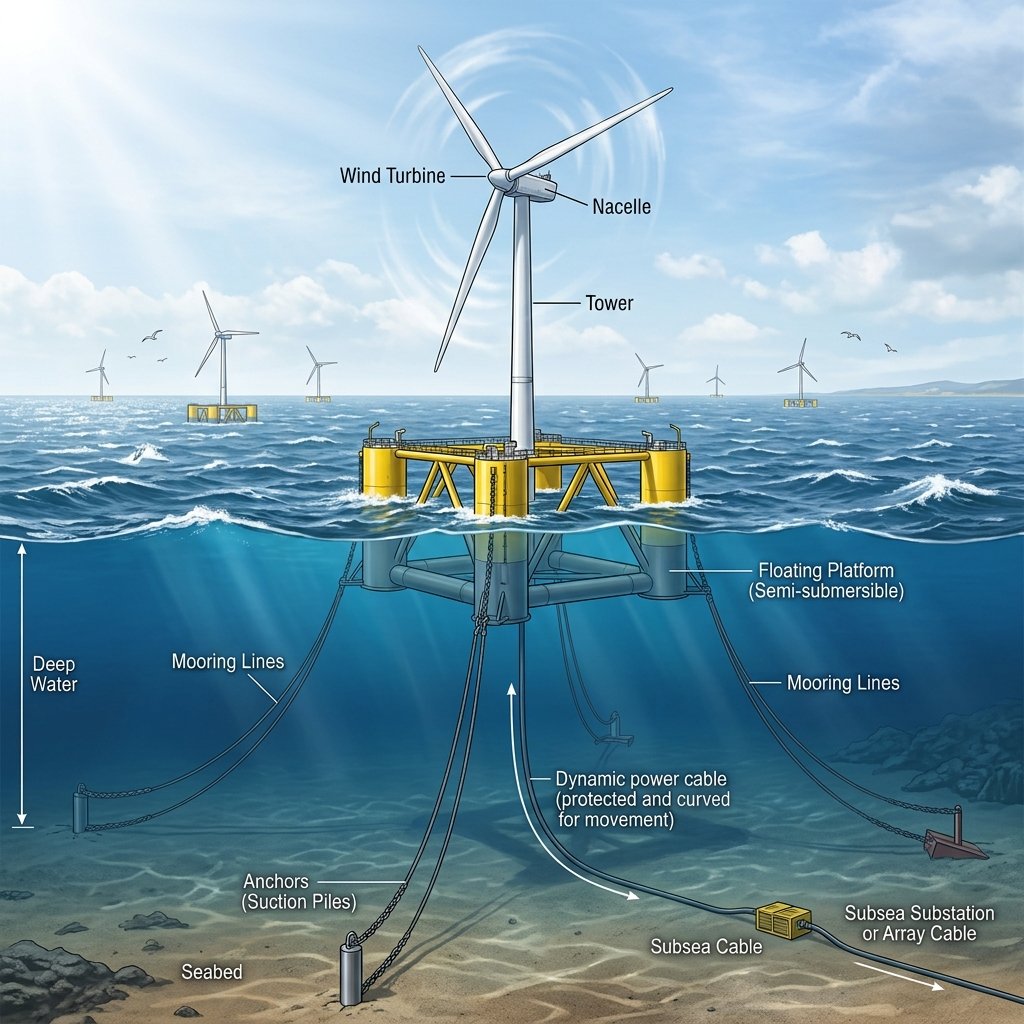
Floating Wind Energy Systems are offshore renewable energy technologies that use wind turbines mounted on floating platforms rather than foundations fixed directly to the seabed. The platforms are held in position by mooring lines connected to anchors on or within the seabed. This approach allows wind energy development in deeper waters where conventional fixed-bottom offshore foundations may become technically difficult or less economically attractive.
Floating wind combines several engineering fields, including wind turbine technology, naval architecture, offshore engineering, electrical systems, subsea technology, and environmental science. Its development could expand access to strong offshore wind resources while contributing to low-carbon electricity generation.
How Floating Wind Energy Systems Work
The electricity-generation process begins when offshore winds move the turbine blades. The rotor captures part of the kinetic energy in the wind and converts it into rotational mechanical energy. A generator inside the turbine system then converts mechanical energy into electricity.
The major difference between floating and conventional offshore turbines lies below the turbine tower.
Instead of using a foundation rigidly connected to the seabed, Floating Wind Energy Systems place the turbine on a buoyant platform. Mooring lines and anchors restrict the platform’s movement and keep it within its designed operating position.
Electricity generated by individual turbines is transferred through offshore electrical cables. Floating platforms require dynamic cable sections capable of accommodating platform motion before electricity is transferred through the wider offshore transmission network.
Main Components of Floating Wind Energy Systems
A complete floating wind system contains several interconnected technologies.
The wind turbine includes the blades, rotor, nacelle, generator, tower, control equipment, and supporting electrical systems. It performs the primary conversion of wind energy into electricity.
The floating platform provides buoyancy and structural stability. Common concepts include spar-buoy, semi-submersible, and tension-leg platforms. Each design controls turbine movement differently and may be suited to particular water depths, ports, seabed conditions, and environmental loads.
The mooring system normally consists of mooring lines, anchors, and associated components. It prevents the turbine from drifting while permitting controlled movement under wind, waves, and currents.
Finally, dynamic power cables accommodate movement of floating structures. They connect floating turbines to other electrical infrastructure while experiencing mechanical forces that differ from those affecting conventional static subsea cables.
Types of Floating Platforms
Several platform concepts are under development because there is no single design suitable for every offshore location.
Spar platforms use a long, deeply submerged structure with a low center of gravity to provide stability.
Semi-submersible platforms use multiple buoyant columns or hull structures connected together. Their relatively broad geometry provides stability and can offer advantages for assembly and deployment.
Tension-leg platforms use highly tensioned mooring lines connected to the seabed to restrict vertical movement.
Selection depends on water depth, waves, wind conditions, seabed characteristics, turbine size, manufacturing capability, installation strategy, and overall project economics.
Benefits of Floating Wind Energy Systems
A major advantage of Floating Wind Energy Systems is their ability to access deeper offshore waters. Some regions have excellent wind resources but relatively little shallow seabed suitable for conventional fixed-bottom wind farms.
Floating technology can potentially make these resources accessible.
Offshore winds can also be strong and relatively consistent compared with many land-based locations. This creates opportunities for large-scale renewable electricity generation.
Another potential benefit concerns installation. Some floating turbine designs can undergo extensive assembly at ports before being towed offshore. This can change vessel and construction requirements compared with fixed-bottom projects.
Floating wind may also support economic activity associated with ports, manufacturing, marine engineering, turbine maintenance, electrical infrastructure, and specialized offshore services.
Challenges Facing Floating Wind Energy Systems
Despite their potential, floating wind systems face significant engineering and economic challenges.
Platforms must remain stable while exposed simultaneously to wind, waves, currents, and turbine-generated loads. Mooring lines and anchors must survive repeated forces over long operating periods.
Dynamic electrical cables present another engineering challenge because floating platforms continuously move. Cable systems therefore need to tolerate bending, tension, and other mechanical stresses while reliably transmitting electricity.
Marine corrosion, severe weather, offshore maintenance, specialized vessels, port requirements, supply chains, and transmission infrastructure can also influence project costs.
Floating wind technology is developing rapidly, but many designs and industrial processes still require further optimization and large-scale operational experience.
Environmental Considerations for Floating Wind Energy Systems
Renewable energy infrastructure is not environmentally impact-free. Floating wind projects therefore require environmental assessment and responsible site selection.
Potential considerations include interactions with seabirds, marine mammals, fish, fisheries, shipping, underwater habitats, and other ocean users. Anchors, mooring lines, and subsea cables can interact with marine environments in ways that differ from fixed-bottom projects.
Monitoring and mitigation measures should consequently be designed for local environmental conditions rather than assuming that every floating wind farm has identical impacts.
Lifecycle assessment is also important. Manufacturing turbines and platforms requires materials and energy, while installation, maintenance, and eventual decommissioning create additional environmental considerations.
echnology Improving Floating Wind Energy Systems
Research is focused on improving platforms, mooring systems, anchors, dynamic cables, turbine controls, manufacturing, installation, and maintenance.
Digital monitoring can help operators measure structural loads, platform motion, turbine vibration, equipment temperature, and electrical performance. Predictive maintenance may help identify developing problems before equipment failures occur.
Researchers are also developing modeling tools that examine entire floating wind arrays rather than treating each turbine independently. This is important because platform movement, moorings, cables, seabed conditions, currents, and turbine layouts interact as parts of a larger engineering system.
Future of Floating Wind Energy Systems
The future of Floating Wind Energy Systems will depend on whether the industry can reduce costs while demonstrating reliable long-term performance at commercial scale.
Larger projects could encourage standardized platform manufacturing, specialized port infrastructure, improved supply chains, and more efficient installation techniques. Continued research into anchors, moorings, dynamic cables, materials, and turbine controls could further improve system reliability.
However, future growth should not be treated as guaranteed. Project economics, permitting, electricity markets, grid capacity, environmental requirements, supply chains, and public policy will influence how rapidly floating wind expands.
Conclusion
Floating Wind Energy Systems provide a technological pathway for generating renewable electricity from strong winds over deeper offshore waters. By combining large wind turbines with floating platforms, mooring systems, anchors, and dynamic electrical cables, these systems can operate where traditional fixed-bottom foundations may not be practical.
Their long-term contribution will depend on continued engineering progress, cost reductions, environmental management, infrastructure development, and successful commercial-scale deployment. If these challenges are addressed, floating wind could substantially broaden the offshore areas available for renewable electricity generation. https://www.insee.fr/en/metadonnees/definition/c2198
Pingback: 7 Key Benefits of Floating Wind Energy Systems