
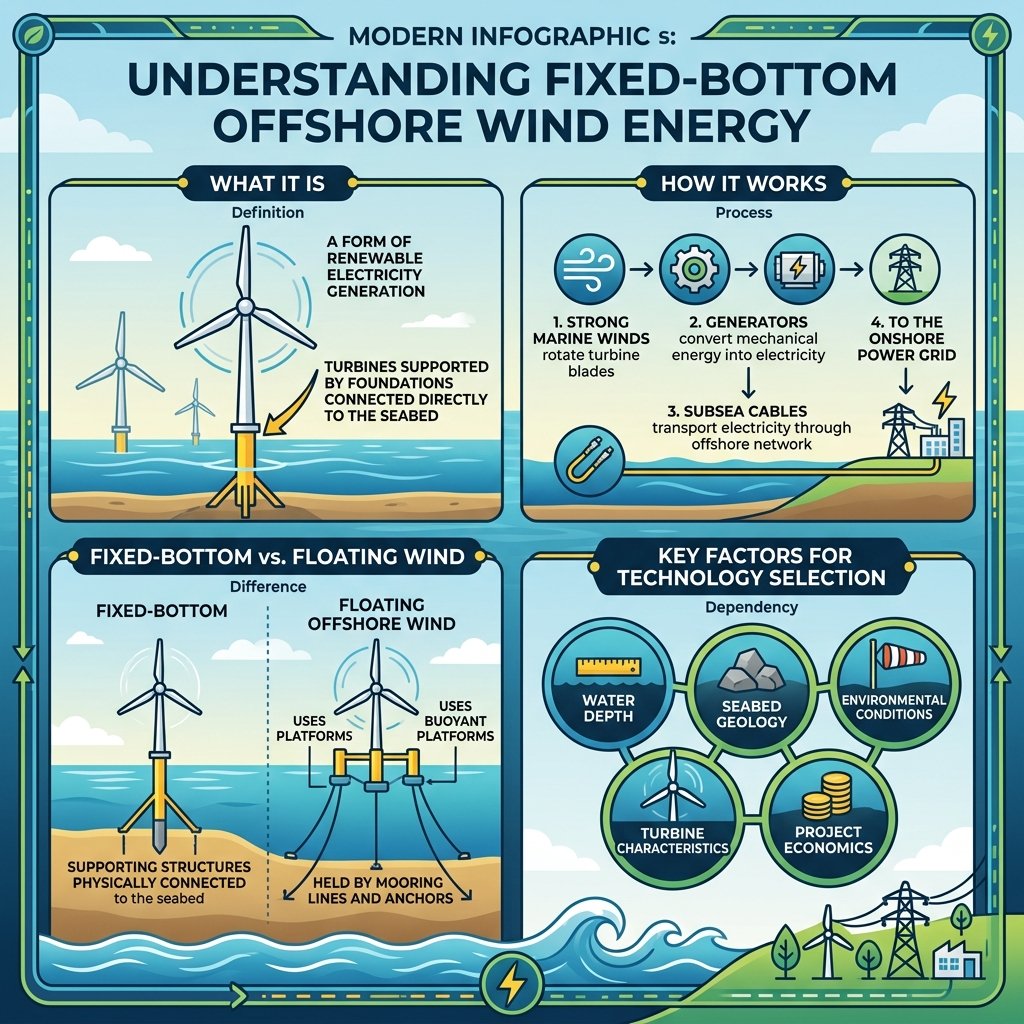
Fixed-Bottom Offshore Wind Energy is a form of renewable electricity generation in which offshore wind turbines are supported by foundations connected directly to the seabed. Strong marine winds rotate the turbine blades, and generators convert the resulting mechanical energy into electricity. Subsea cables then transport electricity through the offshore network toward the onshore power grid. Floating Wind Energy Systems offer an alternative approach to harnessing offshore wind energy.
Floating Wind Energy Systems provide innovative solutions for harnessing renewable energy.
Additionally, Floating Wind Energy Systems can be deployed in deeper waters, expanding renewable energy resources.
Fixed-bottom technology is different from Floating Wind Energy Systems. Floating turbines use buoyant platforms held in position by mooring lines and anchors, while fixed-bottom turbines have supporting structures physically connected to the seabed. The appropriate technology depends heavily on water depth, seabed geology, environmental conditions, turbine characteristics, and project economics.
How Fixed-Bottom Offshore Wind Energy Works
The energy-conversion process begins with the wind. As moving air passes over specially designed turbine blades, aerodynamic forces rotate the rotor. The rotor drives the turbine’s generator system, converting mechanical energy into electrical energy.
Individual turbines within an offshore wind farm are connected by subsea array cables. Electricity is collected and may pass through an offshore substation, depending on the project design. Export cables then carry the electricity toward an onshore connection point, where it enters the wider electrical network.
A key characteristic of Fixed-Bottom Offshore Wind Energy is the foundation system supporting each turbine. These structures must withstand wind, waves, currents, turbine loads, and long-term exposure to the marine environment.
Main Fixed-Bottom Foundation Types
Several foundation technologies can support fixed-bottom offshore wind turbines.
Monopile foundations are widely used. A monopile is a large steel tubular structure installed into the seabed. The turbine tower is supported above it, either through a transition arrangement or increasingly through integrated designs.
Jacket foundations consist of lattice structures with multiple legs connected to the seabed. They can be considered where site conditions, turbine size, or water depth make them appropriate.
Gravity-based foundations rely substantially on their mass and seabed support for stability. Their suitability depends on factors including seabed preparation, water depth, installation requirements, and local engineering conditions.
Foundation selection is therefore a site-specific engineering decision rather than simply choosing one design for every offshore wind farm.
Fixed-Bottom Offshore Wind Energy Installation
The integration of Floating Wind Energy Systems within existing infrastructures can optimize energy outputs.
Moreover, Floating Wind Energy Systems can significantly contribute to decarbonization efforts globally.
Installing Fixed-Bottom Offshore Wind Energy infrastructure requires detailed marine planning.
Before construction, developers investigate wind resources, water depth, waves, currents, seabed geology, environmental conditions, shipping activity, and grid access. Geophysical and geotechnical surveys provide information needed for foundation and cable design.
During construction, foundations are installed at predetermined turbine locations. Turbine towers, nacelles, hubs, and blades are then transported offshore and assembled using specialized vessels and lifting equipment.
Subsea cables are installed between turbines and toward the electrical transmission system. Once mechanical and electrical construction is complete, turbines undergo testing and commissioning before regular electricity generation begins.
Implementing Floating Wind Energy Systems not only enhances energy production but also minimizes environmental footprints.
Benefits of Fixed-Bottom Offshore Wind Energy
One important advantage is access to strong offshore wind resources. Open marine environments often have fewer obstacles than land areas, creating favorable conditions for large-scale wind generation.
Modern offshore wind farms can contain many high-capacity turbines, allowing projects to generate substantial quantities of electricity without directly burning fossil fuels during normal operation.
Fixed-bottom offshore wind also benefits from significant commercial experience. Developers, manufacturers, ports, vessel operators, and engineering companies have accumulated knowledge from projects operating in multiple regions.
The industry can additionally support employment and economic activity in manufacturing, marine construction, electrical engineering, ports, operations, maintenance, and supply chains.
Ultimately, Floating Wind Energy Systems are integral to achieving energy security and sustainability.
Environmental Considerations
Comprehensive assessments of Floating Wind Energy Systems can help mitigate environmental impacts.
Although wind energy is renewable, offshore infrastructure can affect the marine environment.
By embracing Floating Wind Energy Systems, we can harness the power of offshore winds more effectively.
Foundation installation can disturb seabed habitats, while some construction methods generate underwater noise. Wind farms can also interact with fish, marine mammals, seabirds, commercial fisheries, navigation, and other ocean activities.
Environmental impact assessment is therefore an important part of responsible Fixed-Bottom Offshore Wind Energy development. Site selection, seasonal construction restrictions, noise mitigation, habitat monitoring, and other measures may be used depending on local conditions and regulatory requirements.
Environmental effects should also be considered across the project’s lifecycle, from raw-material production and construction through operation and eventual decommissioning.
Engineering and Maintenance Challenges
Collaboration in research on Floating Wind Energy Systems is essential for accelerating the adoption of these technologies.
Marine environments create demanding operating conditions. Saltwater promotes corrosion, while turbines and foundations experience repeated loads from wind and waves.
Engineers use protective coatings, corrosion-control systems, structural monitoring, inspections, and planned maintenance to manage these conditions.
Access can also be difficult. High waves, storms, and strong winds may prevent maintenance vessels or technicians from safely reaching turbines.
The evolution of Floating Wind Energy Systems illustrates the shift towards more sustainable energy solutions.
Subsea cables represent another critical part of the infrastructure. Cable damage can cause expensive repairs and interrupt electricity transmission, making appropriate design, installation, protection, and monitoring important.
Fixed-Bottom Offshore Wind Energy and Technology
As technology advances, Floating Wind Energy Systems are positioned to play a key role in the energy transition.
Technological development continues to change the industry. Offshore turbines have generally increased in size and generating capacity, while foundation designs and installation techniques have evolved to accommodate larger machines.
Understanding the benefits of Floating Wind Energy Systems is crucial for future energy planning.
Digital technologies are increasingly used to monitor turbine condition and performance. Sensors can measure vibration, temperature, structural loads, electrical performance, and other operating parameters.
For many projects, Floating Wind Energy Systems offer a viable alternative to traditional fixed-bottom designs.
Drones, robotic inspection technologies, remote monitoring, and predictive maintenance systems may further improve operations by helping technicians detect developing problems before they cause major equipment failures.
Fixed-Bottom vs Floating Offshore Wind
Fixed-bottom and floating technologies serve overlapping but different offshore conditions.
Fixed-bottom turbines are generally associated with locations where seabed and water-depth conditions allow economically practical foundations. Floating turbines can expand wind development into deeper waters where constructing conventional seabed-connected foundations becomes more difficult.
Neither technology is universally preferable. Water depth, geology, wind resources, environmental constraints, ports, transmission infrastructure, construction capabilities, and economics determine which approach is appropriate for a particular project.
Conclusion
Fixed-Bottom Offshore Wind Energy uses turbines supported by seabed-connected foundations to convert marine wind resources into electricity. Monopiles, jackets, and gravity-based structures provide different engineering solutions depending on site conditions.
The technology offers large-scale renewable electricity generation but also presents challenges involving construction costs, marine environments, grid infrastructure, maintenance, and ecological impacts. Careful site assessment, engineering design, environmental monitoring, and continued technological development are essential for responsible long-term deployment.
https://www.futurelearn.com/info/courses/introduction-to-environmental-science/0/steps/269824