
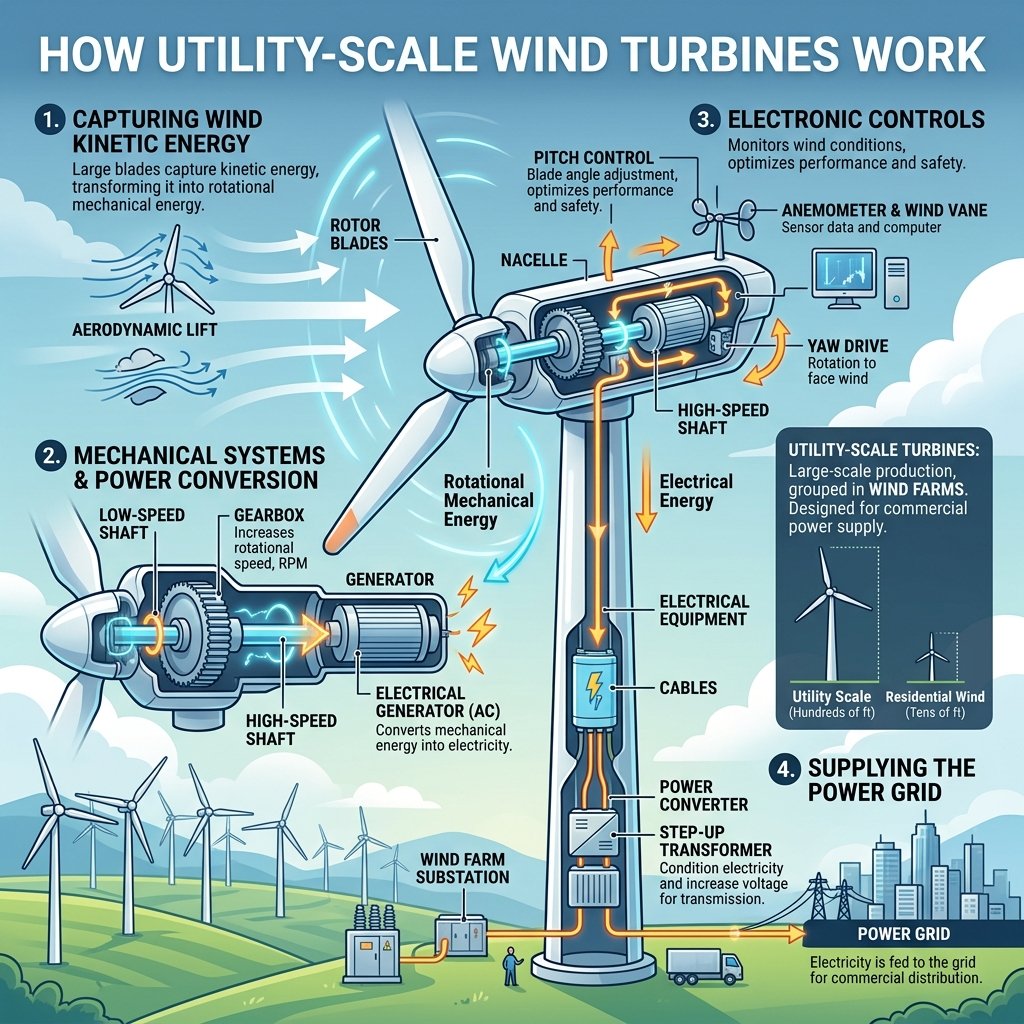
How Utility-Scale Wind Turbines Work begins with a fundamental energy-conversion process: large rotor blades capture part of the kinetic energy carried by moving air and transform it into rotational mechanical energy. A generator then converts this mechanical energy into electricity that can be conditioned and supplied to the power grid.
Understanding how How Utility-Scale Wind Turbines Work fundamentally transforms energy into electricity is crucial.
These turbines are essential for grasping How Utility-Scale Wind Turbines Work efficiently and effectively.
Utility-scale turbines are much larger than small wind systems used for individual homes or farms. They are designed primarily for commercial electricity production and are commonly grouped into wind farms containing multiple turbines.
Understanding their operation requires examining aerodynamics, mechanical systems, generators, electronic controls, towers, electrical equipment, and grid infrastructure.
The interaction of wind and technology showcases How Utility-Scale Wind Turbines Work in practice.
How Utility-Scale Wind Turbines Work with Wind
Analyzing How Utility-Scale Wind Turbines Work reveals their potential in modern energy solutions.
Efficient designs are critical to understanding How Utility-Scale Wind Turbines Work and their energy contributions.
Wind contains kinetic energy because air has mass and is moving. Turbine blades are designed with aerodynamic profiles that create forces as wind passes across their surfaces.
These forces cause the rotor to turn.
The amount of energy available in wind increases strongly with wind speed. However, a turbine cannot capture all the kinetic energy passing through its rotor. Some energy must remain in the moving air downstream of the turbine.
Modern turbines therefore use carefully engineered blades and control systems to capture useful energy efficiently while keeping structural loads within safe operating limits.
Rotor and Turbine Blades
The rotor normally consists of three blades connected to a central hub. As the blades rotate, the rotor converts aerodynamic forces into rotational motion.
Blade length is particularly important because longer blades create a larger swept area. A larger rotor can interact with more moving air, increasing the amount of energy potentially available to the turbine under appropriate wind conditions.
Modern blades are typically manufactured using engineered composite materials. Designers must balance strength, stiffness, weight, fatigue resistance, aerodynamic performance, manufacturability, and cost.
Each design decision impacts How Utility-Scale Wind Turbines Work in real-world scenarios.
Blade pitch systems can rotate individual blades around their longitudinal axes. Adjusting blade pitch helps regulate power production and control loads as wind conditions change.
Further exploration into How Utility-Scale Wind Turbines Work will enhance future energy strategies.
Nacelle and Drivetrain
Behind the rotor is the nacelle, which houses many of the turbine’s major mechanical and electrical components.
In conventional geared turbines, the rotor turns a low-speed shaft connected to a gearbox. The gearbox increases rotational speed before mechanical energy reaches the generator.
Not every modern utility-scale turbine uses this arrangement. Some designs use direct-drive generators that eliminate the conventional gearbox. Other configurations use different drivetrain technologies.
Harnessing knowledge about How Utility-Scale Wind Turbines Work is essential for energy advancements.
Each approach involves engineering trade-offs involving weight, efficiency, reliability, maintenance, materials, and cost.
How Utility-Scale Wind Turbines Work with Generators
The generator performs one of the most important energy conversions inside the turbine.
Mechanical rotation from the drivetrain is transformed into electrical energy through electromagnetic principles. Power-electronic equipment then helps control the electrical output and ensures that generated electricity meets required grid conditions.
Transformers increase voltage for efficient electricity transmission.
Electricity from individual turbines within a wind farm is collected through an electrical network before being transferred to a substation. From there, higher-voltage transmission infrastructure connects the wind farm to the wider electricity system.
Yaw and Pitch Control Systems
Utility-scale turbines need sophisticated control systems because wind direction and speed continually change.
The yaw system rotates the nacelle so the rotor remains appropriately oriented relative to the wind. Sensors provide information about wind direction and operating conditions.
The pitch system changes the angle of the blades. At suitable wind speeds, pitch control helps optimize energy capture. During high winds, blade angles can be adjusted to reduce loads and control power.
Ultimately, How Utility-Scale Wind Turbines Work shapes our understanding of renewable energy generation.
If conditions become unsafe, the turbine’s control and braking systems can shut the machine down.
Evaluating How Utility-Scale Wind Turbines Work contributes to improving wind energy efficiency.
Towers and Foundations
Utility-scale turbines use tall towers to position rotors where wind resources are generally stronger and less affected by obstacles near the ground.
The tower must support the rotor and nacelle while resisting dynamic forces produced by wind and turbine operation.
The intricacies of How Utility-Scale Wind Turbines Work demand careful attention in engineering design.
Foundations transfer these loads into the ground. Foundation design depends on turbine size, soil conditions, geology, environmental loads, and whether the turbine is located onshore or offshore.
Offshore utility-scale turbines require specialized foundation or floating-platform technologies adapted to marine conditions.
Recognizing the dynamics of How Utility-Scale Wind Turbines Work enhances our energy solutions.
Wind Farms and Electricity Production
Understanding How Utility-Scale Wind Turbines Work also requires looking beyond individual machines.
Commercial turbines commonly operate together as wind farms. Each turbine sends electricity into a collection network, while monitoring and control systems track the performance of the entire facility.
Wind-farm layout is carefully planned because turbines can influence one another. A turbine extracts energy from the wind and produces a downstream wake containing reduced wind speed and increased turbulence.
Future advancements will depend on how well we understand How Utility-Scale Wind Turbines Work.
Engineers therefore consider turbine spacing, prevailing wind directions, terrain, wake effects, environmental constraints, roads, cables, and grid connections when designing a wind farm.
Efficiency and Capacity Factor
Wind turbines do not generate their rated maximum output continuously because wind conditions vary.
In conclusion, exploring How Utility-Scale Wind Turbines Work remains crucial for sustainable energy development.
A project’s capacity factor compares its actual electricity generation over a period with the electricity it could theoretically generate if it operated continuously at maximum rated power.
Capacity factor should not be confused with turbine efficiency. It is influenced by wind resources, turbine characteristics, downtime, grid limitations, wake losses, and other operational factors.
This distinction is important when comparing wind projects or evaluating their expected electricity production.
Environmental Benefits and Limitations
Utility-scale wind turbines generate electricity without burning fuel during normal operation. As a result, operational greenhouse gas emissions are very low compared with fossil-fuel electricity generation.
However, wind power is not environmentally impact-free. Turbine manufacturing requires materials such as steel, concrete, copper, polymers, and composite materials. Wind farms can also affect landscapes, wildlife, habitats, and local communities.
Responsible projects therefore require environmental assessment, appropriate siting, wildlife monitoring, community engagement, and lifecycle planning.
Future of Utility-Scale Wind Turbines
Future turbines are expected to benefit from continued improvements in blade engineering, generators, power electronics, sensors, digital monitoring, materials, and predictive maintenance.
Research is also examining recycling and circular-economy approaches for turbine materials, particularly composite blades.
Larger turbines may reduce the number of machines required for a given project capacity, particularly offshore, although increasing turbine size creates new manufacturing, transportation, installation, and engineering challenges.
Conclusion
Understanding How Utility-Scale Wind Turbines Work shows that wind power is more than simply rotating blades. Modern turbines integrate aerodynamic blades, rotors, drivetrains, generators, power electronics, control systems, towers, foundations, cables, substations, and digital monitoring.
These systems convert naturally occurring wind into grid-scale electricity without direct fuel combustion during operation. Their performance depends on wind resources, engineering design, turbine placement, grid infrastructure, maintenance, and environmental conditions.
Continued research and engineering improvements can increase reliability, improve energy production, reduce lifecycle impacts, and strengthen the role of utility-scale wind power within diversified low-carbon electricity systems.https://www.futurelearn.com/info/courses/introduction-to-environmental-science