
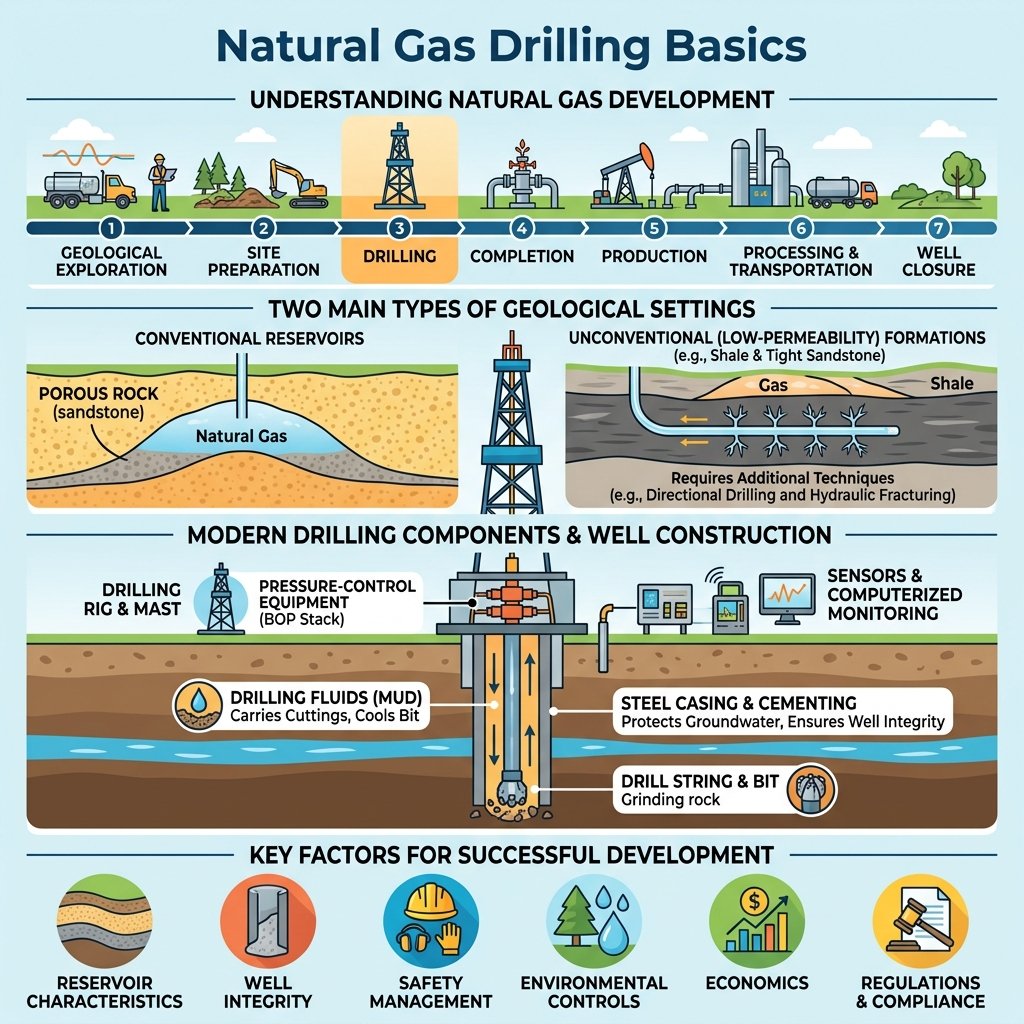
Natural Gas Drilling Basics begin with understanding how energy companies create wells that reach natural gas trapped in underground geological formations. Drilling is one stage of a much larger natural gas development process that can include geological exploration, site preparation, well construction, completion, production, processing, transportation, and eventually well closure.
Natural gas occurs in different geological settings. Some accumulations are found in conventional reservoirs where porous and permeable rocks allow gas to move relatively easily toward a well. Other resources occur in low-permeability formations such as shale and tight sandstone, where additional techniques may be required to achieve commercial production.
Modern drilling combines geology, mechanical engineering, drilling fluids, steel casing, cement, pressure-control equipment, sensors, and computerized monitoring. Although drilling technology has advanced considerably, successful gas development still depends on reservoir characteristics, well integrity, safety management, environmental controls, economics, and applicable regulations.
Understanding Natural Gas Drilling Basics
One of the most important Natural Gas Drilling Basics is that drilling does not simply involve making a hole until natural gas is discovered. Considerable geological and engineering analysis normally takes place before a production well is developed.
Geologists study rock formations, geological structures, existing well information, and other subsurface evidence. Geophysical surveys, including seismic methods, can provide additional information about underground structures.
Engineers use these data to select potential drilling targets and design wells appropriate for expected geological conditions.
However, geological and geophysical information cannot guarantee that a well will produce commercially useful quantities of gas. Exploration always involves uncertainty, and drilling provides direct information about the subsurface.
How a Natural Gas Well Is Drilled
A drilling rig provides the equipment required to construct the well. A rotating drill bit breaks rock as the well progresses underground. Sections of drill pipe connect the bit to equipment at the surface.
Drilling fluid, commonly called drilling mud, is circulated through the well during drilling. Depending on the operation, drilling fluids perform several important functions. They can cool and lubricate the drill bit, transport rock cuttings toward the surface, help stabilize the wellbore, and contribute to pressure control.
Rock fragments returned to the surface can also provide geological information. Combined with measurements taken inside the well, these samples help specialists understand the formations being penetrated.
Modern wells can reach substantial depths, but there is no single standard depth for natural gas drilling. Depth depends on the location and geological formation being targeted.
Casing and Cementing Natural Gas Wells
Well construction is another essential part of Natural Gas Drilling Basics.
After selected sections of a well have been drilled, steel pipes known as casing are installed. Cement is then placed in the annular space between the casing and surrounding formation in designed intervals.
A well may contain several casing strings, including conductor, surface, intermediate, and production casing, depending on its design.
Casing and cement perform several functions. They provide structural support, help isolate different geological formations, contribute to pressure management, and help protect groundwater-bearing zones from fluids moving through the well.
Well integrity depends on appropriate engineering design, materials, cement placement, testing, monitoring, and maintenance. Poor construction or deterioration can increase the risk of unwanted fluid migration or other well-control problems.
Vertical and Horizontal Drilling
Traditional natural gas wells were commonly drilled mainly vertically toward the target reservoir. Vertical wells remain suitable for many geological formations.
Modern directional drilling allows operators to intentionally change the trajectory of a well underground.
In horizontal drilling, a well normally begins vertically and then gradually turns until a section travels laterally through or along the target formation.
Horizontal drilling is particularly important for shale gas and other low-permeability resources because a long horizontal section can contact considerably more reservoir rock than a simple vertical penetration.
Multiple horizontal wells may also be drilled from a single surface location. This approach can reduce the number of separate drilling pads required for a development, although associated roads, pipelines, water systems, and other infrastructure can still create a substantial surface footprint.
Hydraulic Fracturing Is Different from Drilling
An important scientific distinction in Natural Gas Drilling Basics is the difference between drilling and hydraulic fracturing.
Drilling creates the well. Hydraulic fracturing stimulates the reservoir.
Hydraulic fracturing is commonly used after drilling in shale and certain other low-permeability formations. Fluid is injected into the target rock under sufficient pressure to create or extend fractures.
The injected mixture commonly contains water, proppant—often sand—and smaller quantities of additives designed for particular technical functions. Proppant helps keep fractures open after pumping pressure is reduced, providing pathways through which natural gas can move toward the well.
Not every natural gas well requires hydraulic fracturing. Whether stimulation is needed depends primarily on reservoir properties and production requirements.
Well Completion and Natural Gas Production
Finishing drilling does not automatically make a well ready for commercial production.
The well completion stage prepares the well to allow hydrocarbons to enter the production system safely and efficiently. Completion design varies significantly according to reservoir type and well configuration.
Equipment may be installed to control pressure and regulate production. In some wells, selected sections of casing are perforated to create connections between the reservoir and wellbore. Low-permeability formations may subsequently undergo hydraulic fracturing.
After completion, natural gas can flow toward the surface if reservoir pressure and well conditions permit.
Raw natural gas may contain methane together with water vapor, carbon dioxide, hydrogen sulfide, natural gas liquids, and other components. Consequently, produced gas frequently requires processing before entering major transmission pipelines.
Safety is fundamental to Natural Gas Drilling Basics because drilling operations involve heavy machinery, rotating equipment, high pressures, combustible hydrocarbons, and potentially hazardous gases.
One important concern is maintaining control of underground pressure. A blowout preventer, or BOP, is specialized well-control equipment designed to help seal and control a well when abnormal pressure conditions occur.
Modern operations can also use gas detectors, pressure sensors, automated monitoring, emergency shutdown equipment, worker training, and defined operating procedures.
Hydrogen sulfide may occur naturally in some reservoirs and requires particular precautions because it is highly toxic.
Technology can improve monitoring, but safe drilling continues to depend on well design, trained personnel, equipmscipline, and effective emergency planning.
Environmental Considerations of Natural Gas Drilling
Natural gas drilling can create environmental impacts that vary according to geology, location, development scale, technology, and management practices.
Potential issues include land disturbance, habitat fragmentation, noise, water consumption, wastewater production, air pollutants, methane emissions, spills, and the construction of roads and supporting infrastructure.
Groundwater protection is especially connected with good well construction and surface management. Proper casing and cementing are therefore important barriers intended to isolate the well from groundwater formations.
Methane emissions can occur at different stages of natural gas production and handling. Leak-detection programs, improved equipment, maintenance, vapor-control systems, and direct measurement technologies can help identify and reduce emissions.
Water used or produced during drilling and well completion also requires appropriate storage, treatment, recycling, or disposal according to its composition and regulatory requirements.
Technology and the Future of Natural Gas Drilling
Digital technology is increasingly influencing Natural Gas Drilling Basics. Modern rigs can collect large quantities of information about drilling speed, pressure, temperature, vibration, direction, and geological conditions.
Measurement-while-drilling and logging technologies provide engineers with subsurface information while drilling operations are underway. Directional systems can help maintain a well along a planned trajectory.
Automation and data analytics can support drilling optimization, equipment maintenance, and detection of unusual operating conditions. Artificial intelligence is also being investigated and applied to selected drilling and reservoir-analysis tasks.
These technologies can improve decision-making, but they do not eliminate geological uncertainty or the need for experienced engineers and rigorous safety systems.
Conclusion
Natural Gas Drilling Basics cover much more than operating a drilling rig. Natural gas development begins with geological investigation and well planning before progressing through drilling, casing, cementing, completion, production, and monitoring.
Vertical drilling remains important, while horizontal drilling has greatly expanded access to shale and other low-permeability formations. Hydraulic fracturing can increase production from certain reservoirs, but it is a separate well-stimulation process rather than another name for drilling.
Modern natural gas drilling therefore represents a combination of geological science, engineering, pressure management, well-integrity systems, environmental controls, and digital technology. Understanding these fundamental stages provides a strong foundation for studying how underground natural gas resources are developed while recognizing the technical, safety, and environmental challenges that accompany their extraction. https://en.wikipedia.org/wiki/Natural_resource