
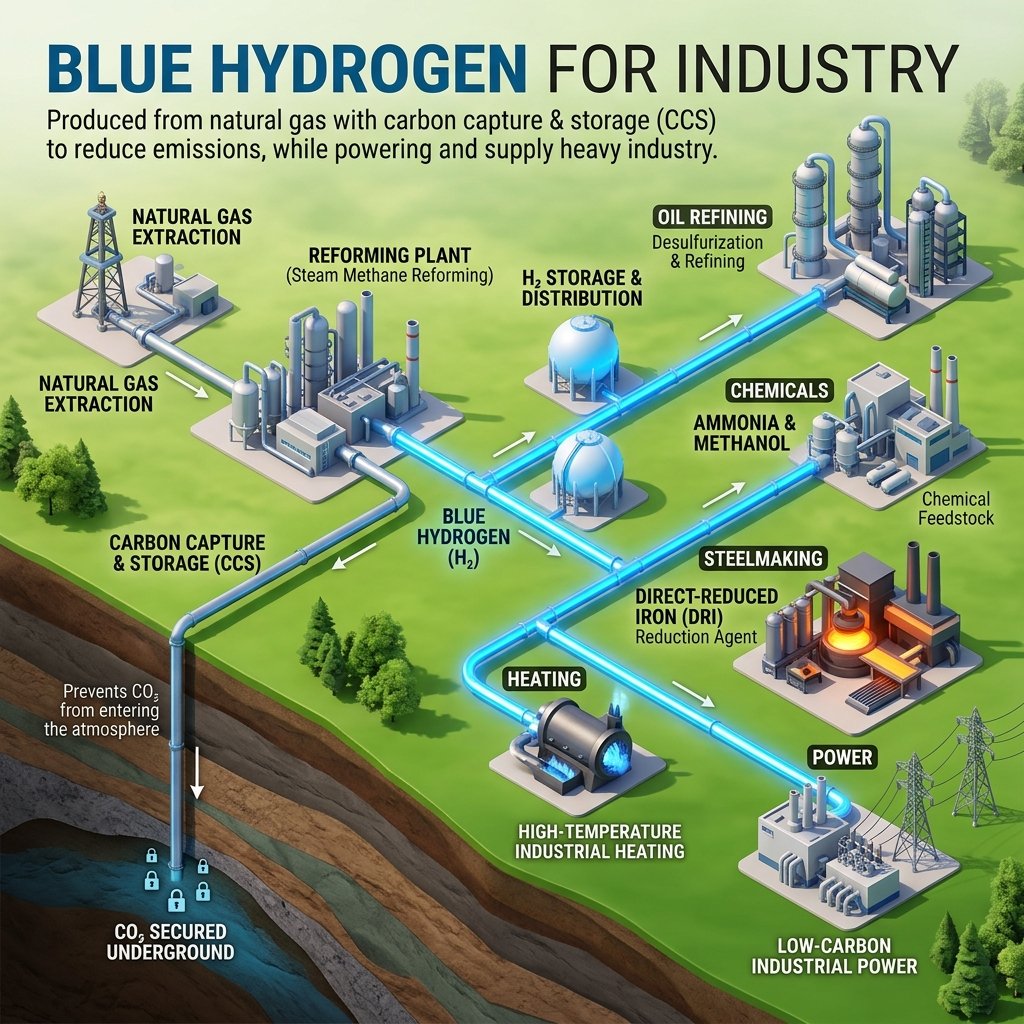
Blue Hydrogen for Industry refers to hydrogen produced primarily from natural gas while carbon capture and storage technology prevents a significant share of the resulting carbon dioxide from entering the atmosphere. Industrial facilities can use this hydrogen as a chemical feedstock, reducing agent, fuel or energy carrier.
Hydrogen is already essential to modern industry. It is widely used in oil refining and in the manufacture of ammonia, methanol and other chemicals. However, most conventional hydrogen is produced from fossil fuels without carbon capture, resulting in substantial greenhouse-gas emissions.
Blue hydrogen is intended to reduce these emissions while continuing to supply industries that already depend on hydrogen. It may also support emerging applications such as direct-reduced iron production, high-temperature heating and low-carbon industrial power.
How Blue Hydrogen for Industry Is Produced
Steam methane reforming, or SMR, is the most established method of producing hydrogen from natural gas. Methane reacts with high-temperature steam to create hydrogen, carbon monoxide and carbon dioxide. A water-gas shift reaction then converts carbon monoxide and steam into additional hydrogen and carbon dioxide.
Autothermal reforming, known as ATR, combines natural gas with steam and controlled amounts of oxygen. This process can produce a concentrated carbon dioxide stream, potentially making it easier to achieve high capture rates.
After production, the hydrogen is purified according to the needs of the industrial user. Carbon dioxide is separated, compressed and transported through pipelines or ships. It can then be injected into suitable underground formations for permanent storage.
The U.S. Department of Energy confirms that hydrogen can be produced from natural gas with carbon capture, utilization and storage. However, it describes natural-gas-based hydrogen as a possible bridge toward a more diverse future hydrogen supply rather than the only long-term production route.
Blue Hydrogen for Industry in Oil Refining
Petroleum refineries use hydrogen to remove sulfur and other impurities from crude-oil products. Hydrogen is also used in hydrocracking, a process that breaks large hydrocarbon molecules into lighter and more valuable fuels.
Replacing conventional hydrogen with lower-emission blue hydrogen could reduce part of a refinery’s operational carbon footprint. This would not make petroleum products carbon-free, because burning gasoline, diesel and other fuels still releases carbon dioxide.
The environmental benefit must therefore be described accurately: blue hydrogen may reduce emissions associated with refinery hydrogen production, but it does not eliminate the lifecycle emissions of fossil fuels.
Refineries are practical early users because they already possess hydrogen equipment, trained personnel and established demand. Some also produce concentrated carbon dioxide streams that can be captured more easily than dilute emissions from combustion exhaust.
Ammonia and Fertilizer Production
Ammonia is produced by combining hydrogen with nitrogen through the Haber–Bosch process. Most ammonia is used to manufacture fertilizers that support global food production. Hydrogen also supplies energy and chemical input to several stages of ammonia manufacturing.
According to the International Energy Agency’s 2026 assessment, ammonia production represents nearly three-quarters of current hydrogen use, while its supply remains overwhelmingly based on natural gas. Hydrogen consumption continues to be concentrated in traditional industrial and refining applications. IEA
Using Blue Hydrogen for Industry could lower emissions from ammonia production where high carbon-capture rates and low methane leakage are achieved. Nevertheless, additional emissions can come from natural-gas extraction, fertilizer production, transportation and fertilizer use on agricultural land.
Blue ammonia is therefore not automatically carbon-free. Its climate performance should be evaluated with complete lifecycle data, including upstream methane emissions and any uncaptured carbon dioxide.
Blue Hydrogen in Iron and Steel Production
Steelmaking is one of the most promising emerging applications for low-emission hydrogen. Conventional blast furnaces use coke, derived from coal, to remove oxygen from iron ore. This process releases large quantities of carbon dioxide.
Hydrogen can instead serve as a reducing agent in direct-reduced iron facilities. When hydrogen reacts with oxygen in iron ore, the main reaction product is water rather than carbon dioxide. The resulting iron can be processed in an electric arc furnace.
The climate benefit depends on the hydrogen source and the electricity used by the steel plant. Blue hydrogen could reduce emissions compared with coal-based production, but residual emissions from natural gas and incomplete carbon capture remain.
The IPCC recognizes hydrogen-based direct reduction as an industrial pathway that may contribute to lower-emission steel production. It also identifies hydrogen made through natural-gas reforming with carbon capture as one of several possible low-carbon production routes.
Industrial Heat and Manufacturing
Industrial operations often require temperatures that are difficult to achieve with conventional electric equipment. Hydrogen may be burned in specialized furnaces, boilers or kilns to produce high-temperature heat.
Potential users include glass, ceramics, metals and chemical manufacturing. Hydrogen combustion produces no direct carbon dioxide because hydrogen contains no carbon. However, high-temperature combustion can generate nitrogen oxides, which affect air quality. Low-NOx burners and emission-control systems may therefore be necessary.
Direct electrification and industrial heat pumps are generally more energy-efficient for low- and medium-temperature processes. Blue hydrogen is more likely to be valuable where electrification is technically challenging or where hydrogen is already needed as a chemical feedstock.
Benefits of Blue Hydrogen for Industry
One potential benefit of Blue Hydrogen for Industry is its ability to reduce emissions from established hydrogen applications without requiring every industrial process to be redesigned immediately.
Blue hydrogen projects may also use existing knowledge from the natural-gas, chemical, refining and pipeline industries. Industrial clusters can share hydrogen pipelines, carbon dioxide transportation systems and geological storage infrastructure, potentially reducing costs.
Hydrogen can support several industrial needs:
- Chemical feedstock for ammonia and methanol
- Reducing agent for iron and steel production
- High-temperature heat for manufacturing
- Fuel for industrial power generation
- Long-duration energy storage
- Production of synthetic fuels
The IEA notes that industrial emissions are among the most difficult to reduce because some arise from chemical reactions and high-temperature heat requirements. Carbon capture and low-emission hydrogen may therefore contribute where simpler solutions are unavailable. IEA
Environmental Risks and Limitations
The climate performance of Blue Hydrogen for Industry depends on the entire supply chain. A project should not be judged only by the capture percentage reported for one carbon dioxide stream.
Plant-wide carbon capture must include emissions from both the reforming reaction and the energy used to heat the process. Methane leakage during natural-gas extraction, processing and transportation must also be measured and minimized. Because methane is a powerful greenhouse gas, high leakage can greatly weaken the benefits of blue hydrogen.
Captured carbon dioxide must be stored permanently. Geological sites require careful selection, regulated injection wells, pressure management and long-term monitoring.
Hydrogen leakage also deserves attention. Hydrogen is not a direct greenhouse gas like carbon dioxide, but it can indirectly affect atmospheric chemistry. Equipment must include compatible materials, ventilation, sensors and emergency shutdown systems.
Costs and Infrastructure Challenges
Industrial blue hydrogen requires expensive facilities for natural-gas reforming, oxygen production, carbon capture, compression, transportation and storage. Hydrogen pipelines and underground storage may also be needed.
The IEA reported in 2026 that some low-emission hydrogen projects had been postponed because supporting carbon-capture infrastructure was delayed. It also stated that high-capture CCUS-based hydrogen production had not yet been demonstrated at the scale and performance required across the emerging project pipeline. IEA
This distinction is important. Blue hydrogen production and carbon capture are established technologies in certain applications, but their integration at consistently high capture rates, low methane leakage and large industrial scale still requires further verification.
Future of Blue Hydrogen for Industry
The future of Blue Hydrogen for Industry will depend on natural-gas prices, carbon regulations, methane controls, storage availability and competition from renewable hydrogen and direct electrification.
Blue hydrogen may be most valuable in industrial clusters with existing hydrogen demand, nearby natural-gas infrastructure and secure geological carbon storage. It should be evaluated according to measured lifecycle emissions rather than its color label alone.
In conclusion, Blue Hydrogen for Industry could reduce emissions from refining, ammonia, chemicals, steel and high-temperature manufacturing. However, it is not automatically renewable or carbon-free. Its genuine environmental value requires high plant-wide capture rates, minimal methane leakage, permanent carbon storage and transparent independent monitoring.