
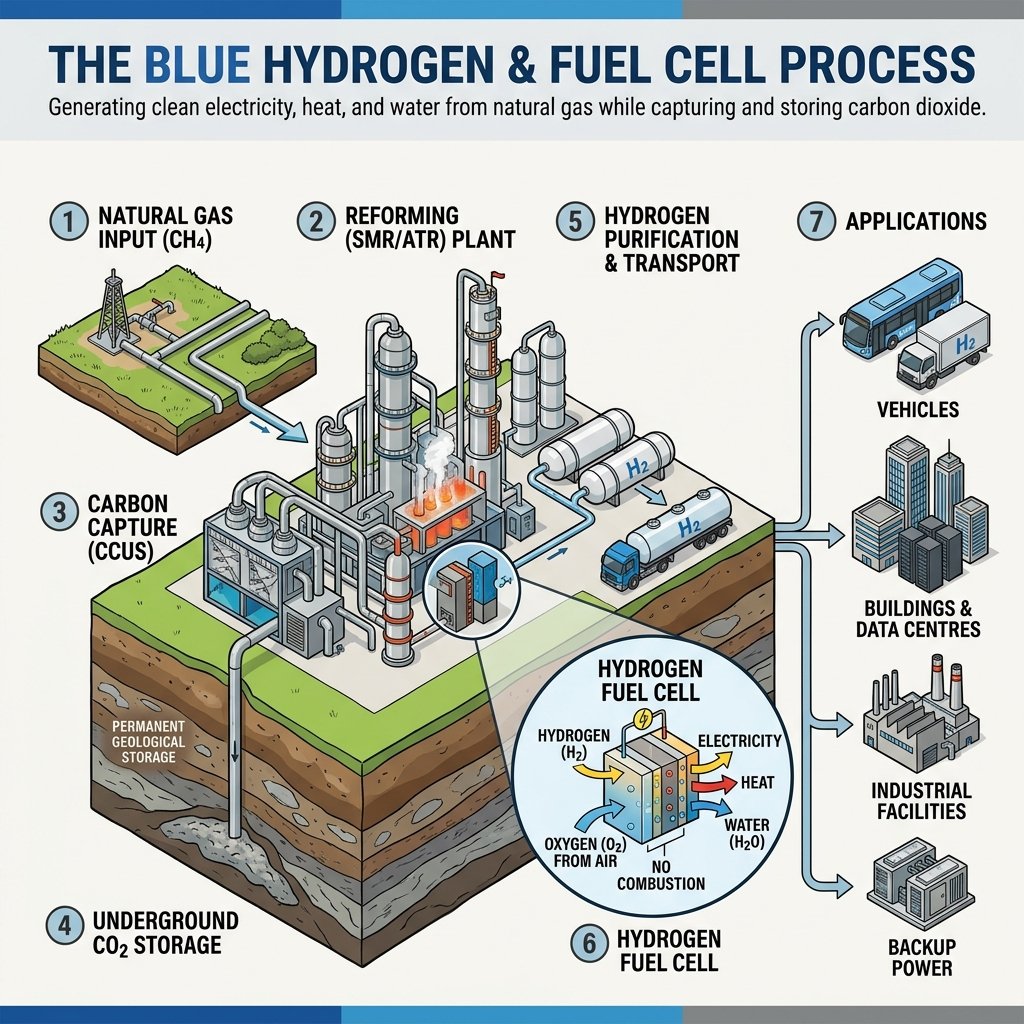
Blue Hydrogen Fuel Cells generate electricity through an electrochemical reaction using hydrogen produced mainly from natural gas combined with carbon capture and storage. Unlike combustion engines, fuel cells do not burn hydrogen. Instead, they combine hydrogen with oxygen to produce electricity, heat and water.
The term “blue” describes how the hydrogen is produced rather than the type of fuel cell that consumes it. Blue hydrogen is generally manufactured through steam methane reforming or autothermal reforming. These processes convert methane into hydrogen but also produce carbon dioxide. Carbon capture, utilization and storage technology—known as CCUS—is used to capture a significant portion of that carbon dioxide before it enters the atmosphere.
The captured carbon dioxide can be compressed, transported and permanently stored in suitable underground geological formations. The remaining hydrogen is purified and supplied to fuel-cell systems used in vehicles, buildings, industrial facilities, data centres and backup-power installations.
How Blue Hydrogen Fuel Cells Work
A typical hydrogen fuel cell contains an anode, a cathode and an electrolyte positioned between them. Hydrogen enters the anode side while oxygen from the surrounding air enters the cathode side.
At the anode, a catalyst separates each hydrogen molecule into protons and electrons. The electrolyte allows the protons to pass through it, but the electrons must travel through an external electrical circuit. This movement of electrons creates usable electricity.
At the cathode, the electrons and protons combine with oxygen to form water. The system also releases heat, which can sometimes be recovered for heating buildings or supporting industrial operations. According to the U.S. Department of Energy, hydrogen fuel cells convert hydrogen’s chemical energy directly into electricity, with water and heat as the principal products at the point of use. Department of Energy
Individual fuel cells generate limited voltage. Manufacturers therefore connect multiple cells to create a fuel-cell stack. Several stacks, along with air compressors, cooling equipment, power electronics and control systems, form a complete electricity-generation system.
Main Types of Fuel Cells
Several fuel-cell technologies can operate with hydrogen. Proton exchange membrane fuel cells, or PEM fuel cells, work at relatively low temperatures and respond quickly to changes in electricity demand. These qualities make them suitable for cars, buses, backup power and smaller stationary systems.
Solid oxide fuel cells operate at much higher temperatures. They are generally used for stationary electricity generation and combined heat-and-power systems. Their high operating temperature can support efficient energy conversion, although they require longer startup periods and durable heat-resistant materials.
Phosphoric acid fuel cells are another option for stationary power. They have been used in commercial buildings, hospitals and combined heat-and-power installations. Fuel-cell selection depends on required output, operating temperature, fuel purity, startup time, cost and intended application.
Hydrogen purity is especially important for PEM systems. Carbon monoxide and other contaminants can damage or “poison” their platinum-based catalysts, reducing performance. Blue hydrogen must consequently meet strict quality standards before being delivered to sensitive fuel cells. Department of Energy
Benefits of Blue Hydrogen Fuel Cells
One major advantage of Blue Hydrogen Fuel Cells is their high efficiency. They convert chemical energy directly into electricity rather than first producing heat to operate a mechanical engine. This eliminates some of the energy losses associated with conventional combustion.
Fuel cells also operate quietly and have relatively few moving parts. These characteristics may reduce vibration and certain maintenance requirements. When the heat produced by a stationary fuel cell is recovered, the combined system can supply both electricity and useful thermal energy.
Another benefit is local air quality. A fuel cell operating on pure hydrogen does not emit carbon dioxide, sulfur dioxide or particulate pollution at its point of operation. Its primary local products are water and heat. This makes hydrogen fuel cells potentially useful in densely populated areas, warehouses, hospitals and enclosed industrial facilities.
They can also provide reliable distributed power. Facilities can install fuel-cell systems close to where electricity is consumed, reducing dependence on distant power stations and transmission networks. Fuel cells may provide backup power for telecommunications equipment, emergency services, data centres and essential infrastructure.
Carbon Capture and Lifecycle Emissions
Although Blue Hydrogen Fuel Cells produce no carbon dioxide during electrochemical operation, the entire system is not automatically emissions-free. Its actual climate impact depends on how the hydrogen is manufactured, processed, transported and stored.
Carbon capture performance is a critical factor. Some blue hydrogen facilities capture carbon dioxide from the main reforming reaction but not from the furnaces that provide process heat. A high capture percentage applied to only one part of a facility can therefore differ from the overall plant-wide emissions reduction.
Methane leakage is another serious concern. Methane may escape during natural-gas extraction, processing and transportation. Because methane is a powerful greenhouse gas, uncontrolled leakage can significantly weaken the climate benefits of blue hydrogen.
The International Energy Agency explains that the emissions intensity of natural-gas-based hydrogen with carbon capture can vary considerably depending on production technology, carbon-capture rate and upstream emissions. This means that the “blue hydrogen” label alone is not enough to determine whether a project has low emissions. IEA
Reliable projects require lifecycle emission measurements, strict methane controls, high capture rates and permanent carbon storage. Independent monitoring and transparent reporting are also necessary.
Applications of Blue Hydrogen Fuel Cells
Blue hydrogen can power stationary fuel-cell systems in factories, commercial buildings and remote facilities. Combined heat-and-power installations can use both the electricity and heat generated by the system, improving total energy utilization.
In transportation, fuel cells may be valuable for buses, trucks, trains, ships and fleet vehicles that require long ranges or rapid refuelling. However, battery-electric systems may be more efficient for many passenger cars and short-distance applications. The best technology depends on vehicle size, operating pattern, infrastructure and energy cost.
Blue hydrogen may also support long-duration energy storage. Hydrogen can be stored and later supplied to fuel cells when renewable electricity production is low or grid demand is high. This application remains technically possible, but its economic competitiveness depends on hydrogen production costs, storage infrastructure and system efficiency.
Challenges and Limitations
The main barriers facing Blue Hydrogen Fuel Cells include high equipment costs, limited hydrogen infrastructure and the expense of producing low-emission hydrogen. Fuel-cell stacks may require costly catalysts, while hydrogen storage tanks, compressors and pipelines need specialized engineering.
Hydrogen is highly flammable and can leak through small openings. Some metals may also become brittle after prolonged exposure. Proper ventilation, compatible materials, leak detectors and professional safety procedures are therefore essential.
Blue hydrogen additionally depends on natural gas and geological carbon storage. It should not be described as renewable unless the original energy source meets an accepted renewable definition. It is more accurately classified according to its measured lifecycle greenhouse-gas intensity.
Future Outlook
Research is improving fuel-cell durability, reducing catalyst requirements and lowering manufacturing costs. Governments and industries are also developing hydrogen standards based on lifecycle emissions rather than relying only on color labels.
Blue Hydrogen Fuel Cells could serve as a transitional or specialized low-carbon technology where natural gas, carbon-storage capacity and hydrogen infrastructure are available. However, their environmental value must be verified for each project.
In conclusion, Blue Hydrogen Fuel Cells can generate efficient, quiet and flexible electricity without direct carbon emissions at the point of use. Their overall sustainability nevertheless depends on high carbon-capture performance, minimal methane leakage, secure carbon storage and responsible hydrogen transportation. When these conditions are independently confirmed, the technology may complement renewable energy, batteries and other low-emission solutions within a diversified energy system.