
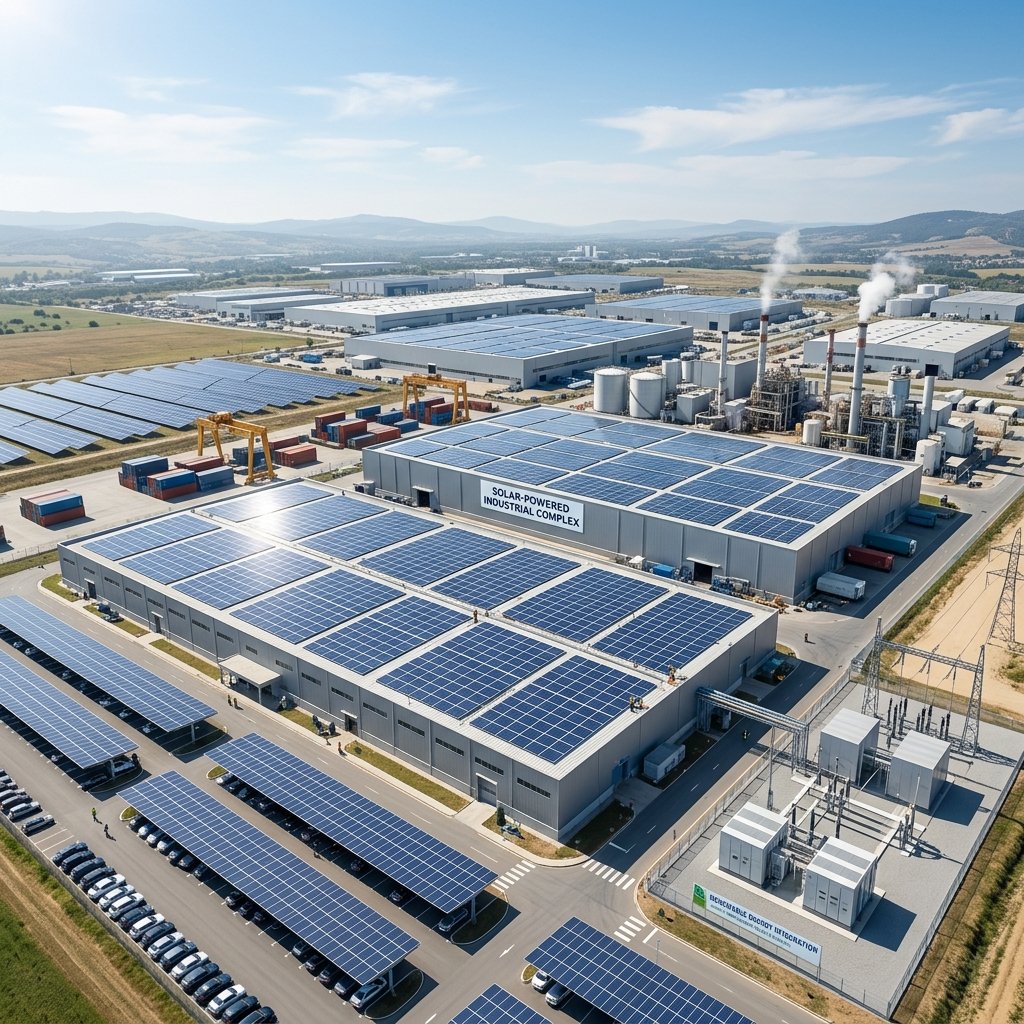
The benefits of industrial solar panels are becoming increasingly important as factories, warehouses, manufacturing facilities, and other large businesses look for reliable ways to reduce electricity costs and improve sustainability. Industrial facilities often consume large amounts of electricity every day, making energy expenses a significant part of their operating costs. Solar power allows these facilities to generate electricity from sunlight and reduce their dependence on electricity purchased from the grid.
Industrial solar installations can be placed on large factory roofs, warehouses, parking structures, or available land around industrial facilities. Modern photovoltaic (PV) systems can operate for decades when properly designed and maintained. For companies with suitable sites and strong daytime electricity demand, industrial solar energy can become an important part of a long-term energy strategy.
Major Benefits of Industrial Solar Panels
The benefits of industrial solar panels extend beyond simply generating renewable electricity. Businesses can use solar power to control some energy expenses, reduce exposure to electricity price changes, lower operational emissions, and make productive use of unused roof or land space.
1. Lower Electricity Costs
One of the most significant benefits is the potential reduction in electricity purchased from the grid. Industrial operations may require substantial power for machinery, lighting, ventilation, cooling, pumps, compressors, computer systems, and production equipment.
When solar panels generate electricity during daylight hours, that electricity can be consumed directly by the facility. The more solar electricity a company uses on-site, the less electricity it may need to purchase from its utility provider.
Actual savings depend on several factors, including local electricity prices, solar resources, system size, financing arrangements, regulations, and the facility’s electricity consumption pattern.
2. Long-Term Energy Savings
Industrial solar projects require an initial investment, but photovoltaic systems can provide electricity for many years. Solar panels generally have no fuel costs because sunlight is freely available.
After installation, routine expenses typically involve inspections, monitoring, cleaning when necessary, inverter servicing or replacement, and other maintenance.
This cost structure can make solar power attractive for companies evaluating energy expenses over a long period rather than focusing only on initial installation costs.
3. Better Use of Industrial Roof Space
Factories and warehouses frequently have large roof areas that would otherwise provide little economic value. These surfaces can sometimes accommodate hundreds or thousands of solar modules.
Rooftop installations can generate electricity without requiring businesses to purchase additional land. Before installation, however, engineers should evaluate structural capacity, roof condition, shading, orientation, electrical infrastructure, fire-safety requirements, and local regulations.
Ground-mounted systems can provide another option when sufficient land is available.
4. Reduced Carbon Emissions
Another important aspect of the benefits of industrial solar panels is their role in reducing operational greenhouse gas emissions associated with electricity consumption.
Solar photovoltaic systems generate electricity without burning fossil fuels at the point of generation. When solar electricity replaces grid electricity produced partly from fossil fuels, a company can reduce the emissions associated with its purchased electricity.
Businesses pursuing climate or sustainability targets may therefore incorporate solar power into broader strategies that also include energy efficiency, electrification, and responsible energy management.
5. Greater Energy Independence
Generating electricity on-site can reduce a facility’s dependence on external electricity supplies during solar production hours. However, standard grid-connected solar panels do not automatically provide electricity during a power outage because safety systems generally disconnect them from the grid.
Facilities requiring backup capability can combine solar panels with appropriately designed battery storage, inverters, controls, and other resilience technologies.
For industrial businesses, combining solar generation and energy storage may improve flexibility and help manage electricity consumption during periods of high demand.
6. Protection Against Energy Price Changes
Electricity prices can change because of fuel costs, infrastructure expenses, market conditions, regulations, and other factors. Businesses that purchase all their electricity from the grid can therefore be exposed to future price increases.
Industrial solar generation can provide a portion of a company’s electricity from an asset with no ongoing fuel expense. This can make some future energy costs more predictable, although solar does not completely eliminate exposure to utility rates
7. Supports Corporate Sustainability
Customers, investors, suppliers, and business partners increasingly consider environmental performance when evaluating companies. Installing renewable energy can demonstrate that a business is taking measurable steps toward cleaner operations.
Industrial solar power can contribute to environmental, social, and governance initiatives and corporate sustainability programs. Companies should nevertheless report environmental benefits accurately and avoid making unsupported claims about being completely carbon-neutral simply because solar panels have been installed.
8. Scalable Energy Solution
Solar installations can be designed for different industrial requirements. A smaller facility might install a modest rooftop system, while a major manufacturing complex could develop a multi-megawatt solar project.
Businesses may also expand systems when additional suitable space, electrical capacity, financing, and regulatory approvals are available.
This scalability makes industrial solar technology relevant to warehouses, food-processing facilities, automotive plants, mining operations, distribution centers, manufacturing companies, and many other energy-intensive businesses.
9. Solar Panels and Battery Storage
Battery energy storage can increase the flexibility of industrial solar installations. Excess solar electricity produced at certain times can potentially be stored and used later, depending on the system design.
Batteries may also help companies manage peak electricity demand or participate in certain energy-management programs where regulations and electricity markets permit.
However, battery storage adds additional costs and requires careful engineering, safety planning, operating controls, and lifecycle analysis. It should therefore be evaluated according to the specific needs of each industrial facility.
10. Low Operating Requirements
Solar PV systems have relatively few moving components compared with many conventional electricity-generation technologies. This can help keep routine operating requirements manageable.
Industrial systems still require professional monitoring and preventive maintenance. Operators should inspect electrical equipment, mounting structures, wiring, inverters, modules, and monitoring systems periodically.
Proper maintenance helps maintain performance, identify faults early, and protect the long-term value of the investment.
Economic Benefits of Industrial Solar Panels
The economic benefits of industrial solar panels can include reduced electricity purchases, improved long-term energy planning, and potentially attractive investment returns. Financial performance varies substantially between projects.
Businesses should conduct a detailed feasibility study before installation. Important factors include annual electricity consumption, hourly demand, available roof or land area, solar irradiation, system costs, financing rates, expected production, maintenance expenses, local electricity tariffs, and available incentives.
A professionally designed financial model can help determine expected payback periods and long-term savings without relying on unrealistic assumptions
The Future of Industrial Solar Energy
Industrial solar technology continues to develop through improvements in module efficiency, inverters, monitoring software, energy storage, and intelligent energy-management systems. Higher-efficiency modules can produce more electricity from limited installation space, which is particularly valuable for industrial rooftops.
Digital monitoring can also allow facility managers to track production and quickly identify abnormal performance.
As companies electrify more industrial processes and pursue cleaner energy strategies, solar PV is likely to remain an important option alongside energy efficiency, storage, grid electricity, and other renewable technologies.
Conclusion
The benefits of industrial solar panels include lower electricity purchases, long-term energy savings, reduced operational emissions, productive use of industrial roof space, greater control over energy costs, and support for corporate sustainability objectives.
Solar power is not a universal solution for every industrial facility. Its economic and environmental performance depends on location, electricity demand, available space, system design, financing, regulations, and maintenance. When these factors are carefully evaluated, industrial solar panels can provide businesses with a practical pathway toward cleaner and more cost-effective electricity generation.
For factories, warehouses, and manufacturing facilities seeking to modernize their energy systems, industrial solar power can therefore represent both an environmental opportunity and a long-term business investment.Contact https://www.unesco.org/en/query-list/n/natural-resources
Pingback: 7 Surprising Facts About How Industrial Solar Panels Work