
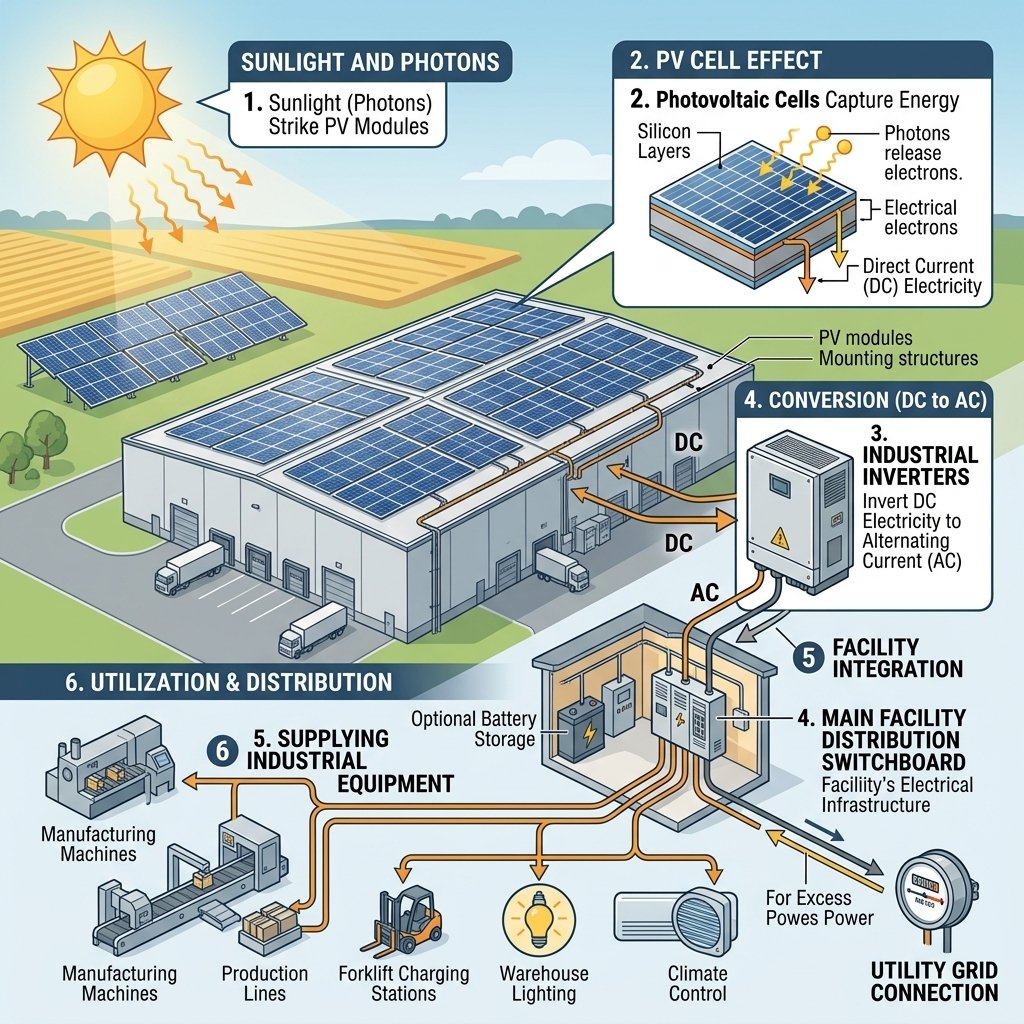
How industrial solar panels work begins with photovoltaic cells capturing energy from sunlight and converting it directly into electrical energy. Industrial solar photovoltaic (PV) systems use the same fundamental photovoltaic principle as smaller rooftop systems, but they are typically designed at a much larger scale to supply factories, warehouses, processing plants, distribution centers, and other commercial or industrial facilities.
Understanding how industrial solar panels work is crucial for maximizing efficiency.
An industrial solar system is more than a collection of panels. It normally includes PV modules, mounting structures, electrical cables, protection equipment, inverters, meters, monitoring systems, and connections to the facility’s electrical infrastructure. Depending on the project, batteries may also be incorporated.
Thus, understanding how industrial solar panels work can lead to more efficient solar solutions.
Understanding each stage helps explain how sunlight arriving at a factory roof or ground-mounted solar array eventually becomes electricity that can operate industrial equipment.
How Industrial Solar Panels Work With Sunlight
The process starts when sunlight reaches photovoltaic cells inside a solar panel. Most commercially deployed solar modules use semiconductor materials, with crystalline silicon being particularly important in today’s PV industry.
When photons from sunlight are absorbed by the semiconductor, their energy can energize electrons. The internal electrical properties of the solar cell cause electrical charges to move, producing an electric current.
Individual solar cells produce relatively small amounts of power, so manufacturers electrically connect multiple cells to create a solar module. Multiple modules are then connected into larger arrays capable of supplying much greater amounts of electricity.
Finally, understanding how industrial solar panels work promotes sustainability within industries.
This modular structure allows photovoltaic technology to be scaled from small systems to very large industrial installations.
This modular structure allows photovoltaic technology to be scaled from small systems to very large industrial installations.
1. Solar Panels Capture Solar Radiation
Ultimately, awareness of how industrial solar panels work supports informed decision-making.
Industrial facilities may install hundreds or thousands of solar modules depending on electricity requirements and available space.
Panels can be installed on:
- Factory rooftops
- Warehouse roofs
- Industrial land
- Parking structures
- Ground-mounted solar fields
Orientation, tilt, shading, available sunlight, structural conditions, and local weather all influence system performance.
Understanding how industrial solar panels work aids in regulatory compliance.
A professionally designed system attempts to maximize useful energy production while satisfying structural, electrical, safety, and regulatory requirements.
2. Photovoltaic Cells Generate DC Electricity
The electricity initially produced by photovoltaic modules is direct current (DC).
Inside each module, individual cells are electrically interconnected. Modules are then connected into strings and arrays according to the electrical design of the installation.
The resulting DC electricity travels through cables toward power-conversion equipment.
This is a critical point when explaining how industrial solar panels work: solar panels themselves do not normally produce the alternating-current electricity directly used by most industrial electrical systems. They first generate DC electricity.
3. Inverters Convert DC Into AC Electricity
An inverter is one of the most important components of an industrial PV system.
The inverter converts the DC electricity generated by solar modules into alternating current (AC). AC electricity is the form used by electrical grids and most conventional industrial electrical systems.
Large industrial installations may use multiple string inverters or larger centralized inverter configurations, depending on engineering requirements.
It’s vital to understand how industrial solar panels work to address energy needs effectively.
Modern inverter systems can also provide monitoring and grid-support functions. Their exact capabilities depend on the equipment, system architecture, and applicable grid requirements.
4. Electricity Enters the Industrial Electrical System
After conversion to usable AC electricity, the solar-generated power can be integrated into the facility’s electrical distribution system.
During periods when solar generation and industrial demand occur simultaneously, the facility can consume solar electricity directly.
For example, electricity may support:
- Production machinery
- Pumps and motors
- Ventilation systems
- Lighting
- Cooling equipment
- Compressors
- Offices and computers
- Automated production equipment
Using electricity at the location where it is generated can reduce the amount of electricity that must be purchased from the external grid.
Learning how industrial solar panels work is essential for energy management.
However, the exact electrical architecture varies considerably between industrial sites and must be designed by qualified professionals.
purchased from the external grid.
However, the exact electrical architecture varies considerably between industrial sites and must be designed by qualified professionals.
In addition, clarity on how industrial solar panels work supports better investment decisions.
5. What Happens When Solar Production Is Too Low?
Solar production changes throughout the day and with weather conditions.
At night, photovoltaic modules do not generate electricity from sunlight. Clouds, shading, dirt, temperature, panel orientation, and seasonal conditions can also affect output.
A comprehensive grasp of how industrial solar panels work ensures reliability in energy supply.
If an industrial facility requires more electricity than its solar installation is producing, a grid-connected facility can obtain the remaining electricity from the utility grid.
For example, if a factory needs 1,000 kW at a particular moment while its solar system supplies 600 kW, the remaining demand can generally be supplied by the grid, subject to the facility’s electrical configuration.
Therefore, an industrial solar system does not necessarily replace the electricity grid. It can operate alongside it.
7. Industrial Solar Panels and Battery Storage
Battery storage is optional rather than an essential component of every industrial solar system.
When included, batteries can store electricity for later use. A properly engineered solar-plus-storage system may help an industrial facility shift solar electricity to different periods, manage peak demand, or improve certain aspects of energy resilience.
However, batteries introduce additional costs, conversion losses, controls, maintenance considerations, and safety requirements.
Solar panels and batteries should therefore be sized according to the facility’s actual electricity profile rather than simply installing the largest possible system.
8. Monitoring Industrial Solar Performance
In conclusion, knowing how industrial solar panels work impacts sustainability goals.
Modern industrial PV installations commonly use monitoring systems to measure electricity production and identify performance problems.
Operators can track variables such as power output, energy production, inverter status, and system faults. More sophisticated systems can compare actual production against expected performance.
Monitoring is particularly important for large installations because a small unnoticed performance problem across a large array can translate into substantial lost energy over time.
Maintenance teams can use this information to identify malfunctioning equipment and determine when inspection or corrective work is necessary.
Factors Affecting How Industrial Solar Panels Work
Solar panels do not convert all incoming sunlight into electricity. Their actual energy yield depends on both the technology and environmental conditions.
To conclude, understanding how industrial solar panels work is vital for embracing renewable energy.
Important factors include solar irradiance, module efficiency, temperature, shading, dirt or soiling, orientation, system losses, inverter performance, and equipment condition.
High module temperatures can reduce electrical performance. Shading can also lower production, while accumulated dirt may reduce the amount of sunlight reaching the cells.
For this reason, industrial solar projects require appropriate engineering, performance monitoring, and maintenance rather than simply installing panels and leaving them unattended.
Industrial Solar System Efficiency
Efficiency describes how effectively a photovoltaic device converts incoming solar energy into electrical energy.
However, module efficiency should not be confused with total annual energy production. Two systems using similar modules can produce different amounts of electricity because of location, orientation, temperature, shading, equipment losses, and system design.
For an industrial project, engineers therefore evaluate energy yield in addition to module efficiency. Energy yield provides a more practical picture of how much electricity an installation can generate over time.
Advantages of Industrial Solar Power
Once we understand how industrial solar panels work, their potential industrial value becomes clearer.
A properly designed installation can reduce grid electricity purchases during solar-producing hours, provide renewable electricity on-site, make productive use of large roofs or available land, and contribute to corporate energy and emissions-reduction strategies.
Solar PV also generates electricity without combustion during normal operation. However, solar equipment still has environmental impacts across its full lifecycle, including raw-material extraction, manufacturing, transportation, installation, and eventual recycling or disposal.
The insights gained from understanding how industrial solar panels work can fuel innovation.
This lifecycle perspective is important when evaluating solar power scientifically rather than describing it as having no environmental impact.
Future of Industrial Solar Panel Technology
Ultimately, grasping how industrial solar panels work is essential for future energy strategies.
Industrial photovoltaic technology continues to develop. Research focuses on improving cell efficiency, reliability, manufacturing, system design, power electronics, and long-term energy yield.
Advanced monitoring and energy-management technologies can also coordinate solar generation with factory electricity demand. Solar-plus-storage systems may become increasingly important where economics and operational requirements justify them.
New cell and module technologies are also being researched to capture more solar energy while reducing electricity-generation costs.
Awareness of how industrial solar panels work is key to improving energy strategies.
Conclusion
Moreover, comprehending how industrial solar panels work can help in reducing operational costs.
Understanding how industrial solar panels work will allow businesses to adapt to changing energy needs.
Understanding how industrial solar panels work requires following the entire energy pathway: sunlight reaches photovoltaic cells, semiconductor materials convert part of that solar energy into DC electricity, and inverters convert the DC electricity into AC power suitable for industrial use.
The electricity can then supply factory equipment and other facility loads. When solar production is insufficient, a grid-connected facility can draw additional electricity from the grid. When production exceeds demand, surplus electricity may be exported, curtailed, or stored, depending on system design and local regulations.
Industrial solar power is therefore not simply about installing panels. It is an integrated electrical system involving photovoltaic modules, mounting structures, inverters, electrical protection, monitoring, grid connections, and sometimes battery storage.
When correctly engineered and maintained, industrial solar panels can provide factories and other large facilities with a significant source of renewable electricity for many years.
Understanding how industrial solar panels work is integral to achieving energy independence.
Therefore, knowing how industrial solar panels work is crucial for energy innovation.
To summarize, knowledge of how industrial solar panels work is essential for operational success.https://www.energy.gov/cmei/systems/articles/pv-cells-101-primer-solar-photovoltaic-cell
Pingback: 7 Key Benefits of Clean Energy From Solar Farms
Pingback: 7 Key Factors Behind Lucrative Industrial Solar Panel Performance