
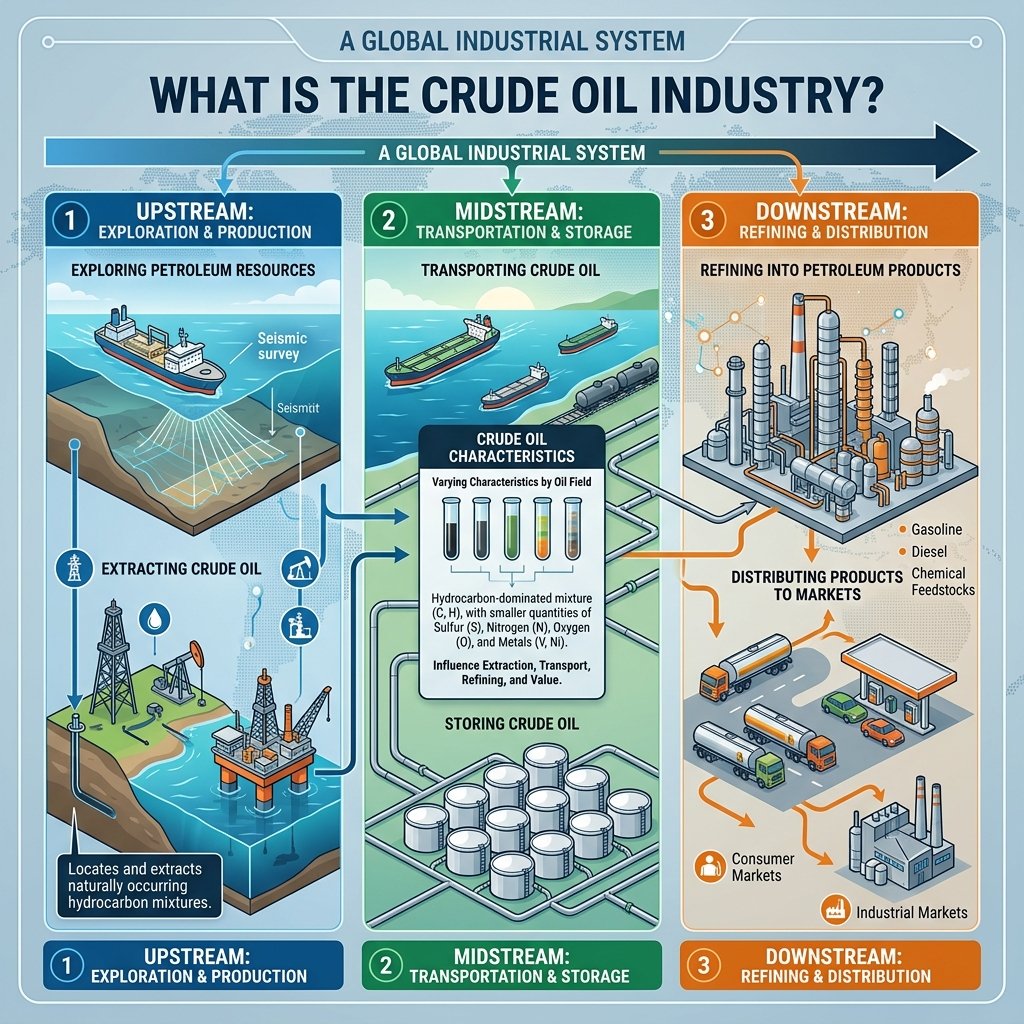
The Crude Oil Industry is a global industrial system responsible for exploring petroleum resources, extracting crude oil, transporting and storing it, refining it into petroleum products, and distributing those products to industrial and consumer markets.
Crude oil is a naturally occurring mixture dominated by hydrocarbons, along with smaller quantities of sulfur-, nitrogen-, oxygen-containing compounds and trace metals. Its physical and chemical characteristics vary substantially between oil fields. These differences influence extraction methods, transportation requirements, refinery configuration, product yields, and economic value.
The industry is commonly organized into three major sectors: upstream, midstream, and downstream. Upstream covers exploration and production, midstream primarily handles transportation and storage, while downstream converts crude oil into finished petroleum products and moves those products toward consumers.
Upstream Crude Oil Industry
The upstream sector represents the beginning of the petroleum supply chain. It includes geological exploration, geophysical investigation, exploratory drilling, field development, well construction, and crude oil production.
Before drilling, geologists and geophysicists investigate sedimentary basins and underground structures that may contain petroleum. Seismic surveys are commonly used to create subsurface images that help identify potential reservoirs.
However, seismic evidence alone cannot confirm that a commercially productive oil accumulation exists. Exploratory drilling and subsequent measurements are needed to determine reservoir properties and evaluate whether development is technically and economically practical.
After discovery, production wells may be drilled vertically, directionally, or horizontally depending on reservoir geology and development strategy.
During early production, natural reservoir pressure may move petroleum toward the well. As reservoir conditions change, operators can use artificial lift, water injection, gas injection, or enhanced oil recovery techniques to maintain or increase production.
Midstream Crude Oil Industry
Once crude oil reaches the surface, it must usually travel from producing regions to processing and refining facilities. This forms a major part of the midstream sector.
Pipelines are widely used for transporting large quantities of crude oil over land. Tanker ships connect major producing and consuming regions across oceans, while rail and trucks can provide additional transportation options in certain markets.
Storage terminals are equally important. They allow producers, refiners, traders, and distributors to manage differences between production rates, refinery requirements, transportation schedules, and market demand.
Safety is critical throughout this network. Pipeline failures, tanker accidents, storage-tank leaks, and other incidents can release petroleum into terrestrial or aquatic environments. Monitoring, inspection, corrosion management, containment systems, and emergency-response planning are therefore important components of oil transportation infrastructure.
Downstream Crude Oil Industry and Refining
The downstream Crude Oil Industry transforms crude oil into commercially useful products.
At a refinery, crude oil first undergoes separation processes such as atmospheric distillation. Different hydrocarbon fractions are separated largely according to their boiling ranges. Additional refinery processes then convert, treat, and blend these streams to produce products with required specifications.
Processes may include vacuum distillation, catalytic cracking, hydrocracking, reforming, hydrotreating, and other conversion and purification technologies.
Refineries can manufacture gasoline, diesel fuel, jet fuel, liquefied petroleum gases, heating fuels, lubricants, asphalt materials, and petrochemical feedstocks.
Crude oil therefore has uses beyond transportation fuels. Petroleum-derived feedstocks are important in chemical manufacturing and can contribute to the production of plastics, solvents and numerous intermediate industrial materials.
Economic Importance of the Crude Oil Industry
The Crude Oil Industry has historically played an important role in transportation, manufacturing, international trade, and energy supply.
Oil prices are influenced by interacting factors including global supply and demand, inventories, production capacity, refinery conditions, transportation constraints, geopolitical events, economic activity, and market expectations.
Oil-producing countries can receive substantial export revenues and government income from petroleum development. At the same time, economies that depend heavily on oil revenues can be exposed to fluctuations in international petroleum prices.
The industry also supports specialized occupations in geology, geophysics, drilling, petroleum engineering, chemical engineering, pipeline operations, refining, environmental management, maintenance, maritime transportation, and industrial safety.
Technology in the Crude Oil Industry
Technological development has significantly changed petroleum exploration and production.
Three-dimensional seismic imaging can improve understanding of subsurface geological structures. Directional and horizontal drilling allow engineers to reach targets that would be difficult to access using conventional vertical wells alone.
Modern facilities also use sensors, automated process controls, digital reservoir models, remote monitoring, and data analysis. These technologies can improve equipment monitoring, operational efficiency, reservoir management, and early identification of abnormal conditions.
Robotics and remotely operated systems are particularly valuable in some offshore and hazardous environments where direct human access can be difficult.
Technology, however, cannot eliminate every geological, economic, safety, or environmental uncertainty associated with petroleum operations.
Environmental Impacts of the Crude Oil Industry
The Crude Oil Industry creates environmental impacts throughout its supply chain.
Oil extraction can disturb land and ecosystems and generate produced water and other wastes. Offshore operations introduce potential risks to marine environments. Transportation creates spill risks, while refining requires energy and can generate air emissions, wastewater, and solid or hazardous wastes.
Oil and gas production, processing, and transportation can also release carbon dioxide and methane. Petroleum products create additional greenhouse-gas emissions when fuels are ultimately combusted.
Environmental performance therefore requires more than responding to major oil spills. Important measures include methane detection and control, reduced routine flaring, wastewater treatment, improved energy efficiency, equipment maintenance, leak prevention, waste management, and effective monitoring.
Safety and Environmental Management
Industrial safety is fundamental throughout petroleum operations because crude oil and many petroleum products are combustible, and production facilities can operate under high pressures and temperatures.
Companies use engineering controls, process-safety systems, fire protection, emergency shutdown equipment, worker training, inspection programs, and emergency-response procedures to reduce risks.
Environmental management also involves monitoring emissions, protecting water resources, controlling wastes, maintaining well and pipeline integrity, and restoring production sites when operations end.
Requirements vary between jurisdictions, so operators must comply with the environmental, occupational, maritime, industrial, and other regulations applicable to each project.
Future of the Crude Oil Industry
The future of the Crude Oil Industry is closely connected to changes in the global energy system.
Petroleum continues to supply transportation fuels and industrial feedstocks, but energy systems are also expanding renewable electricity, electric vehicles, energy-efficiency technologies, alternative fuels, and other lower-emission technologies.
Oil companies and governments therefore face several overlapping challenges: maintaining safe existing infrastructure, meeting current demand, reducing operational emissions, controlling methane and flaring, improving environmental performance, and responding to long-term changes in energy consumption.
The exact future demand for petroleum remains uncertain because it depends on economic development, technology, public policy, consumer behavior, energy security, and the speed of energy transitions.
Conclusion
The Crude Oil Industry is much more than the extraction of petroleum from underground reservoirs. It is an interconnected value chain extending from geological exploration and drilling through transportation, storage, refining, marketing, and industrial use.
Its development has supported modern transportation and industrial production, while also creating significant environmental and climate challenges. Understanding both sides is essential for a scientifically balanced assessment.
Future improvements will depend on better engineering, stronger environmental management, emissions reduction, efficient resource use, effective safety systems, and continued development of alternative energy technologies. Studying the Crude Oil Industry therefore provides important insight into both the modern energy economy and the challenges involved in building a more sustainable energy system
.https://www.futurelearn.com/info/courses/introduction-to-environmental-science/0/steps/269824