
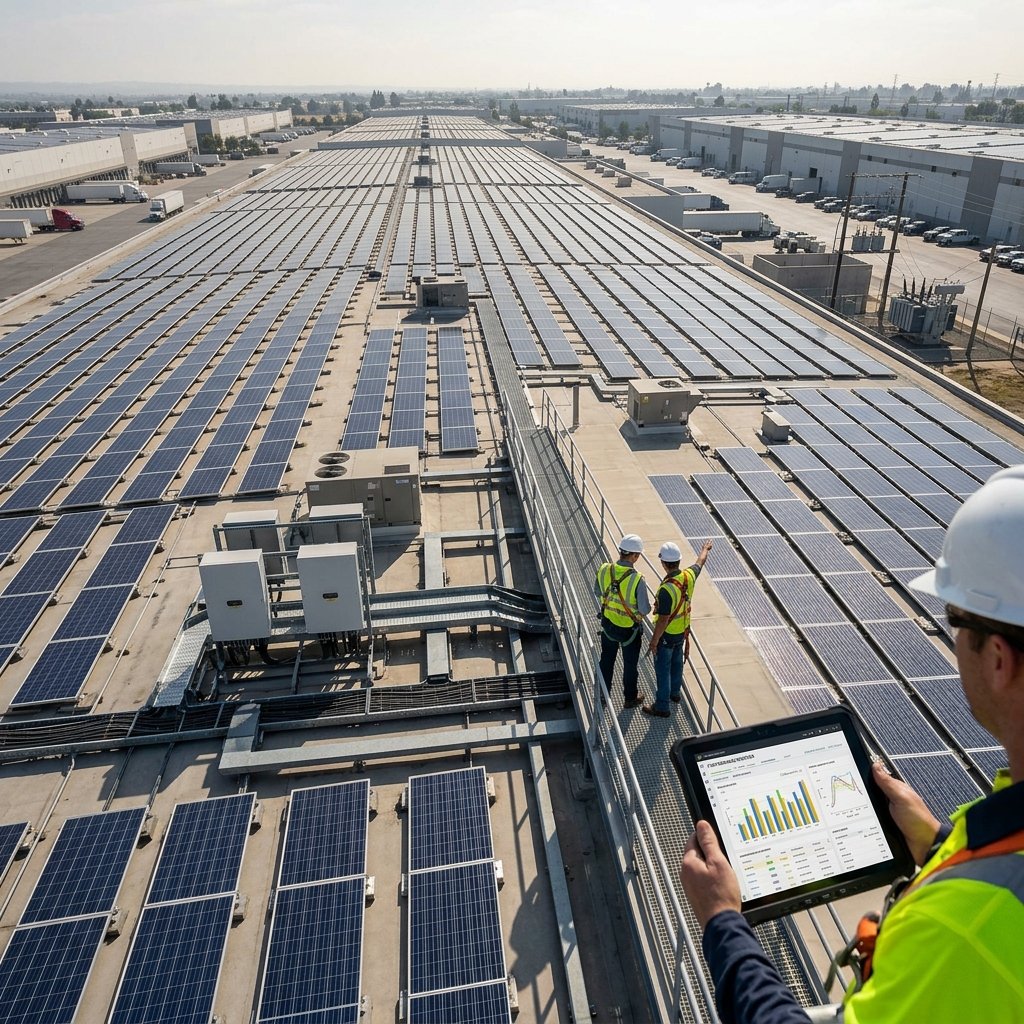
Industrial Solar Panel Performance describes how effectively a large photovoltaic (PV) system produces usable electricity under real operating conditions. Industrial solar installations are commonly used on factories, warehouses, manufacturing plants, logistics centers, and other facilities with substantial electricity demand.
Performance should not be judged only by the efficiency percentage printed on a solar module specification sheet. The electricity actually produced by an industrial PV installation depends on solar radiation, temperature, module technology, orientation, shading, dirt, electrical losses, inverter operation, equipment condition, and system availability.
Understanding these factors helps industrial operators evaluate whether their solar installations are delivering the electricity expected from their design
Understanding Industrial Solar Panel Performance
A solar module’s efficiency represents the percentage of incoming solar energy converted into electrical energy under specified conditions. Industrial Solar Panel Performance, however, is a broader concept because it considers how the complete system performs in the real world.
Laboratory ratings are established under standardized testing conditions. Actual factories experience changing weather, temperature, cloud cover, dust, wind, seasonal sunlight, and electrical demand.
For this reason, engineers frequently evaluate energy yield—the amount of electricity actually generated over a particular period—rather than relying exclusively on module efficiency.
1. Solar Radiation
The amount of sunlight reaching solar panels is one of the most important factors determining electricity generation.
A facility located in an area receiving strong annual solar radiation can generally produce more electricity from the same system capacity than an equivalent facility receiving substantially less solar radiation.
Solar availability also changes throughout the day and across seasons. Clouds reduce incoming solar radiation, while the angle between sunlight and the module surface affects how much solar energy can be captured.
Therefore, historical solar-resource information is an important part of industrial solar feasibility and performance modeling.
2. Temperature and Solar Performance
Strong sunlight is useful for electricity generation, but high module temperature can reduce photovoltaic performance.
Solar cells generally operate more efficiently at lower temperatures. As cell temperature increases, electrical voltage typically decreases, reducing power output.
This means a very sunny but extremely hot day does not necessarily produce exactly the output predicted solely from sunlight intensity.
Engineers account for temperature when estimating annual production. Ventilation around modules, mounting configuration, local climate, and module characteristics can influence operating temperatures.
3. Panel Orientation and Tilt
The direction and angle of an industrial solar array influence the amount of solar radiation reaching its surface.
Ground-mounted systems can often be positioned according to energy-production objectives. Rooftop installations may face additional constraints because panel placement depends on roof orientation, structural design, available area, safety access, and nearby obstacles.
Some large ground-mounted installations use solar trackers that change module orientation as the sun moves across the sky.
Tracking can increase energy production in suitable applications, although it also adds mechanical components and maintenance considerations.
4. Shading
Shading is another important factor affecting Industrial Solar Panel Performance.
Trees, neighboring buildings, chimneys, ventilation equipment, antennas, structural elements, and other objects can cast shadows on modules.
Even partial shading can reduce production, depending on module design and electrical configuration.
Professional site assessment should therefore evaluate potential shading throughout the year rather than considering conditions at only one time of day.
Careful array layout and appropriate electrical design can help reduce shading-related losses.
5. Dust, Dirt, and Soiling
Industrial environments may expose solar panels to dust, pollen, soot, sand, bird droppings, and other materials.
When these substances accumulate on module surfaces, they can reduce the amount of sunlight reaching photovoltaic cells. This phenomenon is commonly called soiling.
The severity varies significantly by location. Dry, dusty environments may experience different conditions from rainy regions where precipitation naturally removes some surface contamination.
Cleaning strategies should therefore be based on site conditions, expected energy losses, water availability, safety, and the economic value of recovered production.
6. Inverter Performance
Solar modules generate direct-current electricity, while industrial facilities and electricity grids generally operate using alternating current.
Inverters convert DC electricity into grid-compatible AC electricity.
Conversion is not perfectly lossless, so inverter efficiency contributes to overall system performance. Equipment faults or downtime can also reduce energy production even when the solar modules themselves are functioning normally.
Industrial installations therefore require monitoring of both PV modules and other system components.
7. Electrical and System Losses
Electricity can be lost at different stages between the solar module and the point where useful electricity is delivered.
Sources can include wiring resistance, electrical mismatch between modules, inverter conversion, transformers, connections, and other balance-of-system components.
Good engineering attempts to minimize these losses through appropriate equipment selection, cable sizing, system architecture, installation quality, and maintenance.
This illustrates why evaluating only solar module efficiency does not provide a complete picture of industrial PV performance.
Measuring Industrial Solar Panel Performance
Industrial operators can use several indicators to evaluate solar installations.
One important measurement is total energy production, normally expressed in kilowatt-hours (kWh) or megawatt-hours (MWh).
Another useful indicator is performance ratio, which compares measured electricity production with modeled production after relevant operating conditions are considered.
System availability is also important. It describes how much of the relevant time the installation is operational and capable of producing electricity when the necessary solar resource and grid conditions are available.
Monitoring these indicators helps operators distinguish between normal environmental variation and technical underperformance.
Solar Panel Degradation
Photovoltaic modules gradually lose some performance as they age.
Long-term degradation can result from normal material aging and exposure to environmental conditions. The exact degradation rate differs according to module technology, manufacturing quality, climate, installation, and operating conditions.
Other equipment, including inverters, connectors, cables, and monitoring devices, may also require maintenance or replacement during the operating life of an industrial solar installation.
Therefore, long-term financial models should not assume that every component will maintain its original performance indefinitely.
Maintenance and Performance
Regular operations and maintenance can help preserve Industrial Solar Panel Performance.
Maintenance programs may include:
- Visual inspections
- Electrical testing
- Inverter inspections
- Performance monitoring
- Fault detection
- Module cleaning when justified
- Checking cables and connections
- Inspecting mounting structures
- Vegetation management for ground systems
- Reviewing abnormal production losses
Digital monitoring systems can compare actual electricity generation with expected production. When unexpected differences appear, technicians can investigate whether the cause is weather, soiling, shading, equipment failure, electrical problems, or another factor.
Early fault detection can reduce unnecessary production losses.
Weather and Industrial Solar Systems
Solar installations operate outdoors for decades and therefore encounter rain, wind, snow, hail, heat, freezing conditions, humidity, and severe weather depending on location.
Systems should be engineered for relevant environmental conditions and applicable technical standards.
Weather does not affect every project equally. Snow may temporarily cover panels in colder climates, while dust and high temperatures may be more significant in hot and dry regions.
This is why industrial solar performance must be evaluated according to site-specific conditions rather than assuming identical output everywhere.
Improving Industrial Solar Panel Performance
Improving performance begins before installation.
Developers should evaluate solar resources, roof or land conditions, shading, structural capacity, module technology, inverter selection, electrical configuration, and expected industrial electricity demand.
After installation, monitoring becomes essential.
Operators can compare measured output with modeled expectations and investigate unexplained losses. Cleaning, preventive maintenance, equipment repairs, vegetation control, and inverter management can then be performed when technically and economically justified.
The objective is not simply to maximize instantaneous power. A well-designed industrial PV system should maximize useful energy production and reliability across its service life while controlling operating and maintenance costs.
Future of Industrial Solar Performance
Research continues to improve photovoltaic efficiency, durability, monitoring, power electronics, system design, and energy yield.
Advanced sensors and digital monitoring systems can provide operators with increasingly detailed information about equipment condition and electricity production.
Improved forecasting can help industrial facilities estimate solar generation and coordinate it with electricity consumption. Battery storage and intelligent energy-management systems can provide additional flexibility where economically and technically appropriate.
These developments may allow industrial facilities to manage solar electricity as an increasingly integrated component of their broader energy systems
Conclusion
Industrial Solar Panel Performance depends on much more than the rated efficiency of individual solar modules. Solar radiation, temperature, shading, soiling, orientation, electrical losses, inverter performance, weather, equipment aging, system design, and maintenance all influence real-world electricity generation.
For industrial businesses, the most meaningful question is therefore not simply how efficient a solar panel is under laboratory conditions, but how much useful electricity the entire system can reliably generate over many years.
Professional design, accurate performance modeling, continuous monitoring, preventive maintenance, and timely fault correction can help an industrial solar installation achieve its expected energy production.
By understanding and managing these factors, factories, warehouses, and other industrial facilities can improve the technical and economic value of their solar investments while supporting long-term renewable electricity generation.https://en.wikipedia.org/wiki/Natural_resource