
Introduction
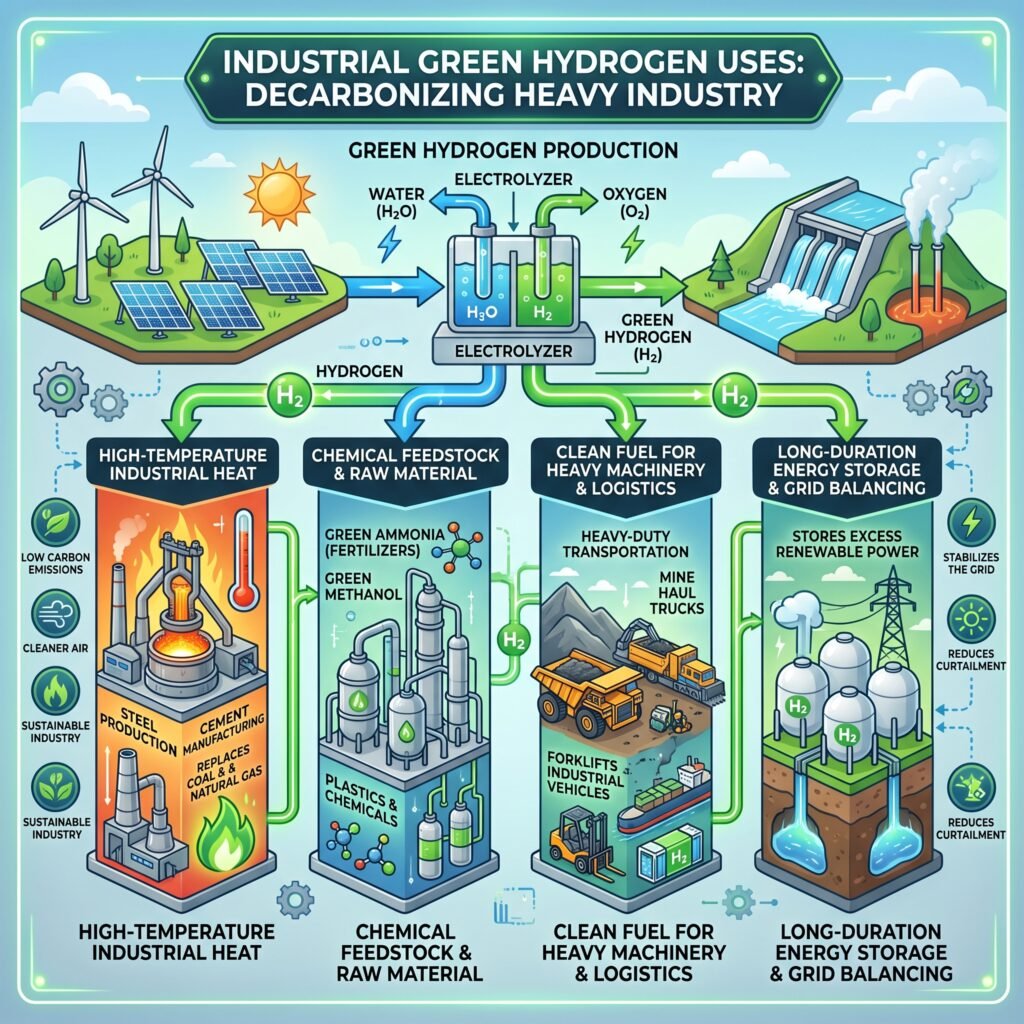
Industrial Green Hydrogen Uses are becoming increasingly important as governments and companies search for practical ways to reduce carbon emissions from heavy industry. Green hydrogen is produced by splitting water into hydrogen and oxygen through electrolysis powered by renewable electricity. Solar, wind, hydroelectric, and geothermal energy can provide the low-carbon electricity required for this process.
Many industrial activities depend on coal, oil, and natural gas because they require extremely high temperatures or hydrogen as a chemical raw material. Electrification can replace fossil fuels in some operations, but it may not be technically practical for every industrial process. Green hydrogen can help fill this gap by supplying clean fuel, industrial heat, energy storage, and chemical feedstock.
Major Industrial Green Hydrogen Uses
Industrial green hydrogen can serve several purposes across manufacturing and heavy industry. It can replace conventionally produced hydrogen, generate high-temperature heat, support renewable power systems, and produce cleaner industrial materials.
The most important applications currently being developed include steel manufacturing, fertilizer production, oil refining, chemical processing, shipping fuels, glassmaking, cement production, mining, and long-duration energy storage. However, its environmental performance depends on the electricity source, water management, production efficiency, and transportation method.
Green Hydrogen in Steel Production
Steelmaking is one of the most promising industrial green hydrogen uses. Traditional steel production commonly uses coke made from coal to remove oxygen from iron ore. This process releases substantial carbon dioxide emissions.
Green hydrogen can be used in direct reduced iron processes as an alternative reducing agent. It reacts with the oxygen contained in iron ore and produces water vapor instead of carbon dioxide at the reduction stage. The resulting material can then be melted in an electric arc furnace powered by low-carbon electricity.
Hydrogen-based steelmaking could significantly reduce the emissions associated with primary steel production. Nevertheless, the industry requires reliable renewable electricity, new processing facilities, hydrogen infrastructure, and a stable supply of suitable iron ore.
Green Hydrogen for Ammonia and Fertilizers
Ammonia is essential for producing nitrogen fertilizers used in global agriculture. Conventional ammonia plants usually obtain hydrogen from natural gas or coal, creating carbon emissions during production.
Green hydrogen can replace fossil-based hydrogen in the ammonia manufacturing process. Hydrogen is combined with nitrogen through the Haber-Bosch process to produce ammonia. When renewable electricity powers hydrogen production and the ammonia plant, the resulting product is often described as green ammonia.
Green ammonia can reduce the carbon footprint of fertilizer production. It is also being studied as an energy carrier and potential fuel for maritime transport. However, ammonia is toxic and requires strict safety standards during production, storage, transportation, and use.
Industrial Green Hydrogen Uses in Refineries
Oil refineries use large quantities of hydrogen to remove sulfur and other impurities from petroleum products. Hydrogen is also required to transform heavy hydrocarbons into lighter and more valuable fuels.
Much of the hydrogen currently used by refineries is produced from natural gas through steam methane reforming. Green hydrogen could replace some of this conventional supply and reduce operational emissions.
This application may create early demand because refineries already understand hydrogen handling and have established equipment and safety procedures. However, green hydrogen cannot eliminate the emissions released when petroleum products are eventually burned. Therefore, it can reduce refinery emissions but does not make fossil fuels completely carbon-free.
Chemical and Methanol Production
Chemical manufacturing represents another important market for green hydrogen. Hydrogen is used to produce ammonia, methanol, solvents, polymers, synthetic fuels, and many other industrial products.
Methanol is traditionally produced using synthesis gas derived from fossil resources. Combining green hydrogen with captured carbon dioxide could produce lower-carbon methanol. This renewable methanol may be used as an industrial chemical, marine fuel, or raw material for other products.
The overall climate benefit depends on where the carbon dioxide comes from and what happens to it after the methanol is used. Careful lifecycle assessment is necessary to avoid overstating emission reductions.
Green Hydrogen for Industrial Heating
Factories require heat for melting, drying, firing, refining, and processing materials. Some operations can use electric furnaces or heat pumps, while processes requiring very high temperatures may be more difficult to electrify.
Green hydrogen can be burned to produce industrial heat or used in fuel cells to generate electricity. Potential applications include glassmaking, ceramics, metals, and certain chemical processes.
Using hydrogen as a fuel must be evaluated carefully. Producing hydrogen and then converting it back into heat can consume more renewable electricity than direct electrification. Consequently, green hydrogen is generally more valuable where efficient electric technologies are unavailable or unsuitable.
Cement, Glass, and Ceramic Manufacturing
Cement, glass, and ceramic plants operate kilns and furnaces at high temperatures. Green hydrogen may replace part of the coal or natural gas used to heat this equipment.
In cement manufacturing, hydrogen can reduce emissions from fuel combustion. However, a large share of cement emissions comes from the chemical conversion of limestone into clinker. Hydrogen cannot directly eliminate these process emissions, so other solutions—including material efficiency and carbon capture—may also be necessary.
Glass and ceramic producers could use hydrogen combustion for high-temperature heating. Equipment design must be adapted because hydrogen has different flame characteristics from natural gas and can influence heat distribution and product quality.
Mining and Heavy Equipment
Remote mines often depend on diesel-powered machinery and generators. Green hydrogen and hydrogen-derived fuels could help power haul trucks, processing equipment, and backup electricity systems.
Fuel cells may offer advantages for heavy vehicles requiring long operating hours, fast refueling, and high energy capacity. Hydrogen can also support mineral processing where high-temperature heat is required. Still, battery-electric equipment may be more efficient for many short-distance mining operations. Companies should compare cost, infrastructure, efficiency, and operating conditions before selecting a technology.
Energy Storage and Reliable Industrial Power
Renewable electricity production changes according to sunlight, wind conditions, and water availability. Electrolyzers can use surplus renewable electricity to produce green hydrogen. The hydrogen can then be stored and used later for industrial processes, electricity generation, or fuel production.
This approach may provide long-duration or seasonal energy storage for industrial centers. It can also improve energy security by reducing dependence on imported fossil fuels. However, converting electricity into hydrogen and back into electricity causes energy losses. Direct renewable electricity and battery storage are generally more efficient for short-duration needs.
Challenges Facing Industrial Green Hydrogen Uses
The expansion of industrial green hydrogen uses faces several challenges. Green hydrogen remains expensive in many markets because electrolyzers, renewable power facilities, storage systems, pipelines, and production plants require substantial investment.
Hydrogen is also difficult to transport because it has a low volumetric energy density. It may require compression, liquefaction, pipelines, or conversion into ammonia and other carriers. Each option increases cost and energy consumption.
Water is another important consideration. Electrolysis requires purified water, and additional water may be needed for cooling. Projects in water-stressed regions should use responsible water management, desalination where appropriate, or treated wastewater without harming local communities and ecosystems.
Conclusion
Industrial green hydrogen uses could support the transition toward cleaner steel, fertilizers, chemicals, industrial heat, shipping fuels, mining operations, and energy storage. Its greatest value is likely to be in industries where direct electrification is technically difficult and conventional hydrogen is already essential.
Green hydrogen is not a universal replacement for every industrial fuel. Successful development requires abundant renewable electricity, efficient electrolyzers, safe infrastructure, responsible water use, and accurate lifecycle emission assessments. When applied to the right industrial processes, it can become an important tool for reducing emissions while supporting modern manufacturing and long-term energy security.blog https://www.unesco.org/en/query-list/n/natural-resources