
Introduction
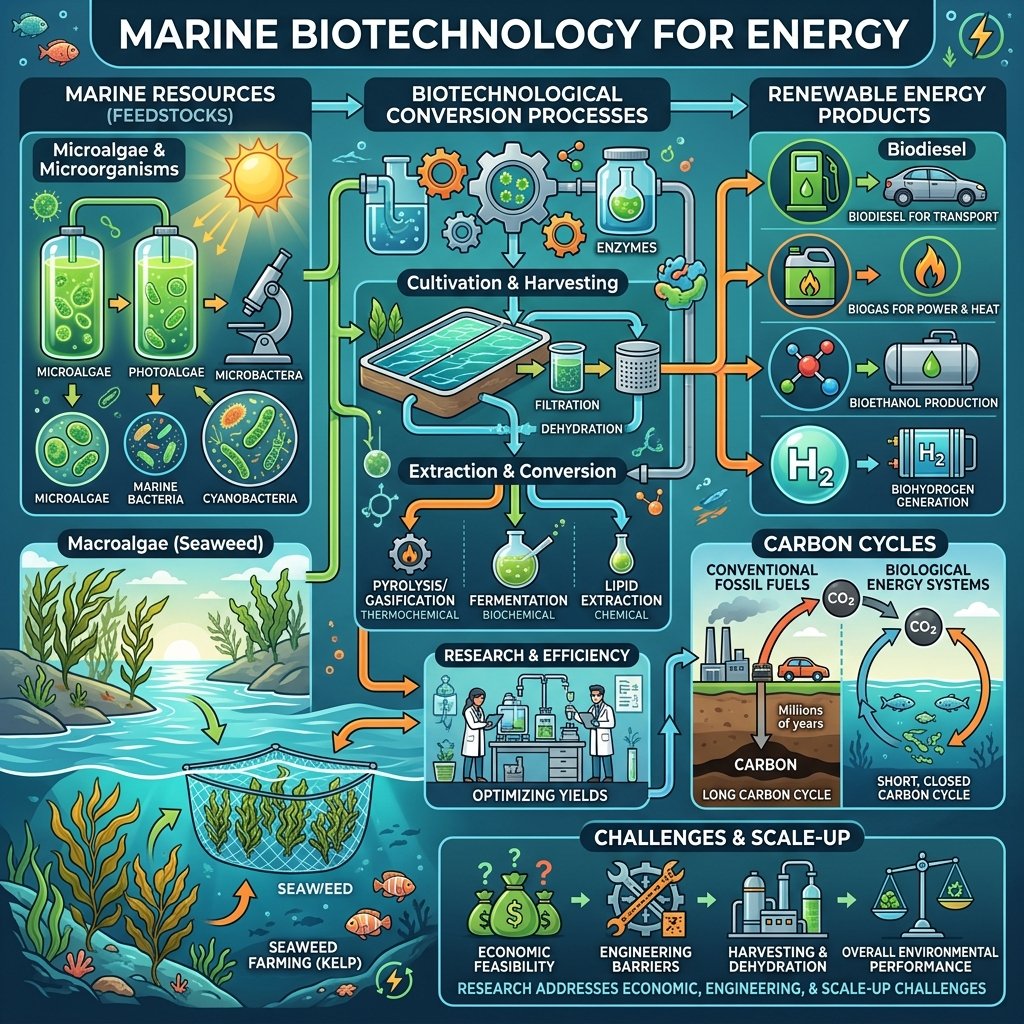
Marine Biotechnology for Energy is an emerging scientific field that uses marine organisms, biological processes, and biotechnology to investigate new ways of producing renewable fuels and energy products. Microalgae, macroalgae or seaweed, marine bacteria, and other microorganisms contain biological materials that can potentially be converted into biodiesel, biogas, bioethanol, biohydrogen, and other fuels.
Innovations in Marine Biotechnology for Energy are paving the way for sustainable fuel sources.
Furthermore, Marine Biotechnology for Energy offers a pathway to reduce carbon emissions.
Overall, the potential of Marine Biotechnology for Energy is substantial when addressing global energy needs.
Interest in these resources has increased because conventional fossil fuels release carbon dioxide that has been stored underground for millions of years, while biological energy systems can potentially operate within shorter carbon cycles. However, calling a fuel “bio-based” does not automatically make it low-carbon. Cultivation, harvesting, drying, processing, transportation, electricity use, nutrients, and conversion efficiency all influence its overall environmental performance.
Exploring various marine species is crucial in Marine Biotechnology for Energy research.
Research reviews continue to identify algae as promising energy feedstocks, while also emphasizing substantial economic, engineering, and scale-up challenges.
This understanding is fundamental to advancing Marine Biotechnology for Energy applications.
How Marine Biotechnology for Energy Works
The pathway for Marine Biotechnology for Energy can vary widely by organism.
Marine Biotechnology for Energy begins by selecting organisms with characteristics useful for energy production.
Research into Marine Biotechnology for Energy continues to evolve.
Photosynthetic microalgae and seaweeds use sunlight to convert carbon dioxide and nutrients into biomass. This biomass contains different proportions of lipids, carbohydrates, proteins, and other organic compounds.
Biotechnology can help scientists identify productive strains, improve cultivation conditions, understand metabolism, optimize harvesting, and develop processes that convert biomass into useful energy products.
The basic system can be summarized as:
Marine organism → cultivation → biomass harvesting → processing → energy conversion → fuel or energy product.
The exact pathway depends on the organism and desired product. Lipid-rich microalgae may be investigated for liquid fuels, carbohydrate-rich biomass can undergo fermentation, while wet organic biomass can potentially be processed into biogas or through thermochemical conversion.
Microalgae for Renewable Energy
This highlights the importance of Marine Biotechnology for Energy in sustainable alternatives.
Advancements in Marine Biotechnology for Energy could lead to new fuel innovations.
Microalgae are among the most intensively researched organisms in marine bioenergy.
The future of Marine Biotechnology for Energy is promising as research expands.
These microscopic photosynthetic organisms can grow rapidly under suitable conditions. Certain species accumulate significant quantities of lipids, while others produce carbohydrates or other compounds useful for industrial processing.
One advantage is that some microalgae can be cultivated using saline or otherwise non-potable water, reducing direct dependence on freshwater in appropriately designed systems. Their production also does not necessarily require conventional fertile agricultural land.
After cultivation, microalgae must be separated from water. Their biomass can then undergo further processing.
This harvesting stage remains a major technical issue because cultures are typically dilute. Removing large quantities of water and processing the resulting biomass can consume substantial energy. Reviews of microalgal biorefineries identify harvesting and downstream processing among important technological and environmental bottlenecks.
Marine Biotechnology for Energy and Biodiesel
Biodiesel is one of the most widely studied algal biofuel pathways.
Some microalgae naturally accumulate lipids. These oils can be extracted and chemically converted into biodiesel through appropriate processing.
The theoretical attraction is clear: instead of depending entirely on oil-bearing terrestrial crops, microorganisms could provide another source of renewable lipids.
But laboratory productivity should not be confused with commercial viability.
Biogas generated from Marine Biotechnology for Energy processes can support energy needs.
Large cultivation facilities require infrastructure, nutrients, carbon supply, water management, harvesting systems, oil extraction, fuel conversion, and energy. Studies have consequently reported very different environmental and economic results depending on productivity assumptions and system design.
Through Marine Biotechnology for Energy, seaweed becomes a valuable resource.
Algal biodiesel therefore remains an important research field rather than a universal commercial replacement for petroleum diesel.
Seaweed for Bioenergy
Macroalgae, commonly called seaweed, provide another marine biomass resource.
Unlike oil-rich microalgae, many seaweeds contain substantial carbohydrates. These organic compounds can potentially be converted through biological or thermochemical processes.
Seaweed has several interesting resource characteristics. Marine cultivation generally does not require conventional agricultural land, and cultivation can avoid direct dependence on freshwater irrigation.
Marine biomass is critical in advancing Marine Biotechnology for Energy solutions.
Nevertheless, harvesting wet seaweed creates a major processing challenge because the biomass contains large quantities of water.
Drying can require considerable energy. A 2026 review of seaweed-based biorefineries found that drying and other energy-intensive processing stages can be major environmental hotspots.
Consequently, technologies capable of processing wet biomass efficiently are especially interesting for future development.
Biogas from Marine Biomass
Anaerobic digestion provides one possible pathway for converting marine organic matter into biogas.
Research in Marine Biotechnology for Energy will focus on maximizing efficiency.
During anaerobic digestion, microorganisms break down biodegradable material in an oxygen-free environment. The resulting biogas generally contains methane and carbon dioxide.
Seaweed and other suitable marine biomass can potentially serve as feedstocks.
The methane-rich fraction can be burned for heat and electricity or, after purification to appropriate specifications, converted into biomethane for applications where regulations and infrastructure permit.
Future technologies in Marine Biotechnology for Energy will be pivotal for energy transition.
However, seaweed composition varies substantially among species and seasons. Salts and certain chemical compounds can also affect biological digestion.
Researchers therefore investigate pretreatment methods, microbial communities, feedstock mixtures, and operating conditions to improve methane production.
Bioethanol from Marine Resources
Marine biomass containing fermentable carbohydrates offers another potential energy pathway.
First, complex carbohydrates must generally be broken down into simpler sugars. Selected microorganisms can then ferment those sugars into ethanol.
Seaweed is interesting because its carbohydrate composition differs from terrestrial crops.
Marine biotechnology can assist researchers in finding or engineering microorganisms and enzymes capable of processing specific marine carbohydrates more efficiently.
However, conversion efficiency, pretreatment requirements, contamination control, and production cost remain important considerations.
Marine Biohydrogen
Biohydrogen represents a more experimental area of marine energy biotechnology.
Certain algae and microorganisms can produce hydrogen under particular biological conditions. Researchers are studying metabolic pathways and environmental conditions that could potentially increase hydrogen productivity.
Hydrogen itself releases no carbon dioxide when used in a fuel cell, but the environmental performance of hydrogen depends strongly on how it is produced.
Biological hydrogen from marine microorganisms remains primarily a research and development field. Significant improvements in efficiency, stability, reactor engineering, and production cost would be necessary for widespread commercial deployment.
It should therefore be described as a potential future technology, not as an established large-scale marine energy industry.
Marine Microorganisms and Advanced Biotechnology
Marine microorganisms possess enormous biochemical diversity.
Scientists can study their genes, enzymes, metabolic pathways, and environmental adaptations to identify processes potentially useful for renewable energy.
Modern biotechnology may include genomics, metabolic engineering, synthetic biology, strain selection, and advanced bioprocess engineering.
A major research objective is to develop organisms that grow efficiently while producing useful quantities of lipids, carbohydrates, hydrogen, or other energy-related molecules.
Recent research has also shifted toward viewing marine microalgae as parts of integrated circular biofactories, combining biomass production with nutrient recycling, carbon utilization, wastewater treatment, and production of multiple valuable products.
Marine Biorefineries
The biorefinery concept may be particularly important for making marine biotechnology economically practical.
Producing only a low-value fuel from expensive cultivated biomass can be difficult to justify financially. A biorefinery instead attempts to obtain several products from the same biomass.
For example, valuable pigments, proteins, chemicals, or other compounds might be recovered before remaining biomass is converted into fuel or energy.
This resembles the principle of a petroleum refinery, where one feedstock generates multiple products.
Microalgal biorefineries can combine bioenergy and bioproduct production, potentially improving resource efficiency. However, life-cycle studies show that energy-intensive processing can undermine environmental benefits if systems are poorly designed.
Environmental Benefits and Limitations
Overall, Marine Biotechnology for Energy could reshape the energy landscape.
Marine biotechnology offers several potential advantages.
It is clear that Marine Biotechnology for Energy is vital for future developments.
Algae capture carbon dioxide during photosynthesis, some production systems can use saline water, and marine biomass may reduce competition for fertile agricultural land. Algae can also absorb nitrogen and phosphorus, creating opportunities to integrate biomass production with nutrient management.
Yet these benefits are not automatic.
Pumping water, producing nutrients, maintaining cultivation systems, harvesting microscopic cells, drying biomass, extracting compounds, and converting fuels can require significant energy.
Life-cycle assessment is therefore essential.
Research comparing algal energy systems has produced widely varying results because environmental performance depends on technology, energy sources, location, productivity, system boundaries, coproducts, and assumptions used in calculations.
This means statements such as “algal fuel is carbon neutral” should be avoided unless supported by a complete assessment of the specific production system.
Future of Marine Biotechnology for Energy
The future of Marine Biotechnology for Energy will depend on improving the entire production chain rather than solving one biological problem.
Scientists are investigating better marine strains, metabolic engineering, low-energy harvesting, nutrient recycling, wet-biomass processing, thermochemical conversion, integrated wastewater systems, and multiproduct biorefineries.
Recent research also explores digital modeling and integrated life-cycle and techno-economic assessment to identify where improvements have the greatest effect. Commercial deployment of marine microalgal biofuels nevertheless remains limited by cost and scalability.
This distinction is essential: the scientific potential is substantial, but widespread commercial competitiveness has not yet been demonstrated across marine biofuel pathways.
Conclusion
Marine Biotechnology for Energy combines marine biology, microbiology, biotechnology, chemistry, and engineering to explore renewable energy production from ocean-related biological resources.
Microalgae, seaweed, and marine microorganisms could contribute to biodiesel, biogas, bioethanol, biohydrogen, and other future fuels. Integrated marine biorefineries may also produce fuels alongside higher-value chemicals and materials, improving economic and resource efficiency.
However, major challenges remain in cultivation, harvesting, water removal, processing energy, conversion efficiency, cost, and large-scale sustainability.
Marine biotechnology should therefore be viewed neither as a guaranteed replacement for fossil fuels nor merely as a theoretical idea. It is an active field of scientific and engineering research whose future contribution will depend on whether emerging technologies can demonstrate environmental benefits, economic viability, and reliable performance at industrial scale. https://www.unesco.org/en/query-list/n/natural-resources
Pingback: Marine Biotechnology for Biofuels: 7 Ways to Unlock a Brighter Future