
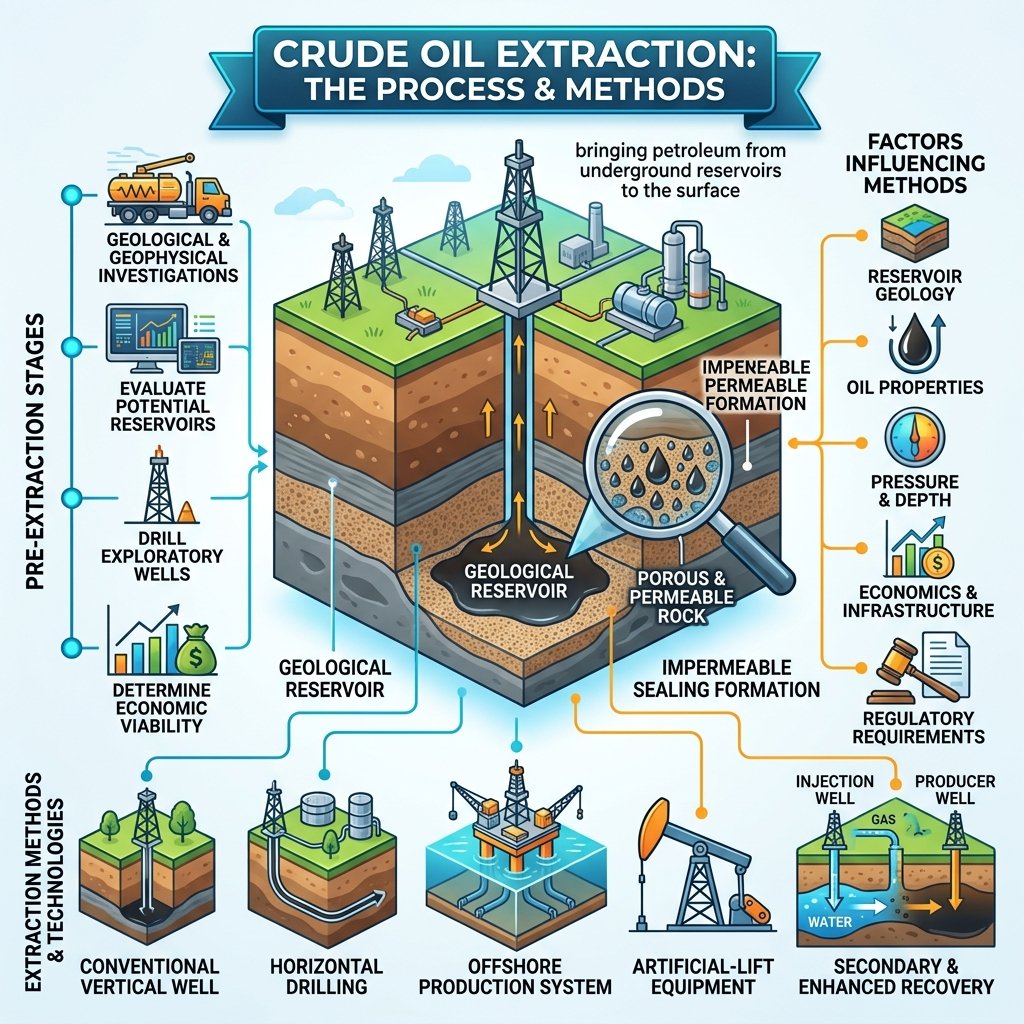
Crude Oil Extraction is the process of bringing petroleum from underground geological reservoirs to the surface, where it can be separated, treated, transported, and eventually refined into useful products. Oil reservoirs occur within porous and permeable rocks where hydrocarbons accumulated over geological time beneath sealing formations.
Extraction is only one stage of petroleum development. Before commercial production begins, companies generally conduct geological and geophysical investigations, evaluate potential reservoirs, drill exploratory wells, and determine whether a discovery can be developed economically and safely.
Modern extraction ranges from conventional vertical wells to horizontal drilling, offshore production systems, artificial-lift equipment, water injection, gas injection, and enhanced oil recovery technologies. The appropriate method depends strongly on reservoir geology, oil properties, pressure, depth, economics, infrastructure, and regulatory requirements.
Exploration Before Crude Oil Extraction
Oil production begins with understanding subsurface geology. Geologists study sedimentary basins, rock formations, structural traps, and other geological characteristics associated with petroleum accumulation.
Geophysical surveys, particularly seismic imaging, can provide information about underground rock structures. However, seismic data do not prove that commercially recoverable petroleum exists. An exploratory well is generally necessary to directly evaluate subsurface formations.
Information collected from drilling, rock samples, well logs, pressure measurements, and fluid testing helps specialists estimate reservoir properties.
If a discovery appears commercially viable, additional wells may be drilled to better define the reservoir before full development begins.
Drilling Oil Wells
Drilling creates a controlled pathway from the surface to the petroleum-bearing formation. Modern drilling rigs use rotating drill bits and drilling fluids to penetrate layers of rock.
Drilling fluids perform several important functions. They can cool and lubricate drilling equipment, carry rock cuttings toward the surface, and assist in controlling pressure within the well.
Sections of steel casing are installed and typically cemented into the well. Proper well construction is important for maintaining structural integrity and isolating different underground formations.
Horizontal and directional drilling have significantly expanded engineers’ ability to access reservoirs. Instead of drilling only vertically, operators can steer a well through a target formation, increasing contact with petroleum-bearing rock.
Primary Crude Oil Extraction
After a productive well has been completed, the first production stage is generally known as primary Crude Oil Extraction or primary recovery.
Initially, natural reservoir pressure may help push petroleum toward the production well. Depending on reservoir conditions, dissolved gas, gas caps, water movement, gravity, or combinations of these mechanisms can contribute to oil flow.
As petroleum is removed, reservoir pressure can decline and natural flow may become insufficient. Artificial-lift systems such as pumps can then assist in bringing fluids to the surface.
The U.S. Department of Energy notes that primary recovery typically produces only a portion of the original oil contained in a reservoir. This is because petroleum cannot usually be completely displaced from the microscopic pore spaces of reservoir rock using natural pressure and pumping alone.
Secondary Oil Recovery
When primary recovery becomes less effective, operators may use secondary recovery methods to maintain reservoir pressure and move additional petroleum toward production wells.
Water injection is one widely used technique. Water is injected into selected wells to help displace petroleum through the reservoir toward producing wells.
Gas injection can also be used in appropriate reservoirs.
According to the U.S. Department of Energy, secondary recovery can significantly increase the proportion of the original oil recovered compared with primary production alone. Actual recovery varies substantially between reservoirs because geology, fluid properties, reservoir management, and technology differ.
Enhanced Crude Oil Extraction
Some reservoirs can undergo a third stage known as enhanced oil recovery (EOR), sometimes called tertiary recovery.
EOR technologies attempt to change reservoir conditions or petroleum properties so that additional oil can move through rock pores toward production wells.
Methods can include thermal recovery, gas injection, and certain chemical processes. Carbon dioxide injection is one example used in suitable reservoirs. The injected CO₂ can interact with petroleum and, under appropriate pressure and reservoir conditions, improve its mobility.
Steam-based thermal recovery is particularly relevant for some heavy oils because heat reduces oil viscosity, making the petroleum easier to move.
EOR is not suitable for every field. Reservoir geology, oil composition, technology requirements, energy consumption, economics, environmental considerations, and available infrastructure influence whether a particular technique is practical.
Separating Oil, Gas, and Produced Water
The fluid arriving at the surface is not necessarily pure crude oil. Production streams can contain petroleum, natural gas, formation water, injected water, sediment, and other materials.
Surface processing equipment separates these components before the crude oil is stored or transported.
Produced water is particularly important in environmental management. Its quantity and chemical composition can vary considerably between wells and geological formations. EPA identifies produced water, drilling fluids, drill cuttings, produced sand, and well-treatment fluids among important waste streams associated with oil and gas extraction.
Produced water can contain salts, hydrocarbons, minerals, treatment chemicals, and naturally occurring radioactive materials depending on local geology and production conditions. Consequently, its treatment, reuse, storage, and disposal require appropriate controls.
Environmental Challenges of Crude Oil Extraction
Crude Oil Extraction provides an important industrial raw material and energy resource, but production can also create environmental risks.
Potential impacts include land disturbance, habitat disruption, air emissions, greenhouse-gas emissions, accidental oil releases, wastewater generation, and risks to surface water or groundwater if fluids are improperly managed.
These impacts are not identical at every production site. Their scale depends on factors such as extraction technology, reservoir characteristics, facility design, operational practices, environmental regulation, and local ecosystems.
For example, EPA research has documented cases where spills of produced water associated with oil and gas operations reached groundwater or surface-water resources.
Environmental management therefore includes well-integrity controls, leak detection, wastewater management, spill prevention and response, emissions monitoring, and responsible site closure.
Technology and the Future of Crude Oil Extraction
Digital technology is increasingly important in petroleum production. Sensors, automated controls, reservoir models, seismic analysis, and data-driven monitoring can help operators understand reservoir behavior and identify equipment or production problems.
Technological improvement, however, does not eliminate the fundamental environmental impacts associated with petroleum production and consumption. The future role of crude oil will also depend on energy demand, climate policies, technological development, economics, and the expansion of alternative energy systems.
Conclusion
Crude Oil Extraction is a complex engineering process that connects geology, drilling, reservoir engineering, surface processing, environmental management, and transportation. Production may progress from primary recovery to secondary methods and, where technically and economically appropriate, enhanced oil recovery.
Understanding these stages also shows why an oil reservoir does not behave like a simple underground tank. Petroleum occupies pore spaces within rock, and recovering it efficiently requires detailed knowledge of pressure, fluids, geology, and reservoir behavior.
At the same time, responsible extraction requires careful management of produced water, drilling wastes, emissions, spills, and other environmental risks. Continued improvements in monitoring, engineering, resource recovery, and environmental protection will therefore remain important wherever crude oil production continues.https://en.wikipedia.org/wiki/Natural_resource
Pingback: Crude Oil Industry: 7 Revolutionary Insights to Explore