
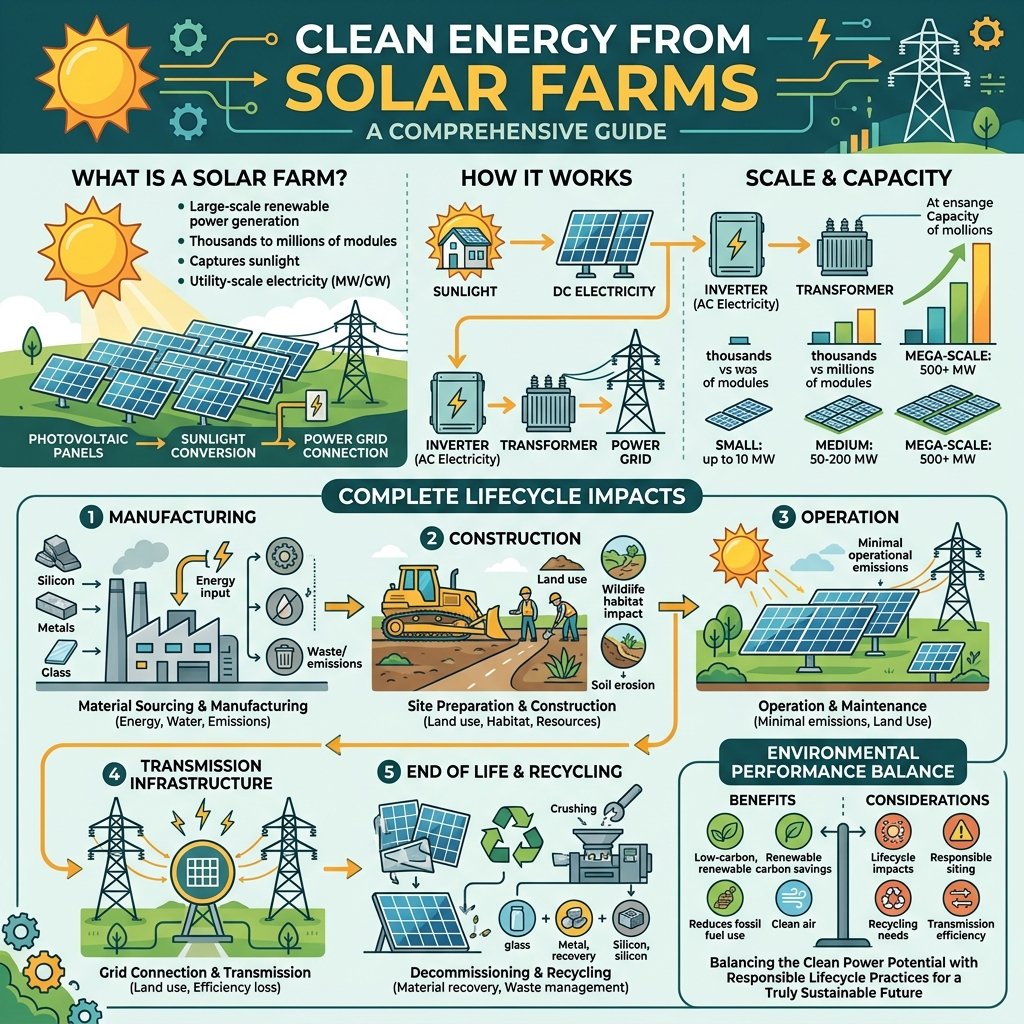
Clean Energy From Solar Farms is an increasingly important source of electricity as countries expand renewable energy systems and seek alternatives to fossil-fuel-based power generation. Solar farms, sometimes called photovoltaic power stations or utility-scale solar plants, use large arrays of photovoltaic (PV) panels to capture sunlight and convert it into electricity.
Unlike rooftop solar systems designed primarily to serve individual buildings, solar farms can contain thousands or even millions of solar modules and generate electricity for transmission or distribution through the power grid. Their capacity varies considerably, from relatively small projects to installations producing hundreds of megawatts or more.
Solar farms can contribute to lower-carbon electricity systems, but their environmental performance should be evaluated across their complete lifecycle. Manufacturing panels, constructing facilities, using land, building transmission infrastructure, and eventually recycling or disposing of equipment all have environmental consequences.
How Clean Energy From Solar Farms Is Generated
The production of Clean Energy From Solar Farms begins with photovoltaic cells. Most modern commercial PV modules contain semiconductor materials, commonly crystalline silicon.
When sunlight reaches a photovoltaic cell, photons transfer energy to electrons in the semiconductor. The structure of the cell creates conditions that allow electrical charges to move, generating direct-current electricity.
Individual cells are connected to form modules, modules are connected into strings, and many strings form large solar arrays. This modular design allows solar technology to be deployed from a few panels to enormous utility-scale power plants.
The electricity generated by PV modules is direct current (DC). Power electronic equipment, particularly inverters, converts this electrici
Large-Scale Solar Electricity Generation
Utility-scale solar farms are designed to produce electricity in much greater quantities than typical residential installations.
Engineers analyze solar irradiation, land characteristics, shading, temperature, electrical infrastructure, environmental constraints, grid availability, and other factors before determining whether a location is suitable.
Some installations use fixed mounting structures. Others use tracking systems that change the orientation of solar modules during the day to improve their exposure to sunlight.
However, additional mechanical equipment can increase construction and maintenance requirements. The appropriate design depends on local conditions and project economics.
Environmental Benefits of Solar Farms
One of the primary environmental advantages of photovoltaic electricity is that solar panels generate power without burning fuel during normal operation.
Coal- and natural-gas-fired power plants release carbon dioxide when fuels are combusted. Solar PV avoids these direct combustion emissions during electricity generation.
Replacing higher-emission electricity with solar power can therefore reduce greenhouse gas emissions associated with electricity production.
Solar generation can also avoid some air pollutants associated with fossil-fuel combustion. This is particularly important when renewable generation displaces electricity from plants that emit pollutants affecting air quality.
However, describing solar electricity as having “zero environmental impact” would be inaccurate. Its impacts occur mainly outside the electricity-generation stage.
Lifecycle Environmental Impacts
A professional assessment of Clean Energy From Solar Farms must examine the entire lifecycle.
Raw materials must be extracted and processed. Solar cells, glass, frames, cables, inverters, mounting systems, and other equipment must be manufactured and transported. Construction can disturb land, while decommissioned equipment eventually requires reuse, recycling, or responsible waste management.
These activities consume energy and materials and can generate emissions.
Nevertheless, lifecycle research generally finds that photovoltaic electricity has substantially lower greenhouse gas emissions per unit of electricity than conventional fossil-fuel generation.
Continued improvements in manufacturing efficiency, cleaner electricity supplies, material recovery, and recycling can further improve solar technology’s environmental performance.
Solar Farms and Land Use
Land use is one of the most important considerations for utility-scale solar development.
Large projects may require substantial areas of land. Poorly planned development can disturb habitats, alter landscapes, fragment ecosystems, or create conflicts with agriculture and other land uses.
Site selection therefore matters.
Developers can sometimes prioritize degraded land, former industrial sites, brownfields, land near existing infrastructure, or other areas where environmental conflicts may be lower.
Another developing approach is agrivoltaics, where solar electricity generation and agricultural activity share the same land. Depending on crop type, climate, panel configuration, and farming practices, this approach can allow certain agricultural activities to continue around or beneath solar installations.
Ecological planning can also include vegetation management, erosion control, drainage protection, and habitat considerations.
Solar Farms and Water Resources
Photovoltaic solar farms generally require far less operational water than conventional thermal power plants that depend heavily on water for cooling.
Water may still be needed for module cleaning, vegetation management, construction, or other site activities.
The amount required depends on climate, dust conditions, cleaning methods, technology, and operational practices.
In water-stressed regions, developers should evaluate water availability carefully and consider cleaning strategies that minimize unnecessary consumption.
Solar Farms and Battery Storage
One limitation of solar electricity is variability. Solar panels produce electricity when sufficient sunlight is available, but production falls in cloudy conditions and stops at night.
Battery energy storage can help manage this variability.
During periods of strong solar production, batteries can store electricity and release it later when needed. Storage can also provide certain grid services, depending on system design and electricity-market rules.
However, batteries are not free of environmental or economic impacts. Manufacturing batteries requires materials and energy, and storage systems experience efficiency losses and degradation.
Therefore, storage should be evaluated as part of the complete energy system rather than treated as an unlimited solution.
Connecting Solar Farms to the Electricity Grid
Generating electricity is only one part of operating a solar farm. The electricity must also reach consumers.
Large projects require transformers, substations, cables, protection systems, controls, and connections to transmission or distribution networks.
Grid operators must continuously balance electricity supply and demand. Because solar output changes with weather and daylight, electricity systems may use combinations of geographical diversity, transmission, storage, demand response, flexible generation, forecasting, and other resources to maintain reliability.
As solar capacity increases, grid planning and modernization become increasingly important.
Economic Importance of Solar Farms
Solar farms can contribute economically by providing large quantities of electricity without ongoing fuel purchases.
Most costs are associated with development, equipment, construction, financing, grid connection, land, operation, and maintenance.
Project economics vary significantly according to solar resources, financing costs, equipment prices, electricity-market structures, regulations, grid availability, and local labor and construction conditions.
Solar development can also create employment during planning, engineering, construction, operation, maintenance, and eventually decommissioning.
Not all jobs are permanent, however, so employment claims should distinguish temporary construction work from long-term operational employment.
Challenges of Clean Energy From Solar Farms
Despite their advantages, solar farms face genuine limitations.
Electricity production varies with daylight and weather. Large projects require suitable land and grid connections. New transmission infrastructure may sometimes be necessary. Supply chains require minerals, manufactured components, and industrial capacity.
Projects can also face community opposition when developers fail to address landscape, biodiversity, agricultural, cultural, or local economic concerns.
These challenges do not mean solar farms are ineffective. They demonstrate why responsible planning, environmental assessment, community engagement, engineering, and long-term management are essential.
Future of Clean Energy From Solar Farms
The future of Clean Energy From Solar Farms will be influenced by technological improvements and changes in electricity systems.
Researchers and manufacturers continue working on higher-efficiency solar cells, advanced module designs, improved inverters, tracking technologies, better forecasting, energy storage, and recycling.
Bifacial modules, which can capture light reaching both sides of a panel, are already used in many utility-scale projects. Advanced monitoring systems can also identify equipment problems and help operators optimize plant performance.
Future solar farms may increasingly operate as integrated energy facilities combining photovoltaic generation, battery storage, sophisticated power electronics, and digital energy-management systems.
Recycling and circular-economy strategies will also become increasingly important as older generations of solar equipment reach the end of their operating lives.
Conclusion
Clean Energy From Solar Farms can play a major role in expanding renewable electricity generation and reducing dependence on fossil-fuel-based power.
Solar farms convert sunlight directly into electricity through photovoltaic technology, producing power without combustion during normal operation. Their advantages can include low operational greenhouse gas emissions, relatively low operational water requirements, scalable electricity generation, and freedom from ongoing fuel costs.
However, solar power should not be presented as environmentally impact-free. Manufacturing, mineral extraction, land use, transmission infrastructure, equipment replacement, and end-of-life management all require careful consideration.
Well-designed projects combine technical engineering with responsible land management, environmental protection, community engagement, grid planning, and long-term recycling strategies.
When these factors are properly addressed, Clean Energy From Solar Farms can provide a scientifically credible and increasingly important component of a diversified, lower-carbon electricity system