
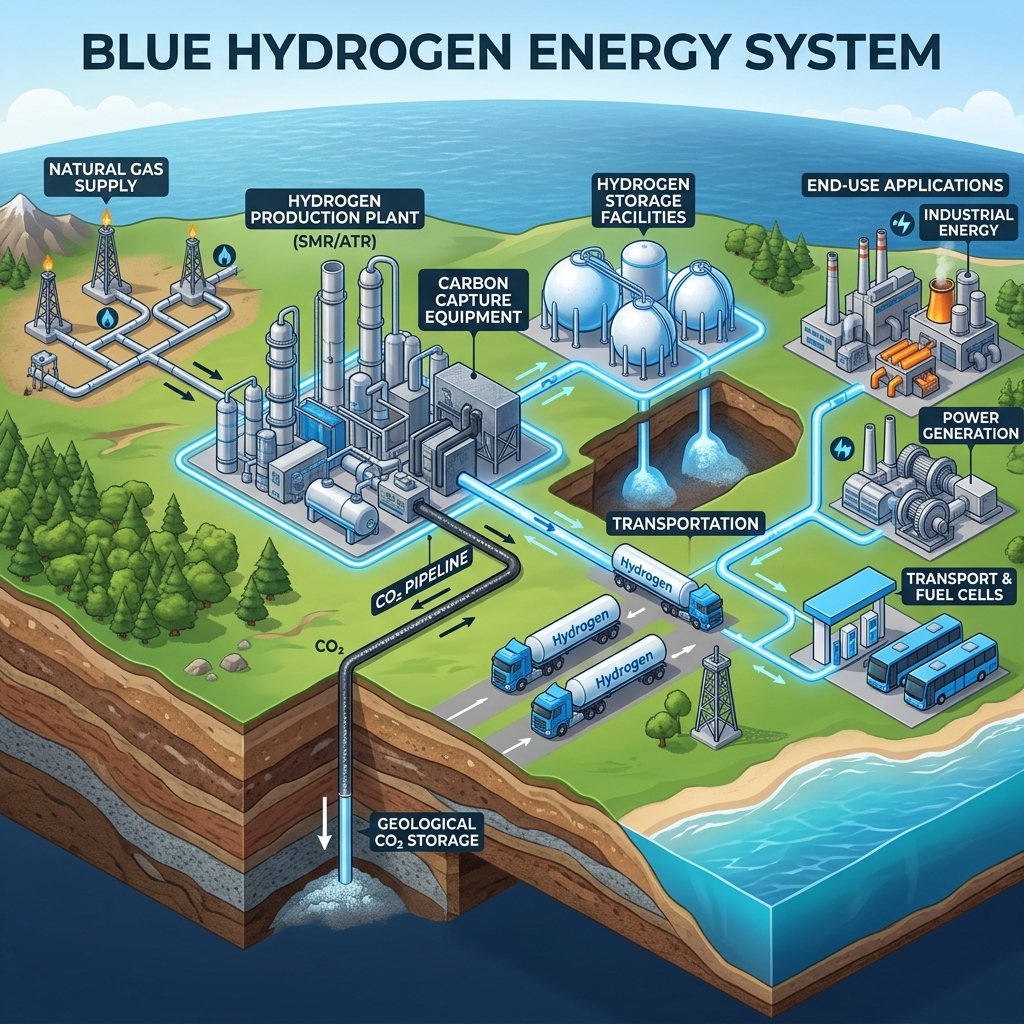
Blue Hydrogen Energy Systems integrate hydrogen production, carbon capture, transportation, storage and end-use technologies into one coordinated energy network. Blue hydrogen is normally produced from natural gas, while carbon capture and storage technology prevents a substantial portion of the resulting carbon dioxide from entering the atmosphere.
Hydrogen is an energy carrier rather than a primary energy source. Energy must first be used to separate hydrogen from compounds such as methane or water. After production, hydrogen can be stored, transported and converted into electricity, heat, industrial energy or transportation fuel.
A complete blue hydrogen system may contain a natural-gas supply network, a hydrogen production plant, carbon-capture equipment, carbon dioxide pipelines, geological storage sites, hydrogen storage facilities and final-use equipment such as fuel cells, turbines or industrial furnaces. The performance of the overall system depends on how effectively these components work together.
How Blue Hydrogen Energy Systems Produce Hydrogen
Steam methane reforming, or SMR, is a widely established method of producing hydrogen from natural gas. In this process, methane reacts with high-temperature steam to form hydrogen, carbon monoxide and carbon dioxide. A second chemical reaction converts carbon monoxide and water into additional hydrogen and carbon dioxide.
Autothermal reforming, known as ATR, uses oxygen and steam to convert methane into hydrogen. It can produce a more concentrated carbon dioxide stream than some conventional SMR configurations, potentially making high capture rates easier to achieve.
Carbon dioxide is separated from the hydrogen-production process, compressed and transported to a suitable storage location. It is then injected into deep geological formations, such as saline formations or depleted oil and gas reservoirs, where it must remain permanently contained.
The hydrogen undergoes purification before entering pipelines, storage facilities or end-use equipment. Different applications require different purity levels. Proton exchange membrane fuel cells, for example, require highly purified hydrogen because contaminants can damage their catalysts.
Carbon Capture and Geological Storage
Carbon capture is the defining feature that distinguishes blue hydrogen from conventional natural-gas-based hydrogen, sometimes called grey hydrogen. However, merely installing carbon-capture equipment does not guarantee that the hydrogen has very low emissions.
Capture rates can differ between facilities. Some plants capture carbon dioxide from the chemical reforming reaction but do not capture all emissions from the furnaces that generate process heat. The plant-wide capture rate can therefore be lower than the percentage promoted for an individual carbon stream.
After capture, carbon dioxide must be transported and stored safely. Storage projects require detailed geological surveys, carefully designed injection wells, pressure management and long-term monitoring. Regulators and operators must verify that the stored carbon dioxide remains underground.
The International Energy Agency reports that much of the direct emissions from natural-gas hydrogen production can be reduced through carbon capture, utilization and storage. However, reaching capture rates above 90% generally costs more than achieving lower capture levels.
Hydrogen Transportation and Storage
Hydrogen produced by Blue Hydrogen Energy Systems can be transported through dedicated pipelines, converted into another carrier or moved in compressed or liquefied form. Existing natural-gas pipelines may sometimes be modified, but their materials, compressors, valves and seals must be examined for compatibility.
Hydrogen molecules are extremely small and can escape through openings that would retain many other gases. Hydrogen can also weaken certain metals through a process known as hydrogen embrittlement. Suitable materials, leak-detection equipment and proper safety procedures are therefore essential.
Storage is especially important when hydrogen is intended to balance electricity supply and demand. Smaller quantities can be stored in pressurized tanks. Large volumes may be stored in underground salt caverns where geological conditions permit.
Hydrogen has very high energy content by mass but low energy density by volume under ordinary conditions. Consequently, compression or liquefaction requires additional energy. The U.S. Department of Energy identifies storage as a major technical barrier for widespread hydrogen use in transportation, stationary power and portable applications. Hydrogen Program
Uses of Blue Hydrogen Energy Systems
Blue hydrogen can serve several parts of the economy. In power generation, it can be consumed in fuel cells or specially designed gas turbines. Fuel cells convert hydrogen’s chemical energy directly into electricity and produce water and heat at the point of use. Turbines burn hydrogen to generate mechanical power that drives an electrical generator.
Industrial facilities may use hydrogen to produce ammonia, methanol and refined petroleum products. It may also contribute to lower-emission steelmaking and provide high-temperature heat for industries that are difficult to electrify directly.
In transportation, hydrogen fuel cells may support heavy trucks, buses, trains, ships and specialized fleet vehicles. Hydrogen may be more attractive for applications requiring long operating ranges, rapid refuelling or high energy storage capacity. However, battery-electric technology can be more energy-efficient for many passenger vehicles and shorter journeys.
The U.S. Department of Energy considers hydrogen potentially useful for industrial processes, heavy transportation, electricity production and long-duration energy storage.
Supporting Renewable Electricity
One possible role for Blue Hydrogen Energy Systems is providing controllable energy when wind and solar production is insufficient. Stored hydrogen can supply fuel cells or turbines during periods of high electricity demand, weak wind or limited sunlight.
This does not make blue hydrogen renewable. It remains connected to natural gas unless renewable or non-fossil feedstocks replace it. Nevertheless, dispatchable hydrogen generation could complement variable renewable electricity where long-duration storage is required.
Hydrogen systems also lose energy during production, compression, transportation, storage and reconversion into electricity. Direct use of renewable electricity is generally more efficient whenever practical. Hydrogen may therefore provide the greatest value in applications where direct electrification is technically difficult, extremely expensive or unable to provide adequate storage duration.
The IPCC identifies low-emission hydrogen as a possible energy carrier for sectors that are difficult to electrify, while emphasizing efficiency, widespread electrification and reduced fossil-fuel consumption in net-zero energy systems.
Environmental Benefits and Limitations
The main proposed benefit of Blue Hydrogen Energy Systems is lower carbon emissions compared with hydrogen produced from natural gas without carbon capture. They may also establish hydrogen infrastructure while renewable-hydrogen production expands.
However, their lifecycle emissions depend on carbon-capture performance, energy consumption and methane leakage throughout the natural-gas supply chain. Methane is a powerful greenhouse gas. Leakage during extraction, processing and transportation can significantly reduce the climate advantage of blue hydrogen.
Hydrogen itself can also leak during production and delivery. Although it is not a direct greenhouse gas in the same way as carbon dioxide, leaked hydrogen can indirectly influence atmospheric chemistry. Monitoring and controlling hydrogen leakage should therefore form part of responsible system management.
Water use, land requirements, pipeline construction, geological storage risks and local industrial impacts must also be evaluated. Environmental claims should be based on verified lifecycle data instead of relying only on the term “blue.”
Costs, Safety and Infrastructure Challenges
Developing Blue Hydrogen Energy Systems requires major capital investment. The system may need reformers, oxygen-production units, capture equipment, compressors, pipelines, storage wells, hydrogen terminals and specialized end-use technologies.
Hydrogen is flammable and requires careful handling. Facilities need ventilation, compatible equipment, emergency shutdown systems, trained workers and continuous leak detection. Carbon dioxide transport and injection also require engineering standards and regulatory oversight.
Economic performance depends on natural-gas prices, carbon prices, capture rates, infrastructure utilization and government policy. Facilities may become expensive or underused if future hydrogen demand does not develop as expected.
Future of Blue Hydrogen Energy Systems
The future of Blue Hydrogen Energy Systems is not certain. The IEA reported in 2026 that low-emission hydrogen production was growing but was still expected to represent only slightly more than 1% of total global hydrogen production during that year. IEA
Blue hydrogen may function as a transitional or specialized energy option in regions with low methane leakage, suitable carbon-storage geology and strong industrial demand. It should not automatically be described as carbon-free, renewable or sustainable.
In conclusion, Blue Hydrogen Energy Systems can connect hydrogen production with carbon capture, storage, transportation and multiple energy uses. Their genuine climate value depends on high plant-wide capture rates, extremely low methane leakage, permanent carbon storage and transparent lifecycle reporting. When these conditions are independently verified, blue hydrogen may complement renewable electricity and direct electrification in selected parts of a lower-carbon energy system