
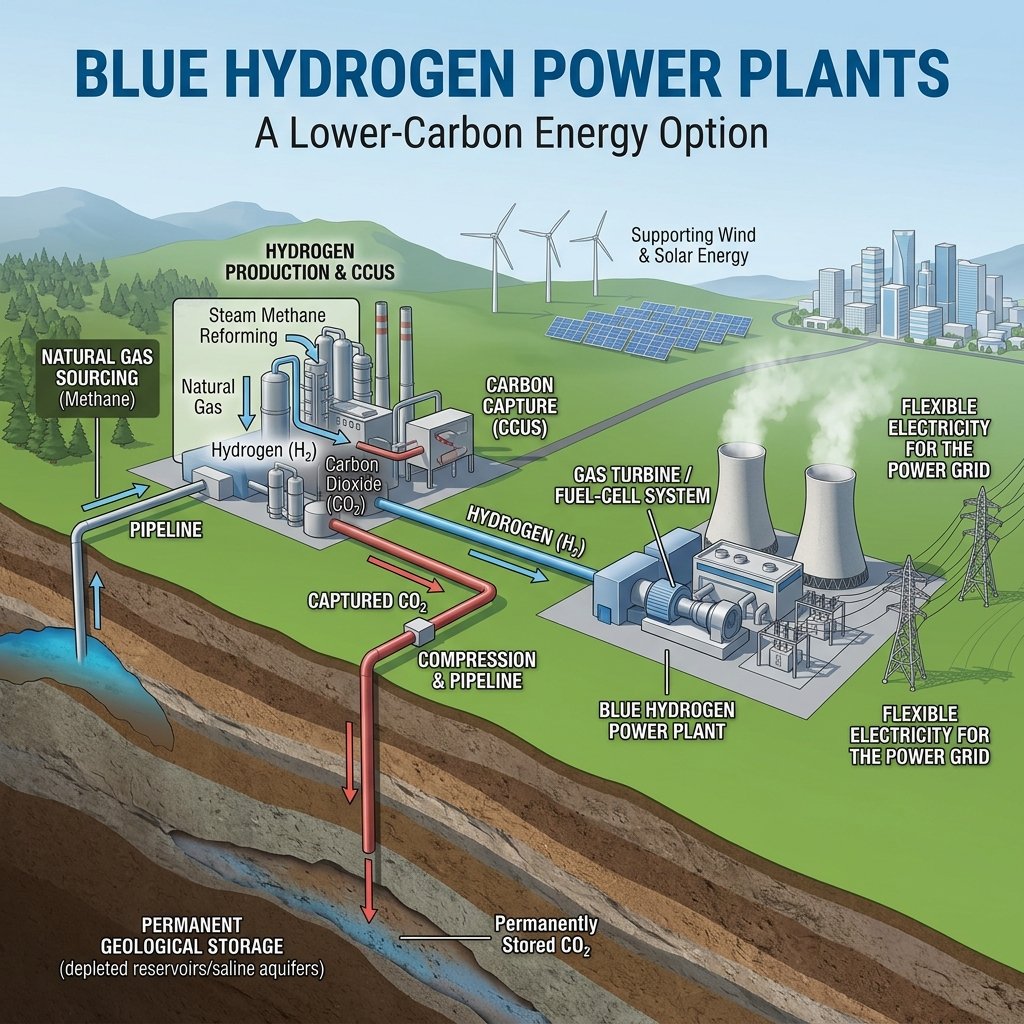
Blue Hydrogen Power Plants generate electricity using hydrogen produced mainly from natural gas while capturing and permanently storing a significant portion of the carbon dioxide created during hydrogen production. They are being considered as a source of flexible electricity that could support power grids containing growing amounts of solar and wind energy.
Blue hydrogen is not naturally available as a separate underground resource. It must be manufactured. Natural gas—primarily methane—is converted into hydrogen through an industrial process such as steam methane reforming or autothermal reforming. Carbon capture, utilization and storage, commonly called CCUS, is then used to separate carbon dioxide from the production process.
The captured carbon dioxide may be compressed, transported through pipelines or ships, and injected into carefully selected geological formations. The hydrogen can subsequently be transported to a power plant and used in a gas turbine or fuel-cell system.
How Blue Hydrogen Power Plants Work
Most proposed Blue Hydrogen Power Plants use combustion turbines similar to those found in natural-gas power stations. Hydrogen is mixed with air and burned inside a combustion chamber. The expanding hot gases rotate turbine blades connected to an electrical generator.
A simple-cycle plant uses one gas turbine to produce electricity. It can start relatively quickly, making it useful during periods of high electricity demand. However, its overall efficiency is lower than that of a combined-cycle facility.
In a combined-cycle plant, the hot exhaust from the gas turbine produces steam. That steam drives a second turbine, allowing the facility to generate additional electricity from the same quantity of fuel. Modern combined-cycle systems are therefore generally more efficient than simple-cycle plants.
Some facilities may initially burn a blend of natural gas and hydrogen before gradually increasing the hydrogen percentage. This approach can help operators test combustion equipment and develop hydrogen supply infrastructure. However, a turbine described as “hydrogen-ready” is not necessarily capable of operating immediately on 100% hydrogen. Additional burners, control systems and safety equipment may be required.
Producing Blue Hydrogen with Carbon Capture
Steam methane reforming is currently the most established method of producing hydrogen from natural gas. Methane reacts with high-temperature steam to form hydrogen, carbon monoxide and carbon dioxide. The carbon monoxide undergoes another reaction with steam, producing additional hydrogen and carbon dioxide.
Autothermal reforming uses controlled amounts of oxygen and steam. It can create a more concentrated carbon dioxide stream, potentially making high capture rates easier to achieve. Nevertheless, actual environmental performance depends on the design and operation of the entire production facility.
Carbon capture rates should be examined carefully. A project may capture carbon dioxide from the main chemical process but leave emissions from the furnaces supplying heat uncaptured. For this reason, the advertised capture percentage and the plant-wide carbon reduction may not be identical.
The International Energy Agency reports that emissions from unabated natural-gas hydrogen can range from approximately 10 to 14 kilograms of carbon-dioxide equivalent per kilogram of hydrogen. Upstream methane and carbon dioxide emissions can account for a substantial part of that total.
Benefits of Blue Hydrogen Power Plants
One potential advantage of Blue Hydrogen Power Plants is dispatchable electricity. Solar panels generate power when sunlight is available, while wind turbines depend on suitable wind conditions. Hydrogen-fueled generators can operate when electricity demand is high or renewable output is low.
Hydrogen can also support long-duration or seasonal energy storage. Fuel may be produced, stored and later converted back into electricity. This could complement batteries, which are often better suited to shorter periods of storage.
Blue hydrogen production may also use existing skills and parts of the infrastructure associated with natural gas, industrial gases, pipelines and underground storage. This may reduce some development barriers in regions possessing suitable facilities and geological conditions.
At the point where hydrogen is burned, it does not directly release carbon dioxide because hydrogen contains no carbon. This is an established chemical fact. However, it does not mean that the complete energy system is automatically carbon-free.
Emissions and Environmental Limitations
The climate value of Blue Hydrogen Power Plants depends on lifecycle emissions. Important factors include methane leakage during natural-gas extraction and transportation, the carbon capture rate, the energy consumed by capture equipment, and the permanence of underground carbon storage.
Methane is a powerful greenhouse gas. Even if a hydrogen production facility captures most of its process carbon dioxide, excessive methane leakage across the natural-gas supply chain can reduce the project’s climate benefits.
Hydrogen combustion can also form nitrogen oxides, or NOx, because high temperatures cause nitrogen and oxygen in the air to react. These pollutants can contribute to smog and respiratory problems. Low-NOx burners, staged combustion and other control technologies are therefore important. The U.S. Department of Energy confirms that hydrogen combustion may produce NOx and that emission-control research remains necessary. Department of Energy
Carbon dioxide storage sites require geological assessment, monitoring and long-term management. Operators must demonstrate that the storage formation can retain the captured carbon and that wells are properly constructed and maintained.
Costs and Infrastructure Requirements
Developing Blue Hydrogen Power Plants requires more than building an electricity generator. A complete system may include a natural-gas supply, hydrogen production equipment, carbon-capture units, carbon dioxide pipelines, storage wells, hydrogen pipelines and possibly underground hydrogen storage.
These additions increase capital costs and create efficiency losses. Hydrogen also contains less energy per unit of volume than natural gas. Consequently, pipelines, compressors, storage facilities and turbine fuel systems may need modification.
Hydrogen is highly flammable and can escape through very small openings. It may also weaken certain metals through hydrogen embrittlement. Appropriate materials, leak-detection instruments, ventilation and operating procedures are essential.
Role in the Future Energy System
The future contribution of Blue Hydrogen Power Plants remains uncertain. Their competitiveness will depend on natural-gas prices, carbon-capture performance, methane regulations, carbon prices, renewable electricity costs and the availability of secure carbon dioxide storage.
Research is continuing into turbines capable of burning high-hydrogen mixtures or pure hydrogen. The U.S. Department of Energy has supported projects examining combustion stability, turbine efficiency, materials and NOx control for hydrogen-based electricity generation. Department of Energy
It is reasonable to view blue hydrogen as a possible transitional or specialized low-carbon option rather than an emissions-free solution. Whether it delivers substantial climate benefits must be demonstrated through transparent lifecycle measurements—not assumed from the color label alone.
Conclusion
Blue Hydrogen Power Plants could provide controllable electricity and backup generation for power systems with large amounts of variable renewable energy. Their strongest potential advantages are flexibility, long-duration fuel storage and lower direct carbon emissions compared with unabated fossil-fuel generation.
However, their environmental performance depends on high carbon-capture rates, low methane leakage, secure geological storage and effective control of nitrogen-oxide emissions. Each project should therefore be evaluated using complete lifecycle data, independent monitoring and clearly reported emissions. When these requirements are met, blue hydrogen may contribute to electricity-system decarbonization, although it should complement—not delay—the expansion of renewable energy, efficiency and other genuinely low-emission technologies.
Pingback: Blue Hydrogen Fuel Cells: 5 Powerful Benefits
Pingback: 7 Key Benefits of Blue Hydrogen Energy Systems
Pingback: 5 Ways Blue Hydrogen for Industry Fuels Sustainable Growth